When 'Safe' Becomes Your Biggest Risk
Familiar investments often mean portfolio concentration. Here's what happens when markets shift.
You've reached your free article limit
You've read 0 of 1 free Pro articles.
 S&P 500
When you think of “the market,” what index comes to mind?
What index is widely dubbed “the benchmark?”
And what index are investors always trying to outperform?
You already figured out that the answer to all three of these questions is, “The S&P 500.”
Sure, the S&P 500 is familiar to investors, and funds like the SPDR S&P 500 ETF Trust (SPY) , iShares Core S&P 500 ETF (IVV) , and Vanguard S&P 500 ETF (VOO) are staples of many portfolios.
One Index, Outsized Influence
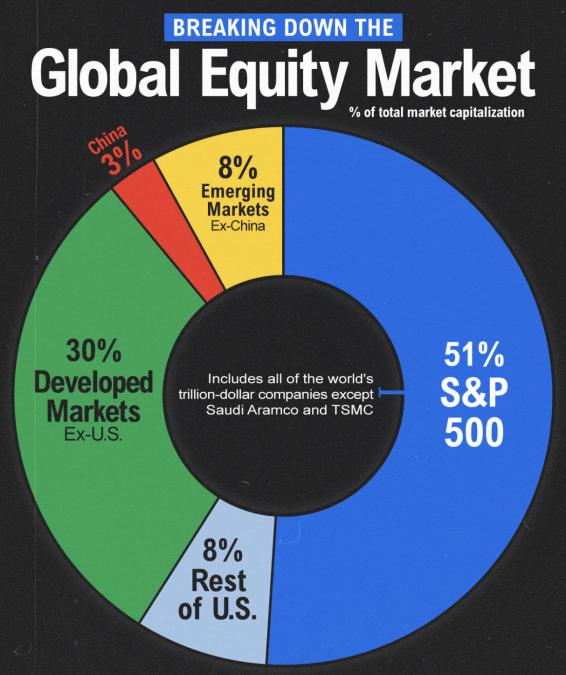
Large-cap U.S. stocks are an immensely important asset class, accounting for about 45% to 50% of global market capitalization.
In practical terms, that means a single index now carries enormous weight in the global market. The “safe” default in many portfolios is already doing a lot of heavy lifting.
This image from Visual Capitalist, using S&P Indices data, illustrates the importance of the S&P 500, relative to other worldwide indexes.
Portfolio Visualizer
But that dominance is masking risk factors.
You can think about it this way: Say you have a portfolio that consists of a 50% allocation into one stock. Say it’s Apple (AAPL) . It’s an established company with an ever-growing market share. Seems pretty stable, right?
But that concentration is out of whack.
Leaning on a Few Big Names
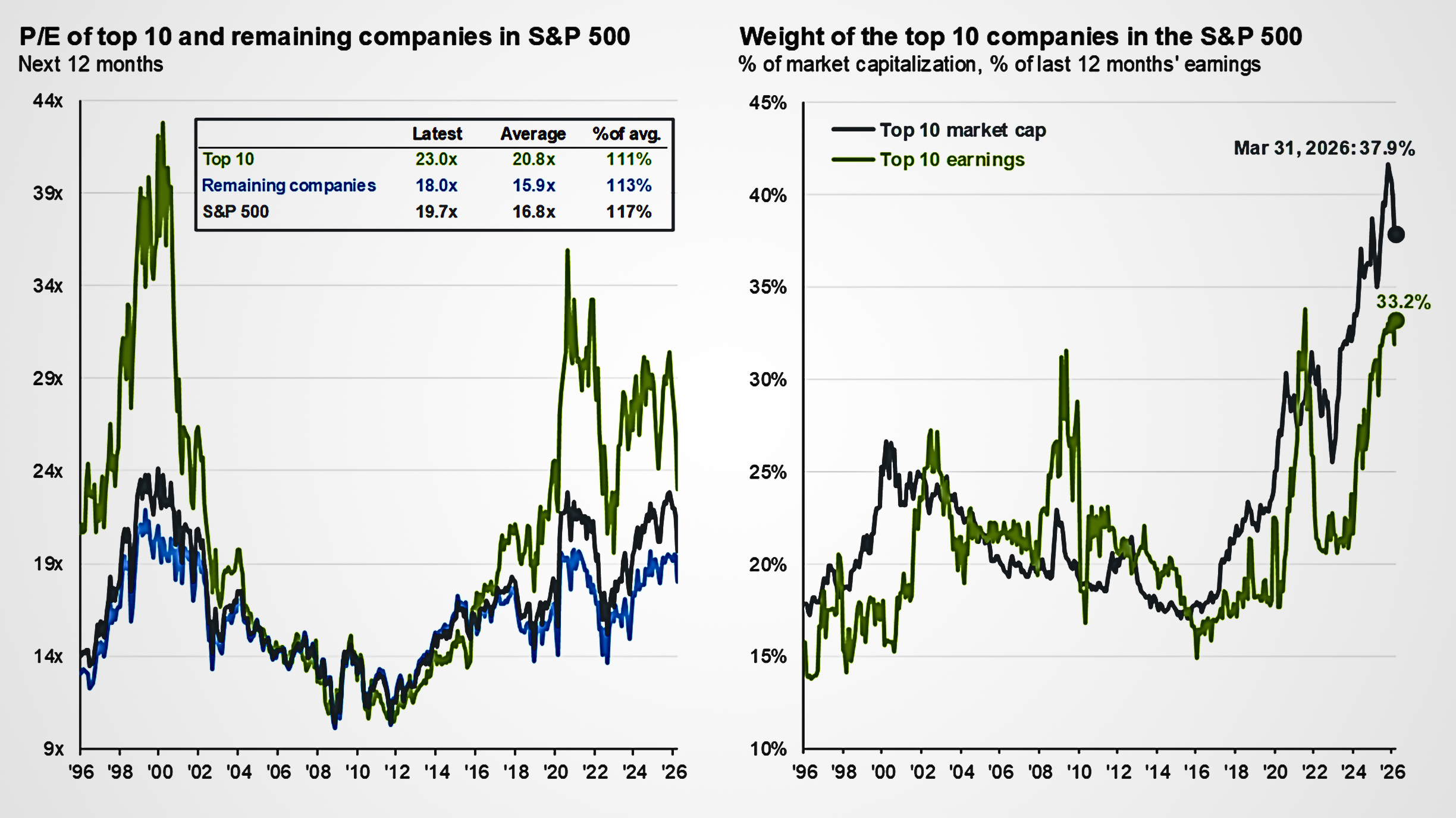
A handful of mega-cap stocks now drive a large share of returns, not just in the S&P 500 but also globally.
Many of those companies are tied to the same economic forces (think AI). For the record, those companies are:
- Nvidia Corporation (NVDA)
- Apple Inc. (AAPL)
- Microsoft Corporation (MSFT)
- Amazon.com, Inc. (AMZN)
- Alphabet Inc. (GOOGL)
- Alphabet Inc. (GOOG)
- Broadcom Inc. (AVGO)
- Meta Platforms, Inc. (META)
- Tesla, Inc. (TSLA)
- Berkshire Hathaway Inc. (BRK.B)
This image from the JPMorgan Guide to the Markets compares the top-10 S&P components to the rest of the index.
JPMorgan Guide to Markets
What Happens When Markets Shift
Growth-heavy leadership can reverse quickly when conditions change. What worked well in one cycle doesn’t always lead in the next.
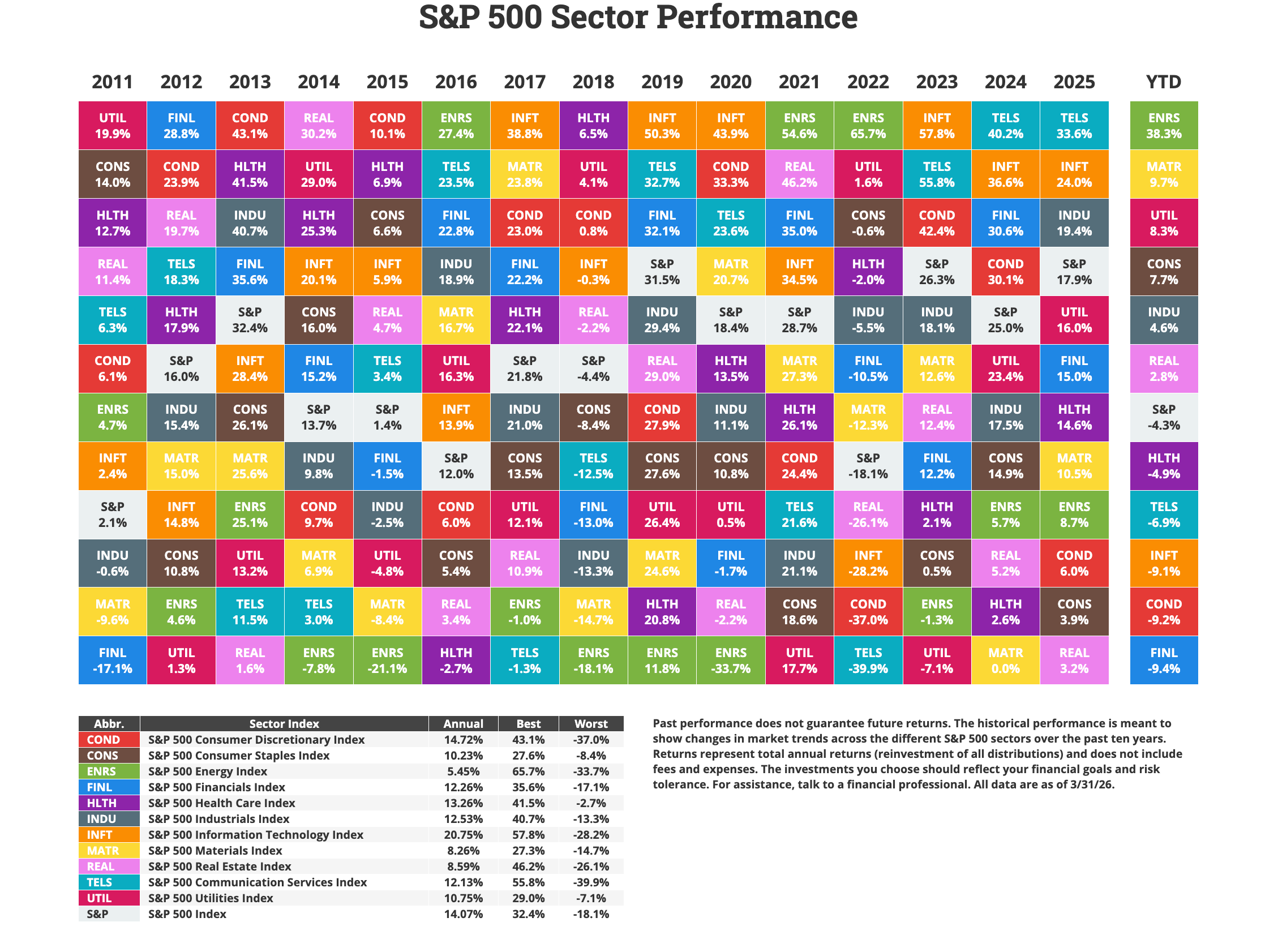
It seems like a long time ago now, but in the quaint, simpler days of 2022, one of the biggest worries was the broad decline of the S&P 500. Growth sectors like info tech, consumer discretionary and telecommunication services led everything else lower.
Below, the periodic table of investment returns, originally published by the Novel Investor, shows how a heavily-weighted sector can determine the direction of the entire index.
And yes, that kind of overweighting adds specific sector risk.
Novel Investor
Timing Matters
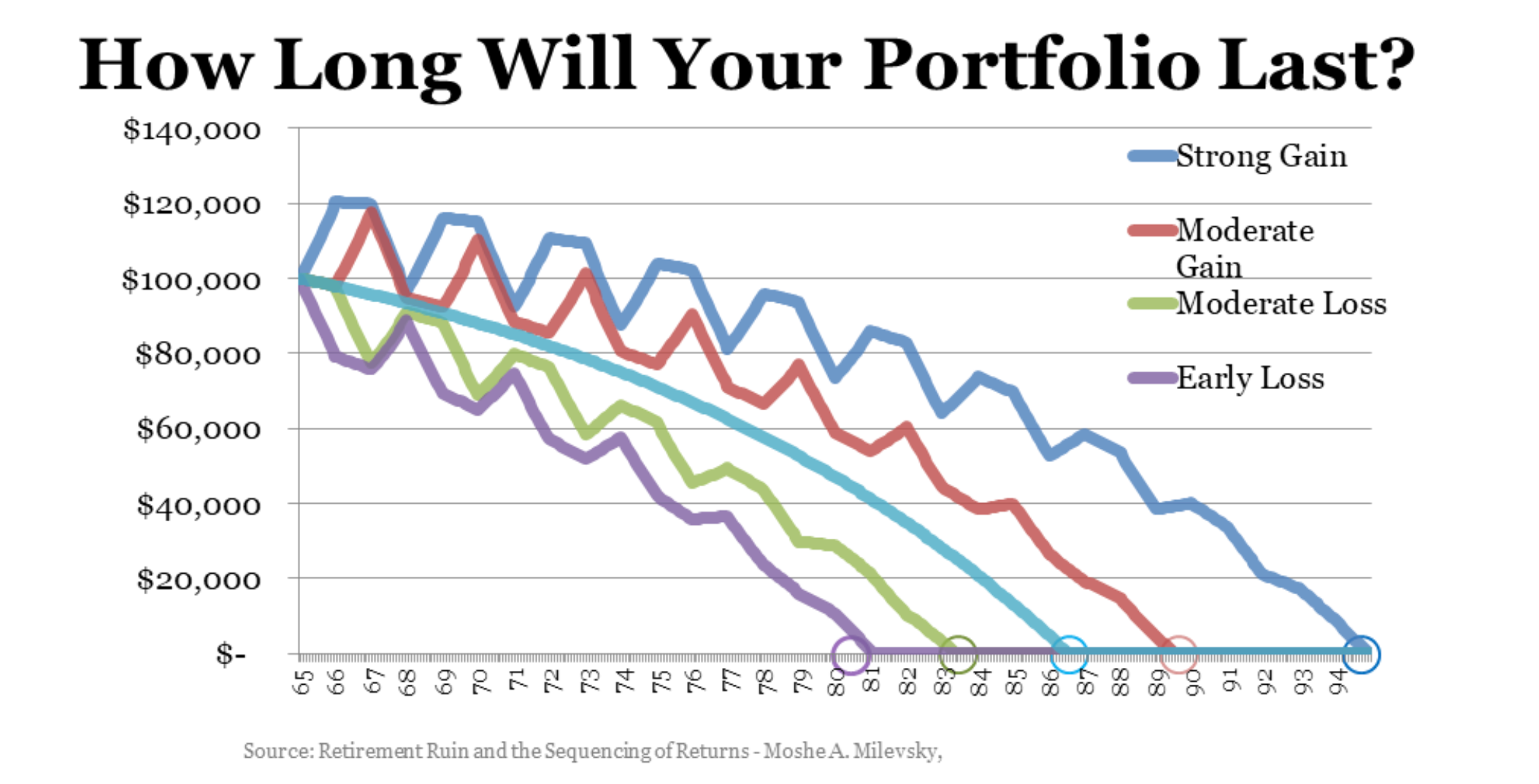
I’ve written before about sequence of returns risk. That happens when withdrawals lock in losses during downturns, reducing recovery potential.
If you’re 30, that stings, and has an effect on your ability to rebound, but it can really have an effect if you’re 70 and need the retirement income next week.
A flat or down market combined with withdrawals quietly erodes portfolios.
I like how the graph below illustrates the dangers of a poor market early in retirement.
DCF Annuities
Two retirees can see very different results: If losses hit early, especially in a down market when you’re making withdrawals, it’s a lot harder to bounce back.
Even with similar average returns, the order in which gains and losses occur can dramatically affect how long a retirement portfolio lasts. Early losses are especially damaging because withdrawals lock in declines, reducing the portfolio’s ability to recover.
A Balanced Approach Smooths the Ride
Adding different equity types, such as various market caps and stocks domiciled in countries outside the U.S., reduces concentration risk.
Also, blending income and growth assets can stabilize withdrawals. This is why savvy investors don’t typically hold just stocks.
Sure, bonds are boring and aren’t the subject of flashy cable TV shows or YouTube channels or “guru” trading memberships, but that income sure comes in handy, especially when stock markets are down.
JPMorgan Guide to Markets
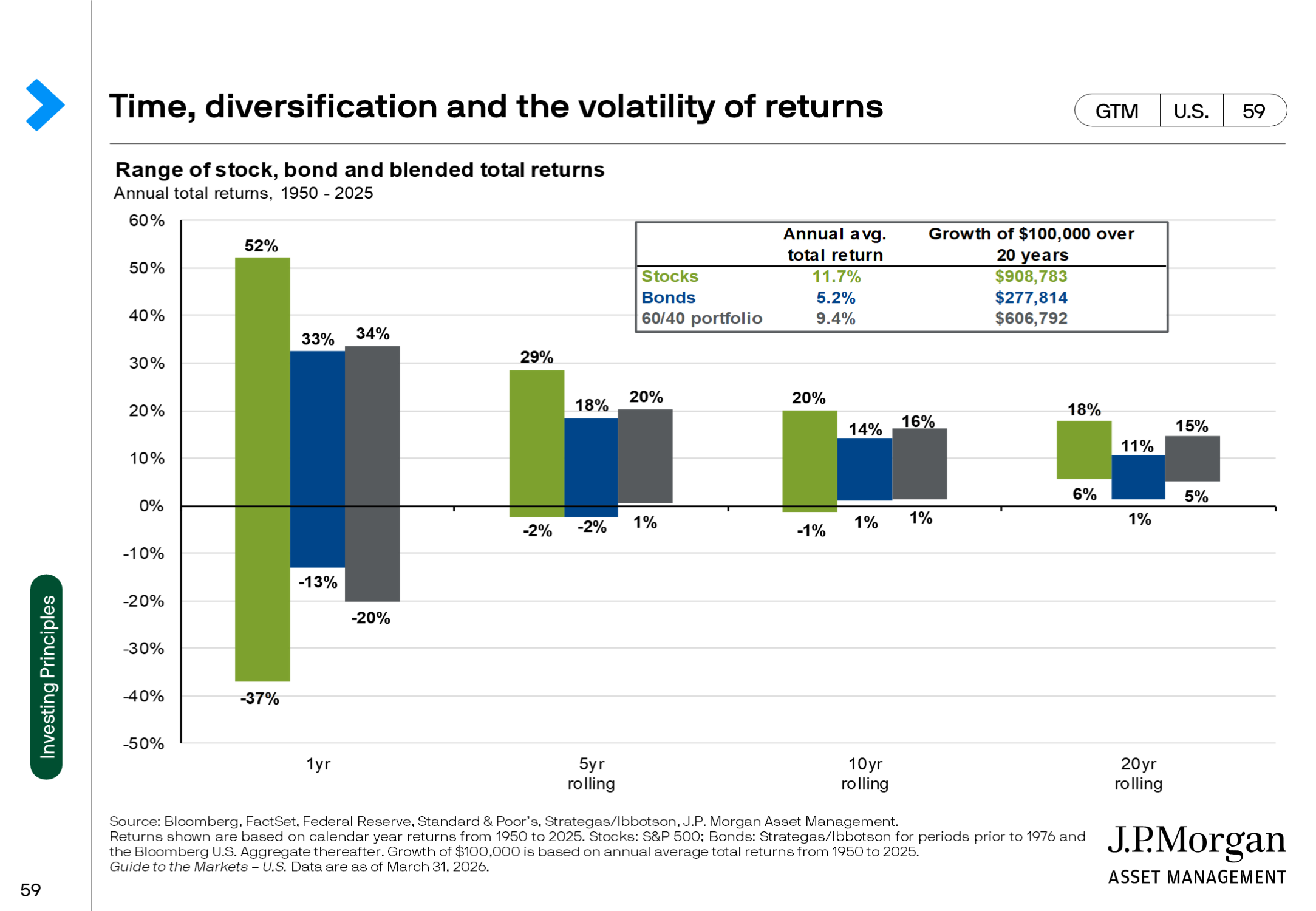
JPMorgan data shows stocks offer higher returns but much bigger swings, especially short term.
Over longer periods, and with a balanced mix such as (but not limited to) a 60/40 portfolio, outcomes become more consistent. That generally reduces the impact of volatility.
The S&P 500 isn’t the whole market, and its current concentration adds risk.
A diversified approach may not always win short term, but it’s more likely to hold up when you actually need the money.