The Race Is on for These Two Dividend ETFs. Which Is Best for You?
With a mere $1 billion gap in the way, SCHD is about to dethrone VIG. But bigger isn’t always better.
You've reached your free article limit
You've read 0 of 1 free Pro articles.
The Schwab U.S. Dividend Equity exchange-traded fund (SCHD) as of Monday held a little more than $112 billion in assets, while the Vanguard Dividend Appreciation Index Fund ETF (VIG) held about $113 billion. That’s a gap of about $1 billion, which is a lot for us mere mortals. But in the world of big ETFs, the gap is close enough that SCHD could pass VIG for the title of largest U.S. dividend ETF within days.
SCHD’s growth happened fast. It ended 2025 with approximately $71.6 billion in assets; by May it had grown to around $95 billion, setting the stage for its latest runup.
Most of that growth is just plain old good market performance, but it’s also due to money chasing that performance. Net inflows totaled $16.78 billion in the past six months.
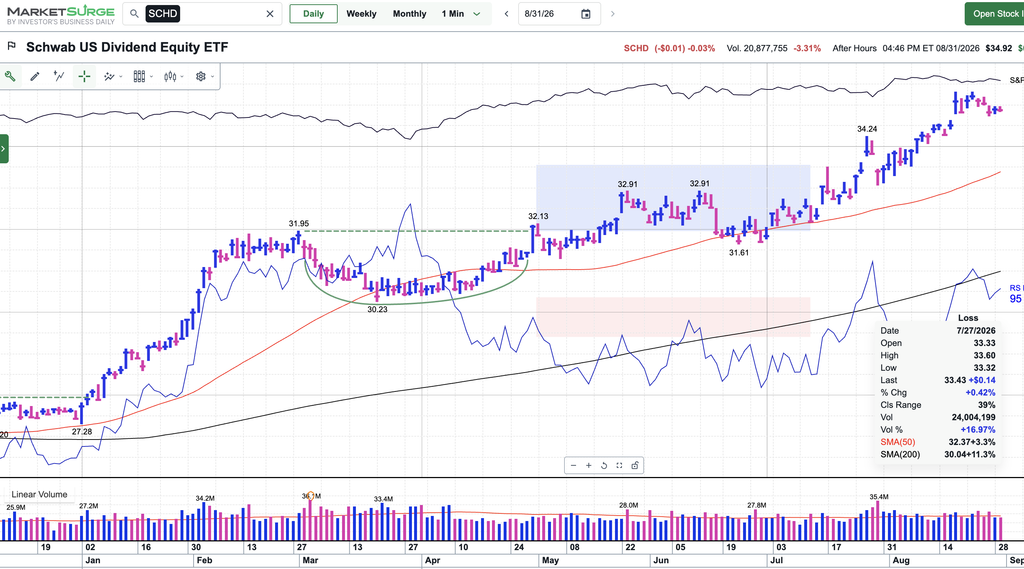
Here’s a year-to-date chart.
Why SCHD Has So Much Pep
SCHD’s screening methodology currently overweights the parts of the market that have worked well in 2026. Top holdings include defensive names, including Merck (MRK), Amgen (AMGN), Procter & Gamble (PG), Abbott Laboratories (ABT), Coca-Cola (KO), Verizon (VZ) and UnitedHealth Group (UNH).
A March reconstitution of the ETF’s underlying index pushed it even further into healthcare while trimming energy. That’s made it, in practice, a bet against the typical mega-cap tech concentration that you find, well, everywhere.
Tech stocks weigh in at 9.2% of fund composition, far less than other large-cap, market-weighted ETFs where tech has run amuck.
That bet has paid off. SCHD has returned about 29.6% over the past year, with most of that due to price appreciation, not the ETF’s 3.01% yield.
How VIG’s Screens Work
VIG looks for companies with at least 10 consecutive years of dividend increases, which tilts it toward steady compounders rather than high current yield. That’s a big part of why VIG yields just 1.48% right now vs. SCHD’s yield 3.01%: VIG is built for dividend growth over time, SCHD’s design means it will pay more today.
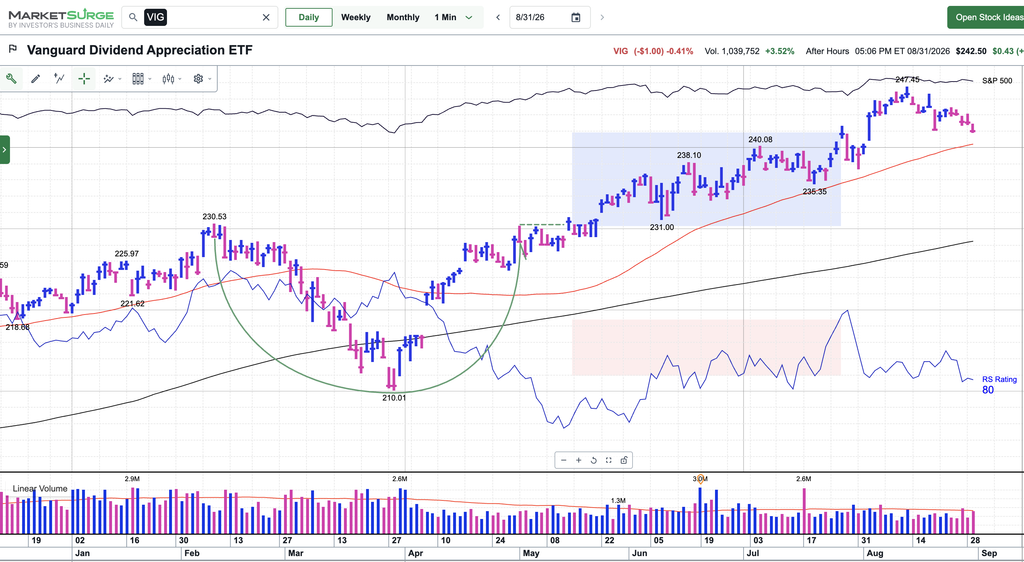
In the past year, VIG’s total return was 16.76%, with about 1.6% coming from dividends.
Here’s how that looked in 2026.
VIG’s top holdings include Broadcom (AVGO), Apple (AAPL), Eli Lilly (LLY), JPMorgan Chase (JPM), and Microsoft (MSFT).
These holdings are big, reliable dividend-growers, but as of now, this ETF tilts toward tech names, not classic high-yield stocks.
SCHD, on the other hand, is packed with cheaper, higher-yielding defensives stocks like Merck, Coca-Cola, and Verizon. Those are precisely the stocks that ran hardest this year. VIG’s underlying index doesn’t track stocks that have moved as much lately.
What This All Means for Investors
None of this means SCHD is automatically the better fund going forward, and it’s important to understand that different types of stocks will deliver their own level of returns in any given market cycle.
SCHD’s yield has compressed as its price has run up, which isn’t surprising. If you go back two years, you can see that investors could purchase shares at a much cheaper entry point. Today, that stands at about 19-times earnings, which is still cheaper than the broader market and not what you’d consider growth territory today.
As a point of comparison, the 10-year Treasury currently yields around 4.7%, meaning an investor who wants current income can get more from government debt, with none of the equity volatility risk, than from SCHD’s dividend alone.
But that doesn’t make SCHD a bad holding; long-term holders still get the dividend growth engine plus price appreciation. What it does mean is that the easy money as the ETF moved from “cheap value fund” to “crowd favorite” has pretty much already happened, at least in this cycle.
There’s also potentially concentration risk at play here.
That same reconstitution that boosted SCHD’s healthcare weighting and fueled this year’s run also means the fund is more dependent on that sector’s strength than it was a year ago. A rotation back into mega-cap tech leadership (or any other sector, really, although that’s unlikely) could just as easily work against SCHD’s current positioning as it worked for it this year.
And the Answer Is….
In this case the assets under management race is a headline, and something fund companies celebrate. It’s not something to base your investment decisions around, since both funds are liquid and well-established. The real question is what an investor needs the fund to do.
- For income now: Someone drawing on a portfolio in retirement, or rapidly approaching retirement will likely find that SCHD’s 3.01% yield and quarterly distributions still do more work than VIG’s 1.48%. Just watch the position sizing, knowing SCHD is more concentrated in defensive sectors than it was a year ago. In a growth market, that will hurt.
- For growth compounding over the long term: VIG’s lower yield and more diversified screen that emphasizes quality over current performance has “historically meant smoother performance (i.e., less volatility risk) with less sector concentration. That’s got its own benefits, but the tradeoff is a lot less current income along the way.
- For dividend-growth without currently-hot sector concentration: There are never just two options when it comes to investing. The Vanguard High Dividend Yield ETF (VYM) and iShares Core Dividend Growth ETF (DGRO) are both worth a look for dividend investors who want yield but aren’t concerned about attending the church of what’s happening now. VYM offers a broader, higher-yielding basket of stocks, while DGRO uses a lower-cost dividend-growth screen that’s less pharma-heavy than SCHD at the moment.
The Real Question Investors Should Ask
SCHD overtaking VIG in assets will make for an easy headline for finance geeks sometime this week or next, and it’s a good indication of how much money has rotated into defensive dividend strategies in 2026.
But an ETF becoming the biggest in its category can be interpreted as winning a popularity contest, not as a buy signal.
The more useful question for anyone holding or considering either fund is what purpose the fund serves. Is it more important to have income now or growth later, because that answer hopefully hasn’t changed just because a fund got bigger.
At the time of publication, Stalter had no positions in any securities mentioned.