Target Makes Progress After Change at the Top
The retail giant could be a buy after former CEO Brian Cornell got out of the way.
You've reached your free article limit
You've read 0 of 1 free Pro articles.

One thing is painfully clear: All Target (TGT) needed was for executive chair and former CEO Brian Cornell to get the heck out of the way so some progress could be made.
Michael Fiddelke took the helm of the beleaguered retailer on February 1, 2026. The announcement was made in late August 2025. The shares bottomed out at $83.44 in late November 2025 and have gained 43% since. The shares are up 13% since the transition was implemented.
On Wednesday morning, Target released the firm’s fiscal first quarter financial results. For the three-month period ending May 2, Target posted a GAAP EPS of $1.71 on revenue of $25.443 billion. These top- and bottom-line numbers both easily beat Wall Street’s expectations, while the sales print was good for year-over-year growth of 6.7%. Comp sales grew 5.6% crushing the 2.4% consensus view. That breaks down to comp store sales growth of 4.7% and digital sales growth of 8.9%. Store traffic grew 4.4%. The average ticket figure was up 1.1%.
Fiddelke commented in the press release:
“First quarter financial results were stronger than expected, providing encouraging early signs that our clarified strategy is resonating with our guests and driving broad-based growth across our business. While we’re pleased with our Q1 performance, our focus remains on building consistent, long-term growth, and we recognize there is much more work in front of us. As we look ahead, we’re focused on staying disciplined and flexible in an uncertain operating environment and continuing to invest boldly in our team, capabilities, and an elevated guest experience to unlock our full potential over time.”
Operations
As sales were growing 6.7% to $25.443 billion, the cost of sales increased 5.4% to $18.061 billion. Normal operating expenses grew 21.1% to $5.562 billion, while depreciation and amortization expenses increased 4.6% to $685 million. That left an operating income of $1.135 billion (-22.9%). The year-ago result involved an after-tax gain of $441 million due to a legal settlement.
After accounting for interest, other income and expenses and taxes, GAAP net income printed at $781 million (-24.6% — see the above mention of a legal settlement). This works out to $1.71 per fully diluted share versus $2.27 for the year-ago period, but well above expectations.
Guidance
Target expects the improved performance to continue. Net sales growth for the full fiscal year is now seen as close to 4%, up from previously issued guidance for 2% growth. Wall Street was looking for growth of 2.3%. GAAP and adjusted EPS are both projected for the full year to land in the higher end of the previously issued range of $7.50 to $8.50. Wall Street was looking for something around $8.11. This guidance is being viewed positively.
Fundamentals
For the period reported, Target generated operating cash flow of $716 million. Out of that number came capex spending of $1.03 billion, leaving “free” cash flow of -$314 million, up from -$515 million for the year ago comp. The firm still paid out $516 million in cash dividends to shareholders during the quarter.
Turning to the balance sheet, Target ended the period with a cash position of $3.534 billion and inventories of $12.317 billion. This left current assets of $18.065 billion. Current liabilities add up to $19.384 billion including short-term debt of $1.133 billion. This puts the firm’s current ratio at 0.93, which gives this balance sheet a failing grade and is in line with where it was last year.
Total assets amount to $58.01 billion. The firm claims no value for anything intangible, which we appreciate. Total liabilities less equity comes to $41.615 billion including $14.282 billion in longer-term debt. Not good.
Opinion
Corporate execution is clearly improving. Profitability is there. Comp sales are accelerating. Cash flows are improving but remain negative. The balance sheet is ugly. The stock is down almost 7% for the day as I write. If one believes that Cornell was the problem, this stock could be a “buy” on this weakness. If one believes that the new CEO can continue with this turnaround project, then again, TGT is a buy. There is no rush to get involved. Keep that in mind. It’s not like Target is about to leave the station and you have to run to get on board.
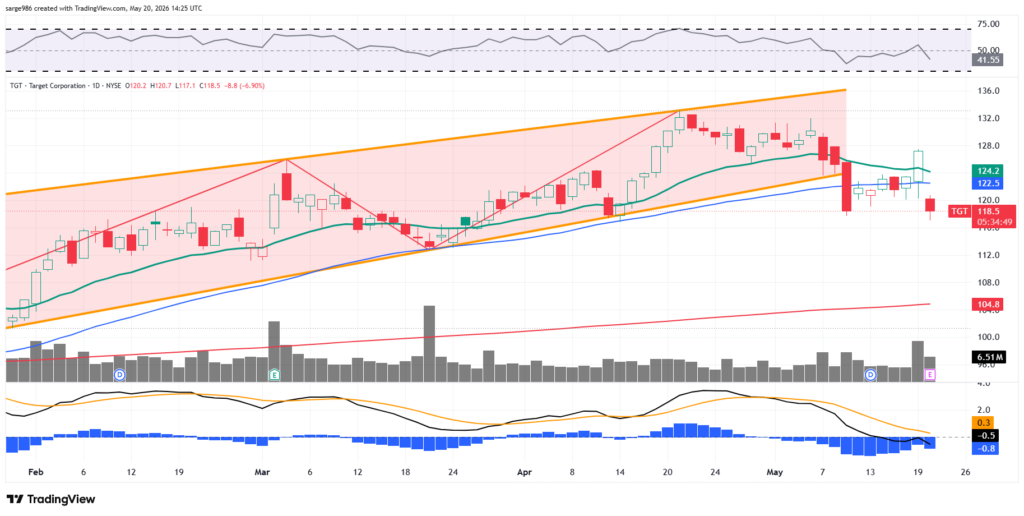
Readers can see that TGT broke down from a rising wedge of bearish reversal in mid-May. The shares have now lost their 50-day SMA. Let’s see if that forces some professional money out of the stock. The share price could go lower in the immediate future. Relative strength is weak. The daily MACD is in lousy shape.
If I were interested in TGT, I would rather write August 21 $105 puts for about $3.25 a contract than lay out any dough up front for the equity.
At the time of publication, Guilfoyle had no positions in any securities mentioned.