Threat of Bond Vigilantes Strikes Fear in Wall Street
If yields continue to rise as the bond vigilantes make their voices heard, expect the market to start running.
You've reached your free article limit
You've read 0 of 1 free Pro articles.
“I used to think that if there was reincarnation, I wanted to come back as the President or the Pope. But now I would want to come back as the bond market. You can intimidate everybody’
– James Carville
Markets have gotten shaky over the past several trading sessions. Equities are still far above their lows in late March. The rise in the indexes since then was largely powered by big first-quarter earnings beats by semiconductor companies like Intel (INTC) and Advanced Micro Devices (AMD) as well as other AI-related names like Datadog, Inc. (DDOG). That powerful tailwind will largely end today with quarterly results from Nvidia (NVDA).
And this “quiet period” before second-quarter numbers start to hit again in late July takes away one of the few tailwinds for further market gains. Market headwinds are increasing on multiple fronts. Energy and many key commodity prices have move substantially higher since the bombing began in Iran at the end of February. A ceasefire is holding for now. But very little progress has been made in permanently reopening the Strait of Hormuz. The Iranian regime’s latest proposal is a non-starter out the gate and the POTUS stated he was an “hour” away from initiating another bombing campaign yesterday but was dissuaded from that action by Gulf allies. I could easily see the kinetic part of this conflict reigniting, as early as this weekend.
Investors to this point have been way too complacent from the global impacts from the U.S.’ latest foray into the Middle East. Goldman Sachs (GS) and Bank of America (BAC) have both recently upped their forecasts around forward oil prices and now see $90 Brent in place at year end. Giant container ship operator Maersk, a key cog in the global logistical ecosystem, is experiencing $500 million higher operating costs on a monthly basis.
The market indexes have largely been unaffected by impacts from this economic backdrop. Investors have for the most part ignored higher gasoline, diesel, jet fuel and fertilizer prices. They have forgiven hotter than expected consumer price index and producer price index readings from the surge in these products.
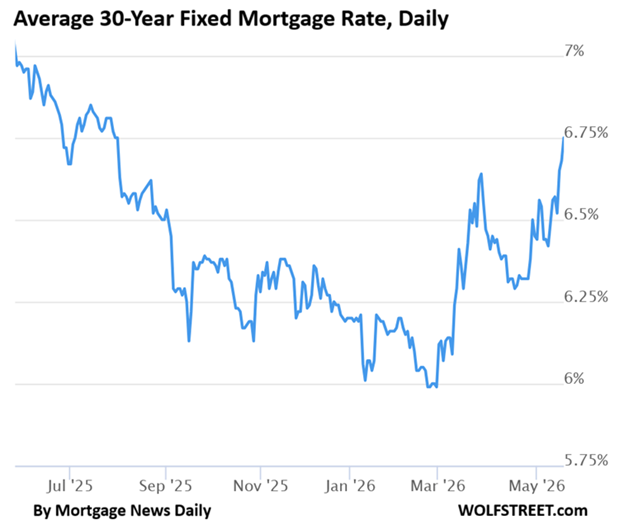
The one thing investors will not be able to ignore, however, is the return of the bond vigilantes. The market is starting to choke on sovereign debt. The 30-Year Treasury yield neared 5.2% on Tuesday. This bond’s highest level since June 2007. That was a month after Chairman Bernanke had told investors that the emerging subprime crisis was “contained.” Spoiler alert: It wasn’t. The surge in yields has pushed average mortgage rates back up to 6.75% after moving just below 6% just before the effective closure of the Strait of Hormuz. Whatever hope for a housing rebound in 2026, now seems shot.
The Fed also appears to have lost the plot given the 30-Year Treasury yield is now roughly 150 basis points above the Fed Funds rate. And it is not only U.S. government debt yields that are shooting higher. Japanese 10-year bond yields just hit their highest levels in 29 years, and U.K. sovereign debt is sporting their highest yields since the late 1990s. Both countries are much more dependent on oil exports from the Middle East than the U.S. it should be noted.
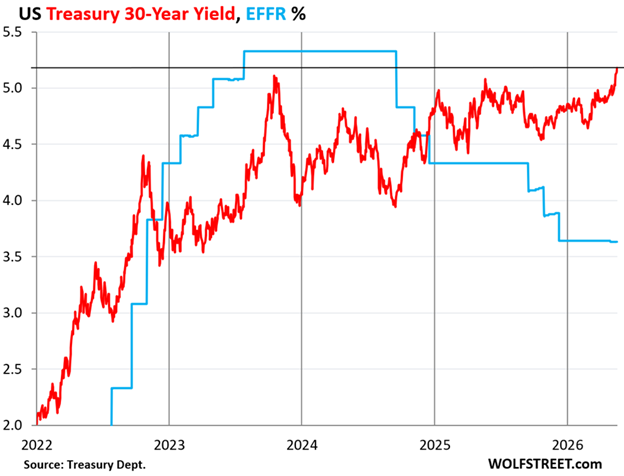
Rising yields mean the equity risk premium that is a foundation of Finance 101 is sporting a larger discount by the week. And that in theory should force a selloff in the markets if yields continue to rise as the bond vigilantes make their voices heard.
At the time of publication, Jensen had no position in any security mentioned.