I’m Eyeing Northrop After Boeing’s $20 Billion Navy Update
Though Northrop Grumman lost out to Boeing in a large deal, it seems ripe for a trade.
You've reached your free article limit
You've read 0 of 1 free Pro articles.
Readers likely already know that I have a soft spot in my heart for the large defense contractors.
Largely a group of cash flow beasts, these names feast on large contract awards provided by the U.S. Department of Defense/War and U.S. allies. Readers who follow me know that, this year, I have not been overweight these contractors in the least, which is a little uncomfortable for me.
I have maintained long positions in Lockheed Martin (LMT) and RTX (RTX) as I expect that the development of hypersonic missiles and the replenishment of stocks of U.S. armaments will benefit these two. LMT is lower than where it started the year, higher than where it was back in April and had a rough summer. RTX had clearly been the group’s winner and my proclaimed favorite. That said, even that stock, after a great run, had a tough summer and is now barely up on the year.
Longtime readers also know that I have avoided taking on long positions in Boeing (BA) due to something an Air Force staff sergeant said to me on the tarmac in Panama back in the 1980s. Though that staff sergeant cost me a bit of dough for decades, his offhand comment sure did save me a lot of stress from 2019 on. Thank you, Staff Sergeant So & So.
The News
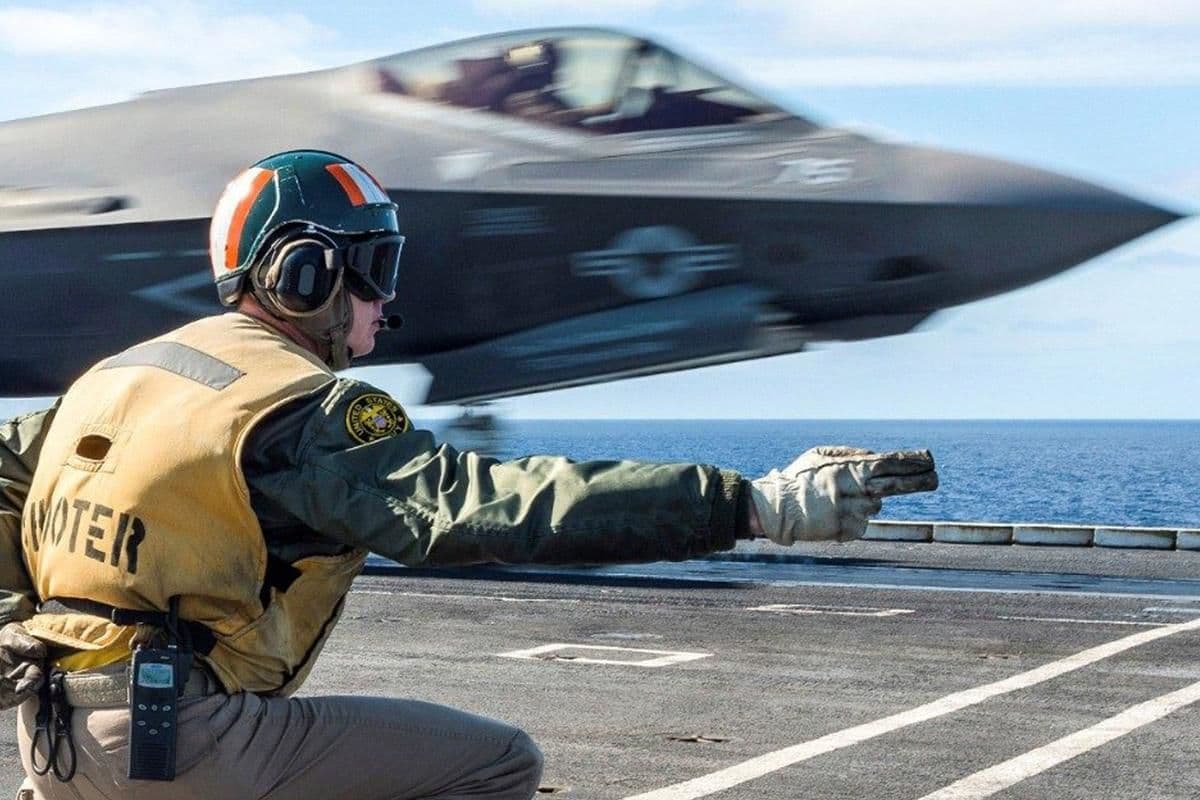
Late on Tuesday, it was learned that Boeing had landed a contract worth roughly $20 billion to develop the U.S. Navy’s next (sixth) generation carrier-based fighter aircraft, beating out Northrop Grumman (NOC) for the deal. Boeing had already landed the contract award to develop the sixth-generation F-47 fighter in 2025, beating out Lockheed Martin for that deal. The F-47 will replace the F-22 Raptor, which is a Lockheed product, but Lockheed still has the fifth-generation F-35 Lightning, and the Navy still needs 270 of those.
The new sixth-generation, carrier-based aircraft has been dubbed the F/A-XX and will ultimately replace the F/A-18E/F Super Hornet, which is also a Boeing product. The new aircraft is expected to enter service in the 2030s with the Super Hornet serving into the 2040s. The new fighter is expected to provide greater range and survivability as the Pacific Ocean and Asia become the U.S. Navy’s primary area of focus.
This is neither here nor there, but I have to ask: As the development of airborne drones as offensive weapons have made land-based armor and tank warfare nearly obsolete, why is the U.S. spending a lot of money developing manned aircraft that would need to be based on aircraft carriers in order to project American influence? Isn’t that kind of like spending and training to fight the last war?
I do hear that RTX is working on a “drone zapper” that could use electromagnetic energy to fry all unmanned vehicles on the battlefield. That would help the U.S. Navy maintain its traditional maritime advantage. That successful development would be the only way that I see the expense of developing, expanding upon and maintaining a Cold War style fleet as worthwhile. I just don’t see aircraft carriers as becoming less vulnerable than they already are, especially in a fight against a peer or near-peer adversary. What I am trying to say is that, in the end, this contract might not wind up being worth the hundreds of billions of dollars over many years that Boeing investors think it is right now.
No, I’m Not Buying Boeing on the News
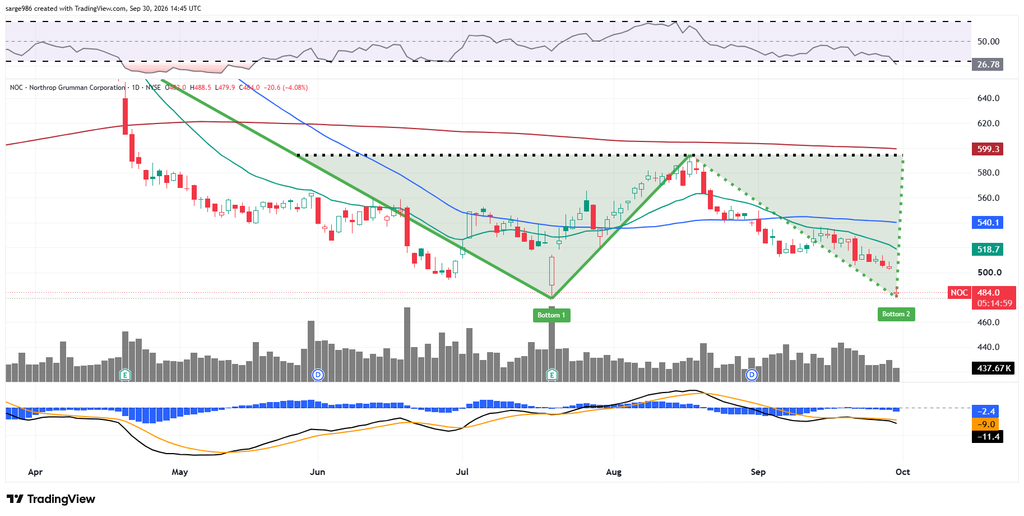
However, NOC has just completed the formation of a double-bottom pattern of bullish reversal. This stock could be ripe for a short- to medium-term trade on the long side based on this and recent weakness. The RSI looks a bit oversold and the daily MACD is bearish looking, but not overwhelmingly so. The stock, in my opinion, could see a reflexive bounce over the near term that could run into trouble when the shares are tested by their own 21-day EMA. That’s where the swing crowd will either reject or embrace any rally.
At the time of publication, Guilfoyle was long LMT and RTX equity.