Here’s Where I’m Keeping My Dry Powder Safe From Market Headwinds
AI valuation absurdity continues, rates are spiking and housing prices are getting weird.
You've reached your free article limit
You've read 0 of 1 free Pro articles.
The market is hanging in there, given the negative economic and geopolitical backdrop. It was reported yesterday that Anthropic had a net loss of $42 billion in fiscal 2025. The AI lab is readying itself to gobble up roughly $100 billion from public investors via an IPO that will value the money-losing company at a desired valuation of $2 trillion. Provided the IPO comes off. Smart ring provider Oura pulled its anticipated IPO on Wednesday citing the environment for first-time offerings. Diesel prices have soared to over $6.50 a gallon, a record, despite considerable progress in restoring oil flow through the Strait of Hormuz in recent weeks. Diesel prices are much higher in Europe and Asia.
The largest headwind facing the markets and the economy in my view, however, is the sharp recent spike up in interest rates. Sovereign bond prices have soared in recent months in the U.K, Japan, Germany and many other members of the G-20. Here in the U.S., the U.S. 30-year Treasury yield touched 5.6% on Tuesday for the first time since 2002. Ten-Year Treasury yields are getting close to the 5.3% threshold and are at their highest point since just before the Great Financial Crisis.
The markets and investors are being much too complacent around this sharp rise in rates in my view. Some of the same pundits on CNBC that were proclaiming it was game over for equities if the 10-Year Treasury hit 5%, are now pontificating the markets will be fine as long as the 10-year treasury doesn’t move to six percent. I am not nearly as sanguine around the markets and U.S. economy in this new interest rate regime.
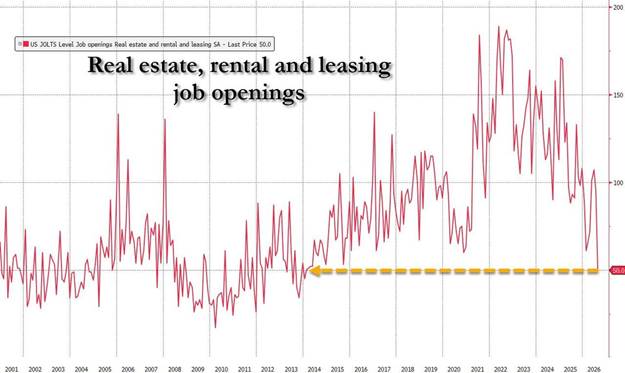
Average 30-Year mortgage rates are approaching 7.5%, and the housing sector was moribund when rates were 100 basis point lower. August job openings in real estate and rental & leasing just got cut in half from July, and are at their lowest levels since early in 2024. I could easily see more layoffs in the offing at companies like Rocket Companies, Inc. (RKT) and Zillow Group, Inc. (ZG).
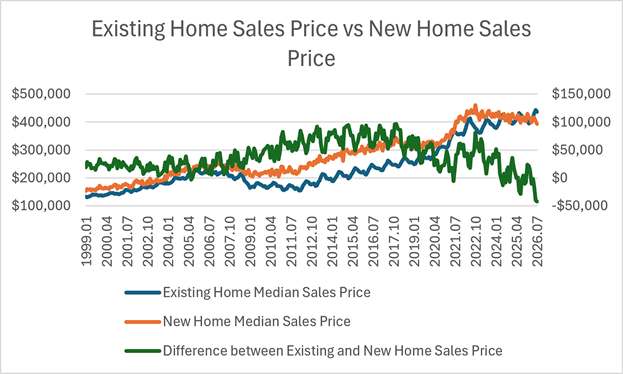
The median new home sales price is now roughly $40,000 below that of the median existing home sale price, according to a recent reading from the U.S. Census Bureau. This is an anomaly in U.S. history and obviously will revert to the mean at some point. I expect the existing home market to be frozen until prices come down substantially. And home building and housing related activity is roughly one sixth of U.S. GDP growth.
Rising rates are doing no favors for the commercial real estate market either. As noted in a recent article, roughly a quarter of the $5 trillion of outstanding CRE debt matures in 2027. The office and multi-family spaces were already struggling with the lower rates at the start of the year with Commercial Mortgage-Backed Securities rates very elevated. Higher rates are going to lead to substantially higher defaults in 2027.
Finally, the private credit market has been deteriorating throughout 2026, with default rates hitting record levels in the second quarter. Higher rates will be just another headwind to the troubled sector, and I don’t think we are anywhere close to peak default rates. Yes, surging rates are just one of many threats to the markets that investors are vastly underweighting.
Three-month Treasuries, however, are now yielding 4.25%. That is where I am keeping most of the 30% of the dry powder within my portfolio at the moment.
At the time of publication, Jensen had no position in any security mentioned.