Asia’s Top Performer Touches Bear Market, But Is Still Up Big in 2026
This market was the top performer last year and in 2026 until the impact of the Iran war. Is now the time to take a position betting on a rebound?
You've reached your free article limit
You've read 0 of 1 free Pro articles.
 Asia Markets
Asia’s most successful market is on the cusp of a bear market, as Asian economies continue to reel from the effects of sky-high oil prices.
Getty
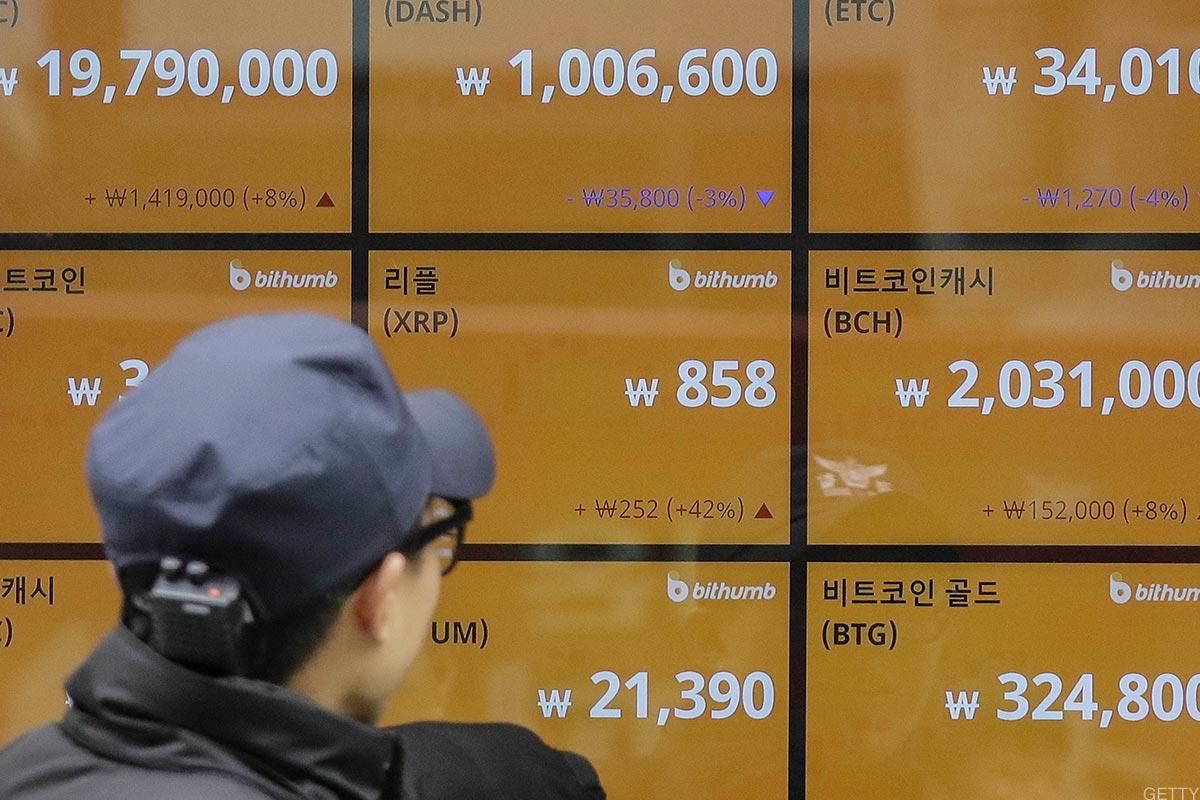
South Korea’s benchmark, the Kospi, plunged 4.3% on Tuesday, taking its losses since an all-time closing high on February 26 to 19.9%. They crossed the bear-market threshold of a decline of 20.0% in morning trade before a very slim recovery near the close.
It has not been unusual to see the Korean market move 6% in either direction since the conflict in the Middle East began. For the most part, the moves have been to the downside, although Korean equities do rally if oil prices ease.
Still Sitting on Outsized Gains
Remarkably, the strength of the rally earlier this year means that the Seoul benchmark is still up 17.2% year to date. But it has seen a dramatic pullback.
The Kospi was the world’s leading major market in 2025. Chipmakers turbocharged its performance, leading to an outsized 75.6% increase for last year. The Korean market has become a proxy play on Artificial Intelligence, but is now being punished for the country’s overreliance on Middle Eastern energy.
Brent crude prices have eased back from a high of $116.74 on Monday to $107.65 as I write. But that still represents a 52.1% increase from their levels of around $70 at the end of February, when the U.S. war on Iran began.
Importing All Its Oil
South Korea imports 100% of its oil, 70% of it coming from the Middle East. And Korea is not unusual in that reliance. Japan also imports essentially all its oil, 95% of it coming from the Gulf. Taiwan, Singapore and the Philippines all also get more than 75% of their oil from the Middle East.
Asian nations are taking steps to mitigate the effects of higher fuel costs. South Korea has already imposed driving restrictions on civil servants, a five-day rotation system based on their license plate, but is mulling extending those curbs to citizens as a whole, for the first time since the 1991 Gulf War.
President Lee Jae Myung is encouraging citizens to take public transport, cut back on power usage, and stop the panic buying of plastic bags, with Lee saying the energy issue is “so severe that even I can’t sleep at night.”
Broad-Based Declines
The declines in Korea are broad-based, with industrials, financials, tech companies and consumer stocks all down heavily. The 19.1% decline in the Kospi for March is the worst since 2008.
The Korean won has also been weakening as investors ship money into safe havens such as the U.S. dollar. The won has lost 6.8% of its value against the U.S. dollar since February 26, to stand at 1,523.58 won to the dollar as I write. The won has declined 16.0% against the greenback since a recent strongpoint of 1,310 in October 2024.
The won has only crossed 1,500 to the U.S. dollar twice before: during the 1997-98 Asian financial crisis; and during the 2008-09 financial crisis. It normally trades around 1,100 to the greenback.
The monopoly electricity supplier Korea Electric Power Corp. (KEPCO) (KEP) (KR:130660) is down 29.5% in the last month, as it bears the direct impact of higher oil and raw-material costs. It is one of only a handful of Korean equities that have a Wall Street cross-listing.
Tire maker Hankook Tire & Technology (KR:161390) is down 28.7% since that peak on February 26, its raw-input costs for rubber and chemicals on the rise.
Hyundai Down Heavily From 127% Gain
Carmaker Kia Corp. (KIMTF) (KR:000270) has lost 29.3% of its value in March. Affiliate Hyundai Motor (HYMLF) (KR:005380) has been the success story among Asian equities this year, surging 49.3% year to date, but has still surrendered 33.9% in March. Hyundai shares were up 127.3% from the start of the year through their all-time high on February 27.
Appliance maker LG Electronics (KR:066570) is off 27.5% in March. It had been posting a 58.5% increase in 2026 through its peak on February 27, but sold off particularly sharply at the start of March, the impact of the war exacerbated by a dip in quarterly sales producing a 61% year-on-year decline in profit for its fiscal Q3.
The LG Electronics affiliate LG Display (LPL) (KR:034220) is U.S.-listed, but the LCD and OLED screen maker is down 33.3% since February 26.
Memory Chipmakers Driving Market
There’s more to the Korean market than its two largest components. U.S. investors are able to track it through vehicles such as the iShares MSCI South Korea ETF (EWY) , which is down 22.8% since its 2026 peak on February 27. Despite that war-induced correction, EWY is still up 20.1% year to date.
But Korean equities are nevertheless dominated by the trading in memory chipmakers Samsung Electronics (KR:005930) and rival SK Hynix (KR:000660), which combined represent around 40% of the total market capitalization in Seoul.
The chipmakers peaked at the end of February like many of their Korea-market counterparts. But they rallied into mid-March, coming close to regaining their year-to-date highs, before a second selloff undermined their share price as Q1 ends.
Samsung Electronics shares are down 22.8% since an all-time high on February 26. But that has only eaten into a massive 39.4% gain in 2026. Likewise, Hynix stock is off 26.6% since its all-time high on February 26, but still up 24.0% in 2026.
While Hynix was an early mover into the High Bandwidth Memory (HBM) chips necessary to power AI models, Samsung has successfully played catchup, securing key contracts with the likes of Advanced Micro Devices (AMD) , Nvidia (NVDA) , Meta Platforms (META) , and Tesla (TSLA) .
Those trends remain in place. Foreign investors sold the equivalent of a net $23.5 billion in Kospi equities in March, according to exchange data, the largest outflow on record.
But investors are driven purely by geopolitical tensions and the threat from higher energy prices. The selling has been indiscriminate, with no apparent tethering to any impact on sales or earnings.
Expect Korean stocks to rally significantly if a deal is reached to keep the Strait of Hormuz open, or if the United States looks to wind down its attacks on Iran. The potential for an AI-induced bubble is a more direct challenge to Korea’s market leadership than the Middle East conflict, which is depressing Asian equities as a whole, regardless of fundamentals.
Related: This TACO Might Give You Indigestion
At the time of publication, McMillan was long NVDA.