Getting to Know: Louis Llanes
We’re joined today by Louis Llanes, CFA, CMT, to learn more about his investment style. Please enjoy our conversation.
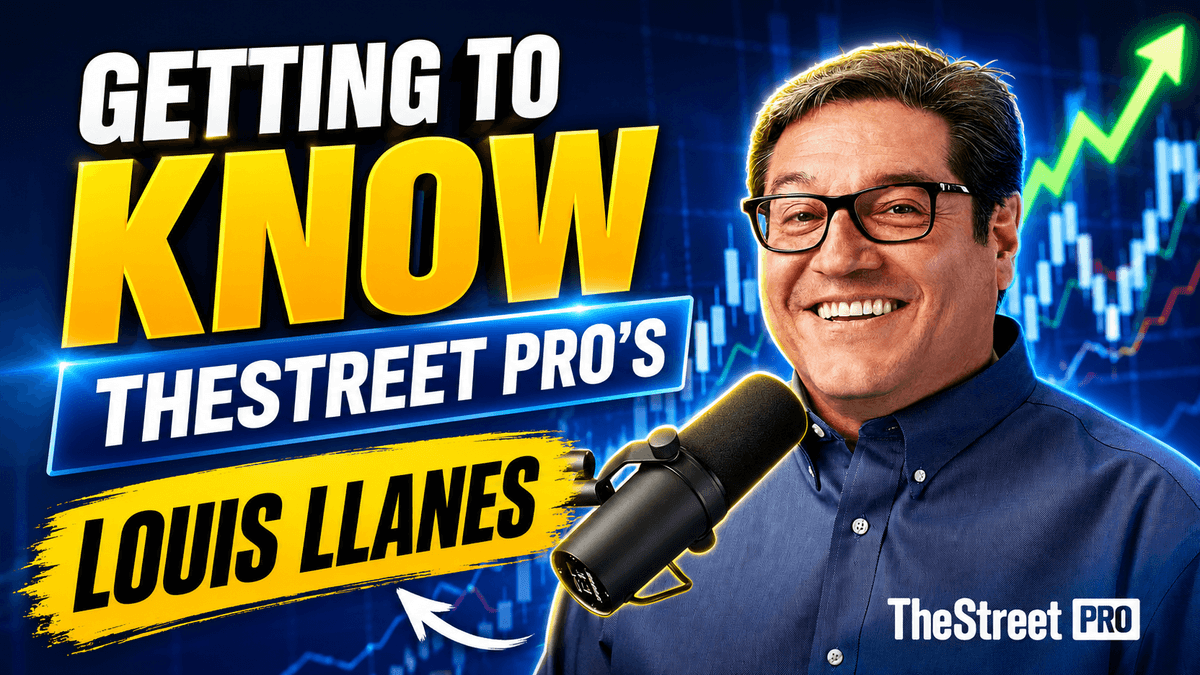
Welcome to the first video in our series on getting to know TheStreet Pro’s contributors. In this first interview, I sit down with Louis Llanes to discuss his investment philosophy, his best and worst trades, and his love of music.
Visit Louis’ Author Page to learn more about him and see articles like From Music Studio to Portfolio: The 3 Steps That Make Returns Sing. And hit the follow button while you’re there and never miss an article!
I hope you enjoy the conversation.
Video
Transcript
Jason Meshnick (00:01.534)
Okay, so what we are doing today is we are getting to know our different contributors and I’m going to start with one person each week and today I am being joined by my good friend and colleague Louis Giannis and actually the first question so the way this is going to work is I’m going to ask each contributor a series of questions so that our our subscribers, our members can get to know everybody and understand the kinds of content.
Louis Llanes (00:07.966)
Yeah.
Louis Llanes (00:17.562)
Well, okay.
Jason Meshnick (00:31.416)
That they can expect from people and who they should follow, and maybe who might not even be the right person for someone to follow. But the the goal is that everyone will be introduced to our contributors and learn a little bit about them and maybe realize that there are some people and different types of analyses that they can get from our contributors that they’re not currently getting. So Lewis, welcome. Thank you for being our guinea pig, our our first person to go through this process. And I just realized even though I did just pronounce your name.
so many people get it wrong. And the first question that I’m going to have for you is how does one pronounce your name?
Louis Llanes (01:08.368)
My last name is Yannis. So the easiest way to remember it is think of yawning with S’s at the end of it. So Giannis. And that’s it it’s it’s a it’s a Spanish last name. So two L’s is pronounced like a Y. And there’s actually an interesting story behind that name, by the way. Do you want to hear a quick story about that? So, okay, so a long time ago in in Spain, there’s a little town in Spain, it’s in North Spain.
Jason Meshnick (01:16.865)
Yannis.
Jason Meshnick (01:28.843)
Absolutely.
Louis Llanes (01:36.101)
you know the Greeks used to hang out with the Romans way, way back in the day. Not because they wanted to, but they they did. And back in the day the the the Greeks used to worship a god called the Janus god. You might have heard of the Janus god. Well, that two L’s is like a J sound in some dialects of Spanish. So that’s where that name derives from. The Greeks kind of named that area.
And then the kings in back in the day renamed everybody who who came from that region with that last name. So way, way back the Spanish heritage in my family is comes from that region. And so that’s where that comes from.
Jason Meshnick (02:19.145)
Awesome. And if I recall, Janice is the two faced god.
Louis Llanes (02:24.326)
Yes. That’s hilarious. One buys and the other one sells. He he’s he’s a very confused god.
Jason Meshnick (02:33.087)
Exactly. Very confused, God. He’s got strategies for everything. Okay. That was awesome. And and that could actually take the place of my first question, but I’m going to ask you my first question anyway. question number one to you is give us a little known fact or something that you would like users, members to know about you.
Louis Llanes (02:53.178)
Okay, so probably one of the most defining moments in my life was when I was like nine and a half, ten. I went to my grandfather’s house, and up in upstairs, like in the attic, he had a a beat-up guitar. it was like an acoustic guitar and it had one string on it. And I was looking at that thing and I I started picking out notes, and I and I remembered the song, you know that song, what is it called, Wipeout?
I remember hearing that song because my dad would listen to that. And I like randomly was able to pick that out. And I thought I was a genius. So I like ran downstairs and I’m like, I want to play guitar, mom, I want to play. I’m like pulling on her dress. You know, I want to play guitar. And she’s, you know, it kind of blew me off. So like for a year solid, she kinda blew me off, and then she said, Fine. And she bought me like this really cheap, like, I don’t know, Sears and Robuck type guitar. And ever since then I’ve been an avid guitar player.
Jason Meshnick (03:22.389)
yeah.
Jason Meshnick (03:47.586)
Is this?
Louis Llanes (03:50.52)
avid recording of guitar and still to this day I’m in fact I’m building a a a new studio in my new house. So looking to record a bunch of artists on the side. It’s my it’s my true original passion. economics I discovered when I was nineteen. There’s a whole nother story behind that. But yeah, music is it.
Jason Meshnick (04:09.901)
Awesome. So when we when we put together the Street Pro Band, you’ll be in charge.
Louis Llanes (04:15.493)
I’m in. Yeah, yeah, I’ll take I’ll take control.
Jason Meshnick (04:16.557)
‘Cause ’cause we’ve we’ve also got a we have a a lead singer as well. but that’ll be for a future episode and I will leave that as a surprise for people. All right. Great. Let’s move on to question number two. So how long have you been with the Street Pro?
Louis Llanes (04:25.891)
Okay. All right. I’m in.
Louis Llanes (04:34.481)
You probably know better than I do. My memory is a couple years now. it sounds about right, is you know. I’m a a relatively newcom relative newcomer, I think. And my come I’m so happy to do it because I love to write. And and you’ve been so gracious to you know invite me in. And and I’ve I’ve enjoyed doing it. I enjoy writing a lot a lot about a lot of different things.
and I can write about a lot of different things because I’m a little bit eccentric that way, just naturally. but you know, it’s been a it’s been a good journey and I hope to do it a lot longer, so
Jason Meshnick (05:14.325)
Awesome. I I hope you do. And and yeah, I I do remember when you first started. I believe it was in September of twenty twenty four. and and I I remember that because I I brought you on and and Lewis, yeah, we’ve known each other for over twenty years now. yeah, because you’re formerly of the Denver area where I live and now you’re living in Austin. so and and I guess the the follow on question to that, question number three is so what type of
member, which what you know, of our our traders and investors who are our members, what kind of person would get the most out of your commentary and ideas?
Louis Llanes (05:55.516)
I think investors that want to be able to take a flexible approach in terms of your time frame and in terms of how you’re gonna approach the markets is going to best be someone to read my my articles because my time frame isn’t always the same.
it’s not like I I’m I’m only a long-term value investor or I’m only a short-term trader that trades technicals. I’m a little bit eccentric in how I approach the markets, it because it just suits me, and I’ve had the most success with it. So I would say readers who are interested in knowing about or thinking about why they should do something, rather than just taking a blind
Like buy this because it broke out here, type investor. I will mention things like that, but it’s that is really only part of the equation for me. I I’m both a technical and a fundamental guy, but I’m a huge believer in portfolio construction and position sizing as a as a formula for success. So people who want to think about not only what to buy or sell, but how much, those are the types of people I think will maybe get some ideas on how they should approach their own.
portfolio and people who want to think about how they’re managing their own money and they’re looking for ideas that they may be able to employ for their own strategy. I wish I could give you an answer that was really simple that said, you know, I buy options and I sell, you know, I’m generating income or something like that.
Jason Meshnick (07:28.278)
Great.
Louis Llanes (07:35.693)
like that’s something that you can be defined into like a product, if you will. But I’ve pretty much come to be at peace with the fact that that’s not who I am.
Jason Meshnick (07:45.933)
Well and I think that’s one of your strengths, Lewis, is that so th if you asked me to describe you, the first thing that I would say, or at least your methodology, is that you’re very data driven, right? Everything that you do, you’ve done the math behind it. so it’s not like I think you do have a great feel for the markets, but you have that great feel for the markets because you’ve studied the markets and you’ve studied it from a mathematical perspective. And and so you mentioned position sizing and I know that you gave a a talk at the CM
the the the CMT Associations, which is the premier technical analysis organization in in the world, and at their annual symposium, it was very prestigious and they invited you to come up and speak about position sizing. that was a number of years ago. So that’s because you’re you’re so data driven. and you helped me write write my paper as well. So because you know you’re good with the computer and so everything that you say really
does start there from a point of of data research. yeah.
Louis Llanes (08:48.741)
It’s very true. I do I do a lot of quantitative analysis. I’m a closet quant. and everybody who knows me well figures that out eventually. but yeah, I I I really am a big believer in numbers over narrative, at least as a starting point. I love to hear narratives, but then I want to kind of di you know go in in a little deeper to see if I can justify it some way. And the only r reason I’m kind of
more driven like that is because I made a lot of mistakes early in my career where I wasn’t following the numbers enough. And I realized that I as a person am less consistent when I’m talking when I’m making judgments based on narrative. And I’ve noticed that my results are just more consistent and overall better. I compound better when I take a numerical approach from a a base case. Yeah.
Jason Meshnick (09:40.214)
Exactly. Yeah. you know, I should ask I think this is a good time to ask this, but too so what’s your day job? ‘Cause you don’t write for us full time and and you do have a successful other business.
Louis Llanes (09:52.274)
Yeah, I work for a company called Farther. we’re a wealth management company. we’re very fast growing. And so I my day job is wealth management. So I manage wealth for high net worth individual clients. And I have a team of people that have different specializations that also support my clientele. So that’s that is my day job. And so part of my job is investing.
But it’s also the all the other things surrounding that, which would have to be like planning-oriented situations as well as estate planning. And I, you know, I have people that are, you know, estate planning attorneys to work with and financial planners and all that that crunch numbers for me. but I I act more like the quarterback, but my main emphasis is on the investment side. So I basically spend, I would say, 20% of my time communicating with clients about things that are specific to their.
family and their family wealth. And then the rest of that time I’m really looking, talking to smart people and trying to understand what’s happening and what I can do to help people have a better financial life. Because one of the things I did realize is that initially when I got into this business I was like you said very data driven. But I realized all that stuff is worthless unless somebody is doing something with it. So I like the the human side too to be able to actually apply
‘Cause we can get very theoretical. and I’m I’m a very application driven person. so that kind of keeps me grounded working with with clients. Yeah.
Jason Meshnick (11:31.006)
Wonderful. Yeah. Great. I’m sure your clients are lucky to have you. all right, let’s get into some of the crazy questions that people are probably expecting. everybody wants to know, Lewis, what is your best trade and what did you learn from it?
Louis Llanes (11:47.282)
That is such a hard question because we always seem to remember the worst trade and not the best trades as much. I can think of a few. I’m I’m just gonna mention a more recent one, and that’s gold. So you know, a few year before gold took this big run up, it was really clear from a macro perspective to me that gold needed to go up and it was going sideways for a long, long, long time.
And and I’ll tell you how I played it wrong initially, but how I got it right eventually. So I knew I was very bullish on gold, but it wasn’t going anywhere. and so I bought leaps on gold. And those and I held those leaps for over a year, and they expired worthless. And then as soon as they expired, it broke out and went up. So I positioned size so I didn’t lose that much of my capital when I did that. but then I bought the physical.
And I bought it right on the breakout and I rode this whole trend up. And and I’ve been paring back on it as it’s gone up. and that’s been a an amazing run. Same thing with silver. I’d you know basically you know it became clear to me that, you know, silver always tends to go up a lot faster than gold when that move happens. And so I took a smaller position size size in silver.
And that one really outperformed. In fact, I I think I wrote about it on the street of how I think silver were outper performed gold, which it which it thankfully did. So that’s one that’s more recently a an amazing good trade. I can think of a few going back in time. And some of them are luck and then some of them you really just g did get the whole thing right. And I would say that gold trade was kind of getting the whole thing right.
Jason Meshnick (13:35.573)
Sounds it. Yeah, you did the research, you put in the time, and then it it went your way after initially not going your way.
Louis Llanes (13:41.884)
Yeah. Initially I lost all that capital, but I again it was a small percentage. Had I been right, I would have the returns would have been enormous on that. But I didn’t that’s another key lesson, is that I I didn’t give up on that trade, you know, because the data was saying that it’s still there, that I got my timing wrong, and so I just it didn’t make sense at that point to do the options because they were too expensive at that point.
So that’s when I went to the physicals.
Jason Meshnick (14:13.747)
Okay. let’s ask the opposite question. What is your worst trade? And that’s a I’m I’m sure it was it was up it was a winner but but it was your worst trade and what did you learn from that one?
Louis Llanes (14:22.653)
Well that’s a that’s a super easy one. Well okay, so early in my career, I I used to trade systematic systems like exclusively. And so and I was working with this shop, it was private money, and I was actually up in Estes Park, you might remember that that time in my career. And it was pretty cool because we were trading stocks, bonds, commodities, currencies, long and short, more of like a global macro, but it was
using more models. So at that time I had like a lot of screens and those screens had a bunch of models that I was trading and I just kept losing on this one model. It just lost, lost, lost, lost, lost. And then I finally decided that I took another trade and I thought it was it was gonna be a lot it it was going to go up. I thought this one’s gonna win. So I held on to it.
And then and I was trading futures, it was an SP 500, it was a bunch of contracts too, it was a lot. And it was supposed to get stopped out, and then I said, No, I I it this one’s gonna turn around. Cause cause all those trades before, by the way, I was getting stopped out and then it turned around and went long. And and I would have been right had I not stopped myself out. Well well, the system didn’t stop out. So I I probably did like seven or eight lost trades in a row, and then that last one I decided this one’s gonna bounce back up.
And and it’s gonna be just like the other ones. I’m I’m tired of taking losses. Overrode the system and the and the SP just cratered. I mean, just freaking cratered. And by the end of the day, I had a very large loss. And I remember going to my manager and I told him about it and he laughed. And he said, You know what? You finally have learned that lesson. Welcome to the trading business. Because everybody’s done that in the in the business.
And I thought I was worried. I like, my gosh, I I didn’t do what what we’re supposed to do. Always follow the system, always follow the system. So I would say that’s the most memorable thing imprinted in my brain about having discipline, so
Jason Meshnick (16:29.682)
And and you owned it too, right? You know, by going by going up to your boss, it’s not like you went home for the day and said, I hope I hope nobody notices this. You said, Yeah, I g I gotta I gotta be a stand up guy and go up and and discuss it and let them know and then yeah, have that post mortem.
Louis Llanes (16:41.915)
Yeah, I did. And then you know what he did? He made me close it. He made I was still open on the position and he made me close it. Yeah. And and and and that it was it was good. It was good.
Jason Meshnick (16:47.241)
Yeah, good.
Uh-huh. Yeah, good for him.
Jason Meshnick (16:57.084)
Awesome. Okay. I think everybody’s had that experience somewhere along the line. And if they haven’t, it just means that they’re going to have it in the future. Yeah. okay. is there anything else that you would like our members to know about you?
Louis Llanes (17:01.36)
Okay.
Louis Llanes (17:05.597)
True.
Louis Llanes (17:14.877)
Mm, I would say that that’s a really good question. What to know about me. Well, I guess other than the fact that I’m a quant at heart, I’m also a technician. You know, that that that part of me is is alive and kicking. And I think that there I believe that there’s times when you have to be more of a technician than a fundamental person.
And I actually think that that is that time is actually right now. And my let me back up and tell you when I think you should be more of a technician, or when I want to be more of a technician versus a fundamental person. That’s when the fundamentals make no sense, but the trends continue. Because I learned that you know, before the dot-com explosion, that for a couple years the fundamentals made zero sense, but there was so much money to be made.
So being able to manage your risk and staying staying with trends, it’s it does make a big difference in your results when things don’t make sense. Like right now, I believe we’re in a more narrow bull market, and that could go on for another couple years. And there’ll be people, you know, and I’m not saying I’m not making a prediction, I’m just saying how you would tactically work it, how I tactically work environments like this, is to just remember that trend, as long as it’s in place in a market like this.
Like for you to just be stubborn and be out completely, there’s some great investors that take that approach, but I’ve learned for me that that’s not the best way. For me, it’s to have a smaller size, stay with it, and then be more of a technician.
Jason Meshnick (18:54.408)
Right. Okay. and and so with that, what are some of your favorite technical indicators?
Louis Llanes (19:01.703)
For stocks, you know, for st for for let’s go with individual stocks because I have different types of technical indicators that I like. For individual stocks, my favorite technical indicators are your real basic stuff. Trend, the the the the support and resistance and trend and momentum, volume. I I I love your th your take on volume. I still use that. I love it when stocks have the right setup.
Jason Meshnick (19:03.922)
Yeah.
Louis Llanes (19:31.6)
volume is actually lower than normal and then it start and then and then you start taking a position and it’s expand buying that as it expands. That’s one of my favorite ways to find stocks. Most recently taking a position in Oracle has been in that realm and and no everybody was telling me I was wrong on Oracle and it felt wrong. so but I sometimes I I you know I I would say the f technical indicators that are a little bit more contr con contrarian
within the context of a trend. Those are my favorite types of indicators. So that would include your basics, think Ed McGee. You know, because that that really does encompass the psychology behind the trade, you know, when people are selling, when they’re buying. And if you understand what’s happening with that stock and you see the buying and selling and support and resistance and the trend lines, it could really help you. But I would also
make a little quick note on that is you don’t want to be obvious where you take your positions because everybody knows those areas. So I try to I try to have a little bit of an anticipation with things. So one person that I I learned a lot from told me that and he’s a very good trader. His name is Peter Brandt. You may have heard of Peter Brandt. yeah a Colorado guy. He he taught me that the concept of an anticipation trade.
Jason Meshnick (20:48.308)
Lives in Colorado.
Louis Llanes (20:56.369)
Where you can take a small position at anticipating what the market might be doing. So let’s say you have a you have a stock that is basing for a long time and it looks like a good base, it’s not breaking out. So t you know, traditionally you’ll see, you know, most technicians will want to see a quote unquote confirmation. But instead, buying at support as it’s reversing up before the breakout and take a small position.
And as it’s going through those key levels when everybody is taking those positions, adding a little bit more, but not adding your full adding your full position on before that happens. And then if you don’t have follow-through, pair it back. So it’s a little bit different way of philosophy. but I think anticipation trades, that was this, I’m giving you long answer, I guess. But the whole concept for me that it tends to work the most is being a little bit more not obvious, but
looking at at it from a contrarian perspective and sticking with the trend.
Jason Meshnick (21:55.498)
Yeah, I think that makes a lot of sense. And I I think similar to that, keeping it as simple as possible. you know, Ralph Akampora’s six rules. I I took Ralph Ralph’s class back in nineteen ninety four or five and and his rules are really as simple as it gets using using simple moving averages, right? And and so he says, Is the is the moving average and I won’t go into all the six rules, but it’s basically is the moving average trending upwards or downwards?
And then how far is the stock above or below or in line with that rising or falling moving average? And and you can get almost everything from that. You can get trend, you get your momentum, a level of volatility to it. You get everything but volume from from that. So simpler really does make the most sense in so many ways.
Louis Llanes (22:43.367)
Mm. I love that. You know, one time I was lucky enough to be able to speak with him over at the University of Denver and he we were after we had you know when walking down the hallway, he was like, I want to tell you about one thing that you should just always do. And I said, What’s that? And he says, just keep a relative strength chart on everything. And and and just make a note what
Jason Meshnick (22:50.078)
Yeah.
Jason Meshnick (23:06.345)
That and that being that not being the RSI, he’s talking about the the ratio of the the performance of one stock versus the index or some other benchmark. Yes.
Louis Llanes (23:19.055)
Yes, exactly. The relative performance and just follow the trend of those and is the relative performance going higher or lower or sideways? And that will keep you in line and in tune. And then the other thing he taught me that I thought was really interesting was I asked him about like how you predicted the Dow because he was known for his predictions with the Dow. And he just had he just had a bottom up approach with the Dow. You know, he just used you know, you know, basic targets.
Jason Meshnick (23:39.763)
Right.
Louis Llanes (23:47.153)
technical targets on each stock and then just use the divisor and that was your prediction. And I thought that was pretty brilliant too. Yep.
Jason Meshnick (23:53.755)
Exactly. Yeah, the simplest methods. a lot of work there, but but the simplest methods. Great. Well Lewis, this has been really helpful and really informative and a great way to kick off this little series. So thank you very much for your time.
Louis Llanes (24:00.081)
Yeah.
Louis Llanes (24:09.616)
Yeah, thank you again and we’ll see you on the next trade. All right. You’re welcome.
Jason Meshnick (24:13.658)
Exactly. Thank you.

Conversation