Credit Markets Send Financial Warning Despite Index All-Time Highs
Prudent investors should position their portfolios accordingly.
You've reached your free article limit
You've read 0 of 1 free Pro articles.

Investors got a rare bright economic reading during this summer on Friday.
The August BLS jobs report showed that 162,000 positions were created last month. This was triple expectations. Both June and July employment were revised up as well. The strong labor reading boosted the probability of a 25 BPS rate hike at the upcoming FOMC meeting.
The central bank probably should boost its primary rate as inflation has been running above its official 2% target for five and a half years now. The conflict in the Middle East continues to be a headwind on the inflation front. The dearth of supply and rising prices around refined products like diesel fuel are particularly getting worrisome. That said, my view remains that Chairman Warsh stands pat in front of the November midterms. I also expect there will be more than a couple of dissents from the meeting.
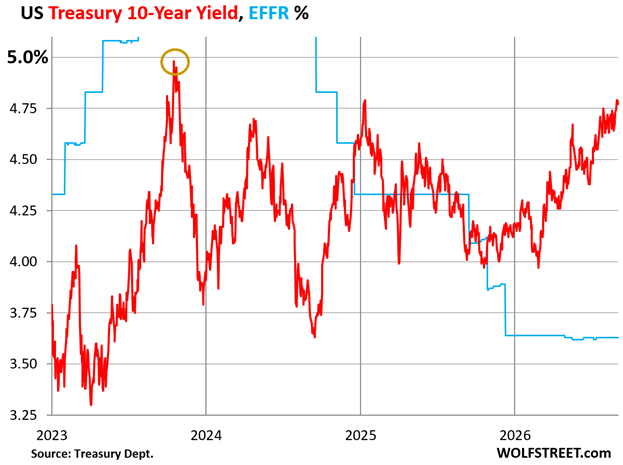
The decision in some ways is moot. The credit markets have already hiked rates to an extent given the yield on the 10-year treasury is hovering more than 100 BPS above the federal funds rate. Sovereign debt yields through a good chunk of the G20 are at 15-to-30-year highs including in the U.K, Germany and Japan.
I continue to believe there will be severe consequences from the Federal Reserve holding rates too low for too long following COVID. Investors, private equity firms and fund managers made a lot of poor capital allocation decisions based on ZIRP. And those problems are now starting to roil to the surface as interest rates move upward. If rates stay elevated, it will not be long before the U.S. is spending $1.5 trillion annually to service its burgeoning debt load.
Default rates hit all-time highs in Q2 for private credit funds, according to Fitch Ratings. Giant private credit funds from the likes of Blue Owl Capital (OWL), Cliffwater and Blackstone (BX) have “gated” quarterly redemptions significantly for three quarters, granted half or less of requested redemptions. If this keeps up, we may get more price discovery and find out whether “mark to model” comes up with values close to mark to market.
Commercial real estate lenders are in for an increasingly difficult time in 2027 as so many loans that were financed during the Fed’s easy money period, now will have to be refinanced at significantly higher rates. Commercial mortgage-backed securities (CMBS) delinquency rates have risen sharply over the past few years on office properties. In August, that delinquency rate approached 12%. This is higher than the peak of the Great Financial Crisis.
The CMBS delinquency rate against multi-family properties is moving toward 8%. These two property sectors account for roughly 70% of $5 trillion of CRE outstanding. And this CRE debt maturity wall peaks in 2027 where more than $1.2 trillion of loans come due.
Then we have the outlook for corporate credit, which is worsening. Longview reported last week that speculative-grade corporate default rates have now hit 4%. That is significantly above the 2.9% 20-year average. These default rates in Europe are at 4.6%, double their 20-year average. The average rate demanded on corporate debt rated triple-C or lower has risen to just north of 10.5%. This is nearly 2.5% higher than where they were a year ago.
And while the indexes continue to trade near all-time highs, credit markets are signaling that the chickens look like they will be coming home to roost in 2027. Prudent investors should position their portfolios accordingly.
At the time of publication, Jensen had no positions in any securities mentioned.