Asia's Worst Performer Slumps Again as MSCI Refuses to Remove Shackles
The Indonesia Stock Exchange is naming and shaming companies and they risk removal from indexes if they don’t rectify free-float requirements.
You've reached your free article limit
You've read 0 of 1 free Pro articles.
It’s green across the screen for most Asian markets Tuesday… with one notable exception.
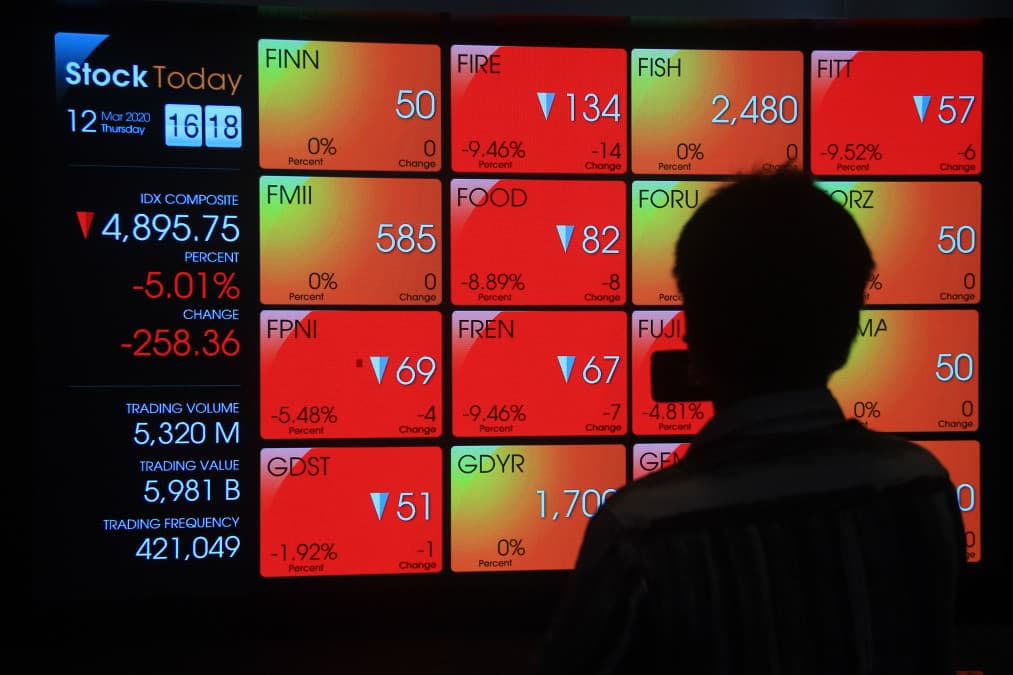
Indonesian equities are down 0.5% on Tuesday, taking their loss from their January 20 peak to 17.2%. The Jakarta stock market is the worst performer in Asia so far this year, down 12.6%, almost double the decline of next-worst India, where the Nifty 50 is down 6.8% in 2026.

The cause for Tuesday’s downtick is a decision by index provider MSCI to push back its decision on whether to downgrade Indonesia’s market status.
Decision Pushed Back to June
MSCI had been due to deliver a verdict on market reforms in Indonesia in May. But it announced late on Monday that it would continue to observe how reforms are implemented for another month, pushing any decision on Indonesia’s status into June.
Meantime, MSCI has frozen any changes to index composition for Indonesia, and will not include new companies in indexes or upgrade companies if they increase in size.
Jakarta stocks this January experienced their worst selloff since the Asian financial crisis in 1997-98, shedding $120 billion in value after MSCI warned that it is considering a downgrade to Indonesia from emerging-market status to a frontier market.
Recent Rally Fails to Undo Q1 Plunge
The Indonesian benchmark, the IDX Composite index, fell 23.7% top to bottom, from January 20 to April 7. Jakarta stocks have since rallied 8.4% on improved prospects in the Middle East, but are still the worst underperformers in the region amid the uncertainty.
MSCI’s decision was a “haymaker to the chin,” as I described at the time, in analyzing the implications the move. Even if Indonesia remains an emerging market in MSCI’s eyes, the index provider warned it could still reduce the weighting of Indonesian securities in emerging-market indexes.
Days later, Moody’s Ratings downgraded the outlook on Indonesia’s sovereign-debt status to negative, from stable, blaming “reduced predictability” in policymaking, a second blow that, as I explained, also stems from concerns about poor stock-market transparency as well as increasing political interference in the economy. Both MSCI and Moody’s are worried about the extent of sudden policy decisions and the sniff of nepotism under President Prabowo Subianto, the son-in-law of former Indonesian dictator Suharto.
Prabowo, a former head of the Indonesian special forces, took office in October 2024. Even if he is now separated from his wife, he comes very much from within the ranks of the political and military elite. That’s in stark contrast to his predecessor, Joko Widodo or “Jokowi,” who rose from humble roots to become governor of Jakarta and then the first post-independence leader from outside the cabal of wealthy, connected families that normally dominate Indonesian politics.
Political Interference, Insider Dealing
Moody’s points to “weakening governance” under Prabowo, who selected Jokowi’s eldest child as his vice president, replaced a much-admired finance minister with a personal friend, and subsequently named his nephew as deputy governor of the central bank, in line to take charge.
MSCI is also concerned with the lack of free float among many Indonesian securities, a lack of transparency about insider holdings, and possible “coordinated trading behaviour” undermining the price of stocks.
Indonesia has been an emerging market since MSCI unveiled the MSCI Indonesia Index in 1990. A downgrade to frontier status would relegate the world’s No. 4 nation in terms of population and No. 22 in terms of stock-market capitalization to the same sort of status as far-smaller and highly volatile stock markets such as Kazakhstan, Bangladesh and Sri Lanka.
It would also force a massive reweighting by institutional investors, which would have to sell Indonesian stocks held in products tracking emerging markets. Investment mandates may even preclude pension funds, for instance, from holding riskier stakes in frontier stocks.
Authorities Respond With Changes
Indonesia’s stock market operator, financial-services regulator and central securities depository have responded to the pressure from MSCI and Moody’s with changes that analysts view as positive but not sufficient to address those concerns.
For instance, the Indonesia Stock Exchange (IDX) has proposed and the regulator has approved a three-year process to double the required free float for Indonesian-listed companies to 15%.
Other changes include enhanced disclosures for shareholders who hold more than 1% of a company, increased “granularity” as to how investors are classified, and the introduction of a framework for the high concentration of shares.
Those changes may be calibrated to stave off the downgrade threat, although MSCI may get stricter about how companies are categorized, culling some Indonesian equities from emerging-market lists. MSCI may also still downgrade the weighting to Indonesia.
The problems surrounding Indonesia’s market are significant in that a handful of families control a network of conglomerates, often with cross-holding ownership among relatives and holding-company structures designed to ensure the “ruling” family retain voting control.
Particular Problem in Indonesia
Those issues are common across Southeast Asia. But there is a particular concentration of power in Indonesia, with the 20 largest listed companies linked to Indonesian tycoons making up nearly 43% of the Jakarta composite stock index, according to the brokerage Trimegah Sekuritas Indonesia, and about 50% of the MSCI Indonesia index.
Last week, the Indonesia Stock Exchange named and shamed nine companies that have exceedingly high insider-ownership concentration of 95% or more:
Property developer Rockfields Properti Indonesia (IDX:ROCK)
Nickel and silica miner Ifishdeco (IDX:IFSH)
Property developer and hotel operator Satria Mega Kencana (IDX:SOTS)
Industrial-gas producer Samator Indo Gas (IDX:AGII)
Geothermal and wind-energy generator Barito Renewables Energy (IDX:BREN)
Furniture and household goods supplier Panca Anugrah Wisesa (IDX:MGLV)
Coal, chemicals and palm-oil producer Dian Swastatika Sentosa (IDX:DSSA)
Food and beverage operator Lima Dua Lima Tiga (IDX:LUCY)
Bird’s nest and collagen supplier Abadi Lestari Indonesia (IDX:RLCO)
Those stocks are at risk of exclusion from MSCI indexes. Most are down significantly Tuesday, with Dian Swastatika Sentosa (down 15.0%) and Ifishdeco (down 14.8%) worst off, followed by Barito Renewables (down 9.5%).
Threat to Remove
MSCI says it will delete from its indexes any stocks identified by Indonesian authorities as part of the new High Shareholding Concentration framework. It says it may also use the 1% shareholder-disclosure data to adjust free-float estimates.
The telecom infrastructure company Solusi Tunas Pratama (IDX:SUPR) said last week that it would go private and delist rather than attempt to meet the new requirements. It is controlled by the Hartono brothers who are heirs to the Djarum clove-cigarette fortune.
More broadly, MSCI says it will also be reviewing the “scope, consistency and effectiveness” of the new data generated on insider ownership and the free float of listed companies.
We could see Indonesian shares rally significantly if the overhang from this review process is removed. But concern about the high concentration of power over the largest listed companies will remain.
At the time of publication, McMillan had no positions in any securities mentioned.