With IBM on Quantum Computing Run, Here's How Far It Could Go
Amid a new AI Labs hub, IBM Quantum Starling and more, Big Blue stock is only now set up for a potential breakout.
You've reached your free article limit
You've read 0 of 1 free Pro articles.
On Monday, shares of IBM IBM closed up 1.19% at $272.08. This was the stock's seventh consecutive green-candle session.
Through the now seven-day winning streak, IBM is now up a sharp 5.18%. Back on June 2, Big Blue had unveiled its new "watsonx AI Labs," which will be the firm's new developer-focused innovation hub.
This lab will be located at 1 Madison Avenue in New York City, and at the start, will work with NYC area-based start-ups. Nearly simultaneously, IBM announced the acquisition of expertise and license technology from the New York-based Seek AI.
For those that had no idea, IBM itself is headquartered in the New York City suburb of Armonk, N.Y., so as a rare East Coast tech firm, the focus on doing business in and around New York, does not come completely out of left field.
Then Came Tuesday
Just yesterday, in this column, we discussed IonQ IONQ and several other quantum computing names. Well, early on Tuesday morning, IBM announced plans to build Planet Earth's first large-scale, fault-tolerant quantum computer by 2029 at its Quantum Data Center up in Poughkeepsie, N.Y.
Fun fact: Poughkeepsie is a little further north than Armonk and cannot really be called a New York City suburb. I happen to have had the most embarrassing moment of my entire athletic career in that town. Playing at Marist University (about 40 years ago), whose home arena held a few hundred fans, skating up the left wing for my now defunct non-scholarship college ice hockey team, I looked back to receive the puck from the defenseman trailing me on the play.
As I received the puck, and looked forward, I was completely laid out by a Marist defenseman. My stick went flying, my helmet came off, one of my gloves slid across the ice. You get the picture. The two or three hundred fans at the game gave the guy who hit me a standing ovation. Just great.
Remember, there is no fighting in college hockey. Back then, fighting was a three-game suspension, so all I could do was try to hit him back when he had the puck. Needless to say, I rode the pine for most of the rest of that game thanks to my coach who was probably mortified. We lost, I think by something like 9-2. Yeah, that stunk.
Back to Quantum Computing...
IBM already operates a global "fleet" of quantum computers and will release a new "Quantum Roadmap" that is intended to demonstrate how the firm plans to build out a practical, fault-tolerant quantum computer.
For those unaware, we are not talking about earthquakes here. Fault tolerance in quantum computing refers to a design meant to handle errors during computation, thus ensuring the reliability of results produced despite any noise or instability in the data. Fault tolerance is reached through error correction techniques that detect errors and correct them, leaving the process with very low logical error rates.
This upcoming system, to be known as "IBM Quantum Starling" will be expected to perform up to 20,000 times more operations than what we currently refer to as quantum computers. Complex quantum states far beyond our current capabilities and even current imagination, will be tackled by this system.
Arvind Krishna, Chairman and CEO of IBM commented, "Our expertise across mathematics, physics, and engineering is paving the way for a large-scale, fault-tolerant quantum computer, one that will solve real-world challenges and unlock immense possibilities for business."
Get a Load of This
Going forward, according to plan, IBM Quantum Starling will be able to access the computational power required for its processes by running 100 million quantum operations using 200 logical qubits. This will ultimately be the foundation for "IBM Quantum Blue Jay," which will be capable of executing 1 billion quantum operations over 2,000 logical qubits.
My fellow humans, my fellow math kids, we may have become obsolete. (Yes, I was the kid the nuns made take math tests in the hallway because they thought I was cheating, and I was the kid that before computers had to figure out grid coordinates for artillery strikes, airstrikes and medivacs.)
IBM does not report for another six weeks.
Breaking Out?
"Sarge, I thought you said that IBM had already been up for seven days?" I did, but only now, is the stock set up for a potential breakout.
Check this out:
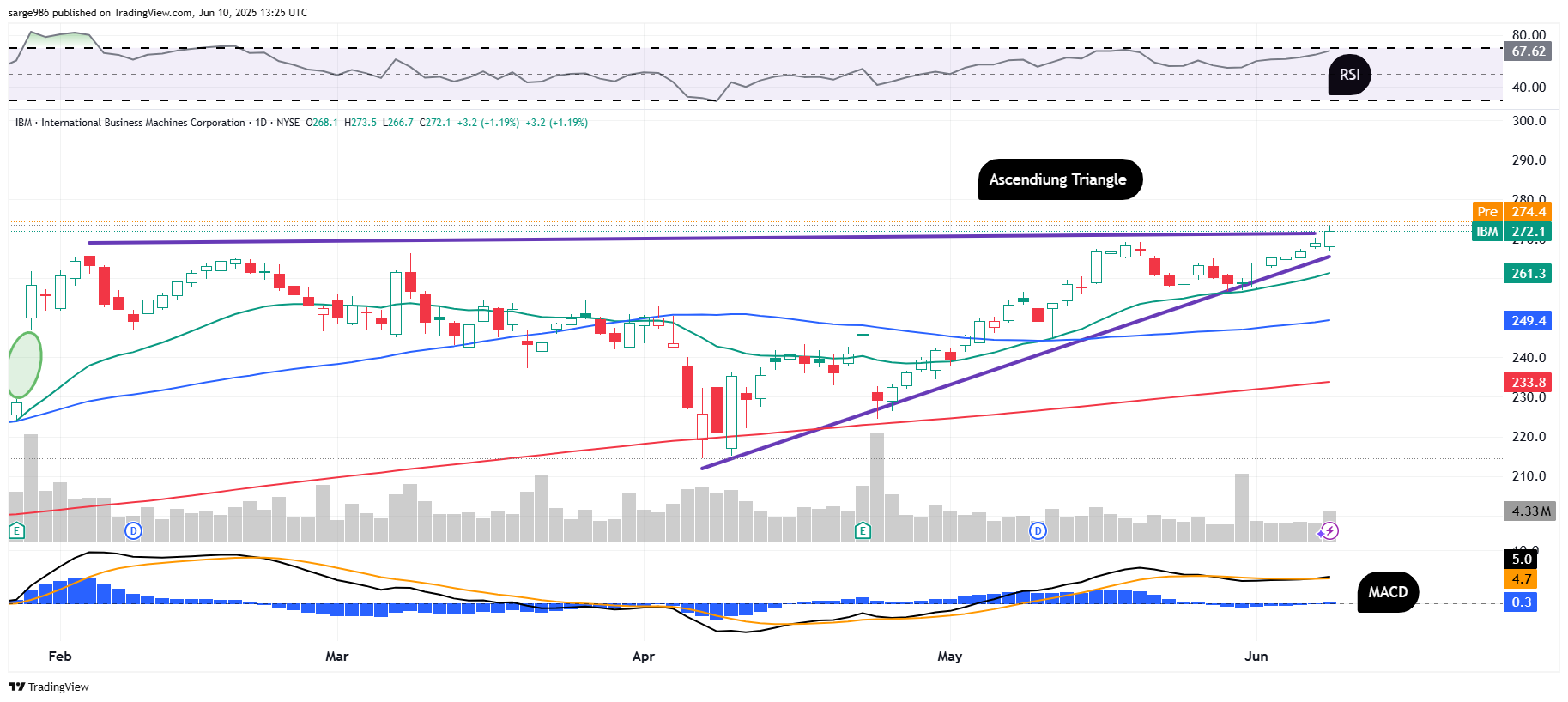
In the chart, above, you will see an almost textbook example of an Ascending Triangle pattern. This one comes with a $271 pivot, which has been the line of resistance throughout. Readers will also see that Relative Strength is quite robust, but not technically overbought.
The stock has taken its 200-day and 50-day simple moving averages (SMAs) and its 21-day exponential moving average (EMA). That largely gets both portfolio managers and swing traders on board.
Now, we see the daily moving average convergence/divergence (MACD) below the chart. The histogram of the 9-day EMA has just returned to positive territory (short-term bullish), as the 12-day EMA has overtaken the 26-day EMA (medium-term bullish). Should the stock successfully take and hold that pivot point, I see no technical reason why this stock cannot reach a price range starting at $310 and stretching as far as $325.
Do I think IBM deserves a spot in the Sarge-folio? If it takes and holds that pivot. Otherwise, we wait.
At the time of publication, Guilfoyle had no positions in any securities mentioned.