Why the Best Investors Eat Their Own Cooking — and Know Their Ingredients
Understanding what’s under the hood matters more than ever in an AI‑driven market. Plus, how I'm rethinking fixed income with liquid alternatives.
You've reached your free article limit
You've read 0 of 1 free Pro articles.
 Looking Under the Hood
I was on the phone the other day with an investment professional who leads an investment team at a registered investment advisory firm. We were discussing private credit, private equity, and the risks embedded in those markets right now.
The conversation turned to various asset classes, and he pulled up a technical graph on his Bloomberg terminal that included a regression analysis. He pointed to a specific number that didn’t make sense and asked how I would interpret it.
I replied honestly: “I don’t know.” Without understanding the exact methodology behind the graph, any interpretation would be guesswork. When I asked about the methodology, he didn’t know either — it was just a standard Bloomberg output. Bloomberg provides excellent tools, but even the best platforms require scrutiny.
I told him that if I don’t know how something is built, I can’t fully trust the output. I prefer to “eat my own cooking” and know the ingredients in my recipe. I use that analogy often. He paused and said, “That makes sense.”
Question Everything Under the Hood
This principle feels more important than ever in today’s world of artificial intelligence. With AI tools accessible to everyone at varying levels of expertise, bad or misleading answers are common.
On another call with wealth managers, one advisor demonstrated how he was using Claude to query investment markets. He showed his prompting style and the resulting calculators and portfolio outputs. As the conversation progressed, it became clear that many users were asking sophisticated-sounding questions without fully understanding what was happening “under the hood.”
AI Speeds Things Up — But Hides Risks
A separate conversation with a client at a major tech firm reinforced this point. His company was an early heavy investor in AI and serves global giants. He observed that many younger employees were relying so heavily on AI for solutions that they were forgetting how to think critically.
As fellow Gen Xers, we reflected on how our generation had to learn models intimately — making mistakes along the way — to truly grasp the logic and potential pitfalls. Smart young people abound, but over-reliance without deep understanding is risky.
This dynamic applies directly to investing. Some now treat AI models as an all-in-one solution. Don’t get me wrong — AI is a powerful tool that belongs in every analyst’s, portfolio manager’s, and wealth manager’s toolkit. It delivers unmatched speed and the ability to process vast amounts of information. Yet it should never replace understanding what’s underneath.
Mental Models, Guesses and Bets
A podcast with Dan Sullivan, founder of Strategic Coach, highlighted how real relationships are gaining importance. At the same time, my tech client noted that AI accelerates output but can introduce errors or flawed code if you don’t understand the details. In investing, the same rule applies: you must know what’s under the hood. Eating your own cooking — understanding your ingredients — is essential.
I’m fully in favor of using AI. Dan Kennedy’s insight resonates here: with the right AI support, individuals can achieve exponential impact by multiplying productivity and output quality.
For me, AI now helps me think about my thinking. I use it to explore different mental models, synthesize relationships between them, and get closer to truth on any topic I’m studying. I always probe for details on how models are built and the relationships within them.
Mental models have been central to my process for years, particularly in macro analysis. They help form hypotheses about the present and future.
As Dan Sullivan notes, life — and especially investing — involves guesses and bets. We make informed guesses based on models and reasoning, then place bets on them (including the bet of doing nothing). The goal is to develop the best possible models, take action, and focus on what truly moves the needle.
Rethinking Fixed Income — Time for Alternatives
In a recent discussion with that same investment professional, we analyzed fixed income adjustments — reducing long-term rate exposure, shifting credit quality, and so on. Those were valid tactical questions, but my mental models suggested they weren’t the most important one. The bigger strategic question: Should we reduce traditional fixed income overall and reallocate to alternatives?
Based on my recent work, I’m shifting more capital — in both the portfolios I manage and my personal accounts — out of traditional fixed income and into liquid alternative strategies. These include alternative equity, alternative fixed income, and absolute return approaches.
Regulations have loosened, enabling more ETFs to use leverage and access instruments that deliver truly non-correlated exposure. Institutions have used these strategies for decades; they are now far more accessible to individual investors.
A Simple Three-Sleeve Framework
To build a practical framework, I ran cluster analysis on liquid alternative ETFs, seeking low correlations (nothing above 0.7) to both stocks and fixed income. Options were limited, but a clean three-sleeve structure emerged as a strong starting point for improving returns per unit of risk:
- Alternative equity sleeve
- Alternative fixed income sleeve
- Absolute return sleeve
Market timing is another alternative approach, but I prefer diversifying strategies for a smoother ride rather than going all-in on timing.
Why Systematic Trend Following Belongs in Portfolios
One sleeve I’m particularly focused on is systematic trend following (also called CTA or managed futures). I’ve been deeply involved with this space for years.
The strategy follows prevailing trends across global assets — stocks, bonds/interest rates, currencies, and commodities. Positions are sized according to risk, and it can go long or short, allowing profits in both rising and falling markets. It is broadly diversified and non-correlated.
See the chart below. This is a year-to-date performance chart for the S&P 500 compared to iMGP DBi Managed Futures Strategy ETF (DBMF) and Simplify Managed Futures Strategy ETF (CTA) . The market is weaker and notice how these funds have perked up with CTA up 12.77% and DBMF 8.02% higher.
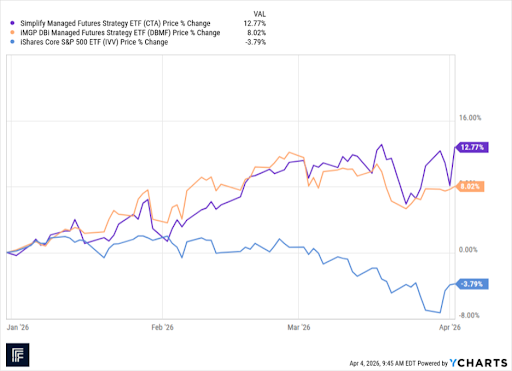
Historically, systematic trend strategies have delivered positive expected returns with a “lumpy” profile — periods of quiet followed by strong moves. Their real beauty is crisis diversification: they often shine when stocks struggle and volatility spikes. They can also perform well even when equities are rising, making them genuinely non-correlated when implemented correctly.
Two ETFs I’m Using: CTA and DBMF
Two ETFs I’ve incorporated — and continue to add to — in portfolios are:
- CTA (Simplify Managed Futures Strategy ETF): A direct systematic trend-following approach using futures.
- DBMF (iMGP DBi Managed Futures Strategy ETF): A replication strategy that aims to match the aggregate performance of major CTAs.
Blending them creates a more robust implementation. Adding even a modest allocation of these to traditional stock/bond portfolios has historically improved risk-adjusted returns — especially valuable after long equity bull markets that lull investors into complacency about downside risk.
Learning the Guitar Setup — The Same Principle Applies
This philosophy came alive recently in a non-investing context. I bought a used Gibson Les Paul Special — a first-run model with the P-90 pickups I specifically wanted for the tone of a song I’m writing and recording. I knew exactly the “ingredient” I was after, just as I know what I’m seeking in CTA strategies.

The guitar arrived unplayable: high action, bowed neck, strings way too high — completely out of spec. It had sat unused, possibly affected by climate shifts. My first instinct was a refund. Normally, I’d send it to a pro for setup. But I’d just moved to Austin, wait times were long, and a guitarist friend (who happens to be a portfolio manager) encouraged me: “Learn it yourself on YouTube.”
I dove in — watching pros who set up guitars for top artists, noting tools, sequence, techniques, and pitfalls. Setup is iterative and circular; you tweak, test, and repeat. After a couple of hours, it improved. I kept refining, and now it plays beautifully and delivers exactly the sound I need.
The parallel to investing (and AI) is clear: Sometimes “eating your own cooking” means going under the hood and learning something new yourself. Understanding doesn’t require doing everything personally — you should delegate what isn’t in your unique ability. But when something sits in your zone of genius, enjoyment, or high payoff, pause and invest the time to truly know the ingredients. Don’t blindly follow AI outputs or any black-box recommendation.
Bottom Line
Eating your own cooking and knowing your ingredients is not about rejecting technology or doing everything yourself. It’s about staying curious, asking the right questions, and understanding what’s under the hood — whether it’s an AI model, a Bloomberg graph, a fixed-income allocation, or a guitar setup.
In today’s environment, moving some capital from traditional fixed income into liquid alternatives — including a thoughtful allocation to systematic trend strategies like CTA and DBMF — can improve portfolio diversification and risk-adjusted returns. The key is to do it with eyes wide open, using tools like AI to enhance your thinking rather than replace it.
Delegate what you must, but never outsource your own understanding — especially on the things that matter most to your financial future. Learn the ingredients. Taste your own cooking. That’s how you build confidence and better outcomes as an investor.
I hope this sparks ideas for how you think about markets or construct your portfolio. I’d love to hear your processes and what works for you. Comment below, follow me on TheStreet Pro, and join me as I restart video content this year.
Happy trading and investing.