Why I Added to Nvidia, Even Without the 'Wow' Factor
The company hit a home run, but is being held back by a case of '90s-era Yankees syndrome: Nothing outside of the incredible is going to be good enough.
You've reached your free article limit
You've read 0 of 1 free Pro articles.
It was the event that we had all been waiting for. The reaction, as I mentioned in Market Recon this morning, seems kind of muted. Nvidia NVDA released its fiscal second financial results on Wednesday evening. The shares sold off, but not significantly so, overnight. As also mentioned in this morning's early column, I have added to my long position in NVDA in between that piece and this one. I also added to my long position in Nvidia rival Advanced Micro Devices AMD, which was trading lower in sympathy with the big dog.
Nvidia posted an adjusted earnings per share of $1.05 (unadjusted EPS was $1.08) on revenue of $46.743 billion (+55.6% y/y). These top- and bottom-line results all beat Wall Street's consensus view, but admittedly not to the magnitude that investors have become accustomed to since the advent of greatly increased AI-related capital spending a couple of years back. The guidance provided by the firm can be looked at this way as well. Solid, even better than officially expected, but not enough to just "wow" the folks who move money around. The three cents per share worth of adjustments were made due to a (relatively) small stock-based compensation expense.
Operations
As revenue grew 55.6% to $46.743 billion, the cost of that revenue increased 72.7% to $12.89 billion. That left a gross profit of $33.853 billion (+50%) on a gross margin that fell to 72.4% from 75.1% (but was up sequentially from the fiscal first quarter). Total unadjusted operating expenses grew 37.7% to $5.413 billion, leaving unadjusted operating income of $28.44 billion (+52.6%). On an adjusted basis, operating income printed at $30.165 billion (+51%).
After accounting for interest, other income & expenses and taxes, unadjusted net income landed at $26.422 billion (+59.2%). This works out to $1.08 per fully diluted share, up from $0.67 for the year ago comparison. After adjustments, net income prints at $25.783 billion (+52%), which works out to $1.05 per fully diluted share. That compares to $0.81 for the year ago period.
On Demand
“Blackwell is the AI platform the world has been waiting for, delivering an exceptional generational leap — production of Blackwell Ultra is ramping at full speed, and demand is extraordinary," said founder and CEO Jensen Huang on the the release. "NVIDIA NVLink rack-scale computing is revolutionary, arriving just in time as reasoning AI models drive orders-of-magnitude increases in training and inference performance. The AI race is on, and Blackwell is the platform at its center.”
Sector Sales Performance
Data Center generated revenue of $41.096 billion (+56.4%), which fell just short of expectations.
Gaming generated revenue of $4.287 billion (+48.9%), which easily beat expectations.
Professional Visualization generated revenue of $601 million (+32.4%), beating expectations.
Automotive generated revenue of $586 million (+69.3%), beating expectations.
OEM & Other generated revenue of $173 million (+96.6%), easily beating expectations.
On Development and Total Cost of Ownership
Driving demand for the Blackwell GB300, which is already in production over the GB200, is the increased efficiency. CFO Colette Kress mentioned during the call that "The GB200 NVL system is seeing widespread adoption with deployments at CSPs and consumer Internet companies. Lighthouse model builders, including OpenAI, Meta and Mistral are using the GB200 NVL72 at data center scale for both training, next-generation models and serving inference models in production."
On the newer chip systems, Kress said, "We expect widespread market availability in the second half of the year as CoreWeave prepares to bring their GB300 instance to market as they are already seeing 10x more inference performance on reasoning models compared to H100. Compared to the previous Hopper generation, GB300 NVL72 AI factories promise a 10x improvement in token per watt energy efficiency, which translates to revenues as data centers are power limited."
Looking ahead to calendar year 2026, Kress added, "The chips of the Rubin platform are in fab, the Vera CPU, Rubin GPU, CX9 SuperNIC, NVLink 144 scale up switch, Spectrum-X scale out and scale across switch, and the silicon photonics processor. Rubin remains on schedule for volume production next year. Rubin will be our third-generation NVLink rack scale AI supercomputer with a mature and full-scale supply chain. This keeps us on track with our pace of an annual product cadence and continuous innovation across compute, networking, systems and software."
On China
It is key to note that there were no H20 sales to China or China-based customers during the fiscal second quarter and the company has assumed that there will be no China-driven revenue during the current quarter in its guidance. Therefore, that guidance is intentionally conservative. We do know that some Chinese customers have already received licenses from the U.S. government to purchase H20 chips from Nvidia. We do not know if those chips will get to market during the current quarter and we do not know how the government's plan to take a 15% cut in revenues produced from Chinese clients will work.
Fundamentals
During the quarter reported, Nvidia generated operating cash flow of $15.365 (+6.1%). Out of that number came capital spending of $1.894 billion and principal payments (of various sorts) of $21 million. That left free cash flow of $13.45 billion (down a smidgen).
Looking over the balance sheet, we see that Nvidia ended the quarter with a cash position of $56.791 billion (which is up more than $13 billion over six months) and inventories of $14.962 billion. That puts current assets at $102.219 billion. Current liabilities add up to $24.257 billion. There is no short-term debt on the books. This leaves the firm with current and quick ratios of 4.21 and 3.59 respectively, which is excellent.
Total assets amount to $140.74 billion of which less than 5% is labeled as either goodwill or other intangibles. That's spectacular. Total liabilities less equity comes to $40.609 billion. This does include long-term debt of $8.446 billion, which is something Nvidia could take care of out of pocket almost seven times over. This balance sheet is fortress-like.
Guidance
For the current quarter, Nvidia is projecting revenue of $54 billion, give or take 2%, again, assuming so sales of H20 chips to Chinese clientele. This is considerably better than the $52.75 billion that Wall Street had in mind. The firm also sees GAAP and adjusted gross margin at 73.3% and 73.5% respectively. Adjusted gross margin is expected to end the full year in the mid-70% range.
Wall Street
I have come across 16 highly rated sell-side analysts who have opined on NVDA since last night. By highly rated, I mean four or five stars out of five at TipRanks. Of the 16, all but one reiterated "buy" or buy-equivalent ratings and that one reiterated a "hold" rating. There have been ten changes in target prices across those 16analysts and all ten were to the upside. One analyst didn't set a target price. The average target price among those 15 analysts who did set one stands at $214.87 with a high of $235 (twice) and a low of $195.
My Thoughts
This was an undeniably strong quarter, and the company provided undeniably strong guidance ... for anyone else. The Yankees used to expect to win the World Series every year. Nvidia is the stock market's version of the Yankees of the late 1990s. Nothing outside of the incredible is going to be good enough.
That said, cash flows are strong. The balance sheet is excellent. That guidance is likely conservative. The stock trades at 41-times forward looking earnings, but in defense of that valuation, Nvidia is still a growth stock. Sure, gross margins are under some pressure. That's because the next chapter of this AI-infrastructure story is always being written. I added to my long position this morning. I told you that. The stock is now one of my top 15 holdings for the first time in a good while.
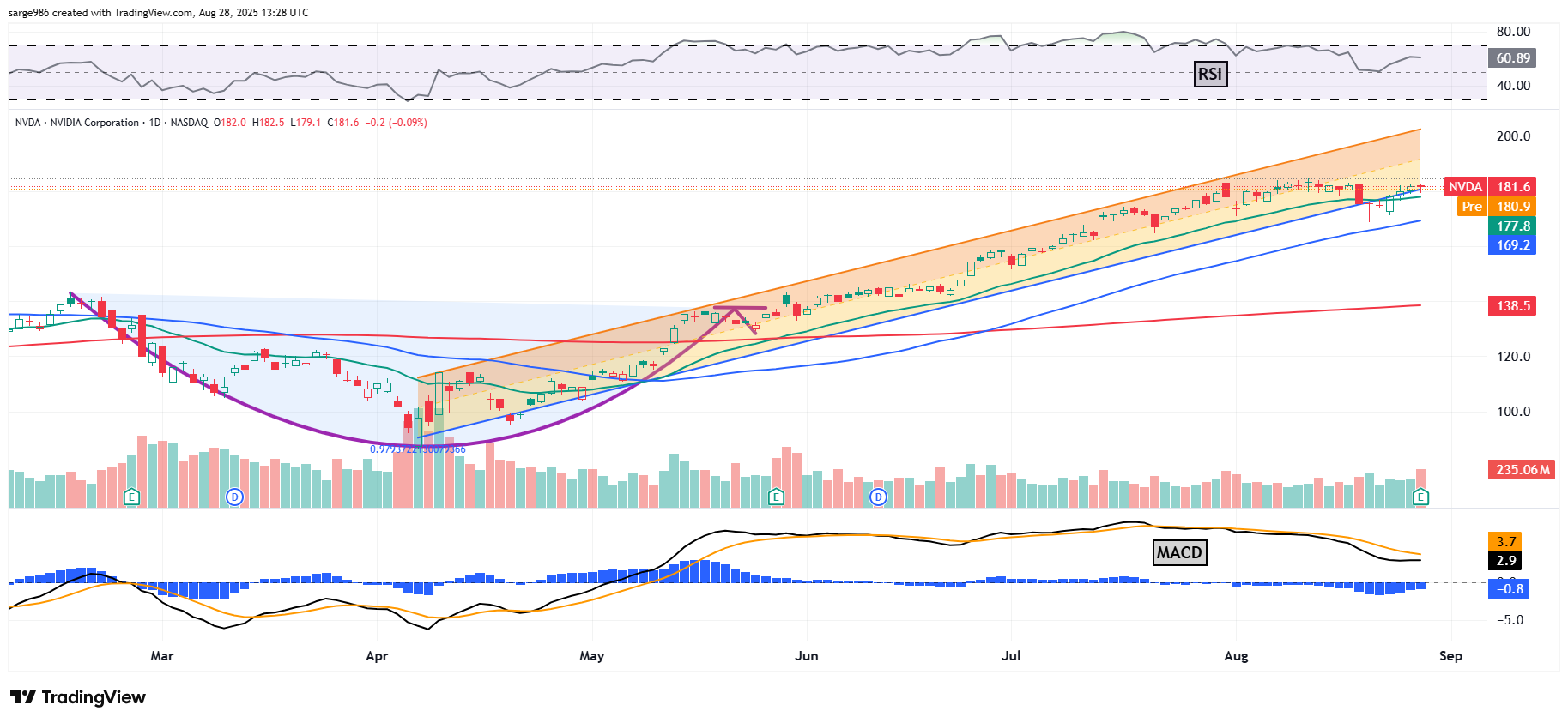
Readers will see that NVDA is fighting to regain the lower trendline of our Raff Regression model this morning after funding support at its 21-day exponential moving average. This uptrend has been in place since the stock broke out of that Cup with Hand pattern back in May. It appears that overnight institutional buyers may have defended the 50-day simple moving average, which would be huge. That means we know where the cavalry is.
Relative Strength is solid without being technically overbought. The daily Moving Average Convergence Divergence is not yet healthy. but appears to be headed that way. The histogram of the 9-day Exponential Moving Average is approaching positive territory as the 12-day EMA approaches the 26-day EMA from the underside. Our upside pivot is the recent high.
Nvidia Strategy
Target Price: $212
Pivot: $184 (recent high)
Add: Down to the 50-day SMA
Panic: Loss of the 200-day SMA.
At the time of publication, Guilfoyle was long NVDA, AMD equity.