Where to Buy the HIMS Dip After FDA Crackdown
Is there a play on the healthcare firm following some issues with Novo Nordisk?
You've reached your free article limit
You've read 0 of 1 free Pro articles.
Bad news piled upon bad news. On Friday, Hims & Hers Health (HIMS) closed in the red. That was the sixth consecutive day that the stock closed lower. At $23.02, the shares closed down 64.8% from its semi-recent high in October. This also happened to be down 68.5% from the stock's 2025 high. Why? Good question.
Food and Drug Administration (FDA) Commissioner Marty Makary announced that the agency will be taking swift action against companies that are "mass-marketing illegal copycat drugs." The remarks came after Hims & Hers had rolled out a reduced cost version of Danish pharmaceutical giant Novo Nordisk's (NVO) weight-loss therapy "semaglutide."
The branded product is a newly launched oral version of Novo's Wegovy therapeutic. The compounded Hims version would sell for a rough $100 discount to the Novo version. Novo's Wegovy pills retail for about $149 per pill. Novo has said that the firm will take legal and regulatory action against HIMS. Makary posted to X (formerly Twitter) at the time, “The FDA cannot verify the quality, safety, or effectiveness of non-approved drugs.”
News on Saturday
Following that announcement and the legal pressure applied by Novo Nordisk, Hims & Hers announced that the firm would no longer offer their compounded version of the above drug.
Hims posted to the firm's account at X, "Since launching the compounded semaglutide pill on our platform, we’ve had constructive conversations with stakeholders across the industry. As a result, we have decided to stop offering access to this treatment."
Needless to say, Novo Nordick traded sharply higher in Europe on Monday morning. HIMS is trading with a $17 handle ahead of the U.S. open.
'Hey Sarge....'
Uhm, Sarge, I heard of generic meds. What is a compounded drug? This is the deal, sports fans.
Compounded drugs are more affordable and more accessible than brand-name drugs. A prescription is still required. The difference is that while active ingredients are FDA-approved and sourced similarly, there are differences in the ultimate, mixed product that changes hands at the point of sale.
Generic drugs are fully approved by the FDA in their final mix and must prove identical results for efficacy and safety relative to the brand name product. They are manufactured in regulated facilities. Compounded drugs are not only not approved by the FDA in the final mix but are not tested for any bioequivalence to the brand-name product and potency can vary. Many compounded drugs are regulated to some degree, but at the state level.
Earnings
HIMS will report the firm's fiscal fourth quarter financial results in about two weeks. Remember, HIMS disappointed investors for its third quarter. Wall Street is looking for a GAAP of $0.05 on revenue of $619.5 million. That top-line number would be good for year-over-year growth of almost 29%, which is not bad, but the bottom-line print would compare poorly to the $0.11 that hit the tape for the same period a year ago.
Investors should be fully cognizant that, in the past week, Jonna Kim at TD Cowen, Allen Lutz at Bank of America and Daniel Grosslight of Citigroup, all rated at three or more stars (out of five) by TipRanks, have significantly cut their target prices for this stock, while Lutz and Grosslight both reiterated outright "sell" recommendations.
Fundamentals
For the firm's third quarter, which ended in September, HIMS generated operating cash flow of $148.7 million. Out of that number came capex spending of $65.3 million, leaving free cash flow of $83.4 million. Out of that number, the firm repurchased $42 million worth of common stock for the corporate treasury. HIMS does not return capital to shareholders in the form of cash dividends. This is not as sloppy as I thought it might be coming in. Never judge a book...
Turning to the balance sheet, HIMS ended September with a cash position of $629.7 million, inventories of $106 million (which a portion of may now be worthless) and current assets of $845.3 million. Current liabilities added up to $450.8 million. This included $118.5 million in unearned revenue and no shorter-term debt. Remember, unearned revenue is not a true financial obligation unless the firm is unable to provide the goods or services sold. I have no idea if any or what portion of these unearned revenues are tied to the drug now in question.
This puts the firm's headline current and quick ratios at 1.88 and 1.64, which is healthy. If we do adjust for those unearned revenues, these ratios rise to 2.54 and 2.22 in that order. The short of it is that HIMS should have no problem meeting the firm's short- to medium-term financial obligations.
Total assets amounted to $2.233 billion, which includes a negligible percentage labeled as anything resembling an intangible. I do appreciate that. Total liabilities less equity came to $1.652 billion. This does include long-term debt of $971 million, which is why this balance sheet, though it does pass muster, does not pass the Sarge test with an "A" or "A+," but more of a "B-." Let's go to the chart.
The Chart
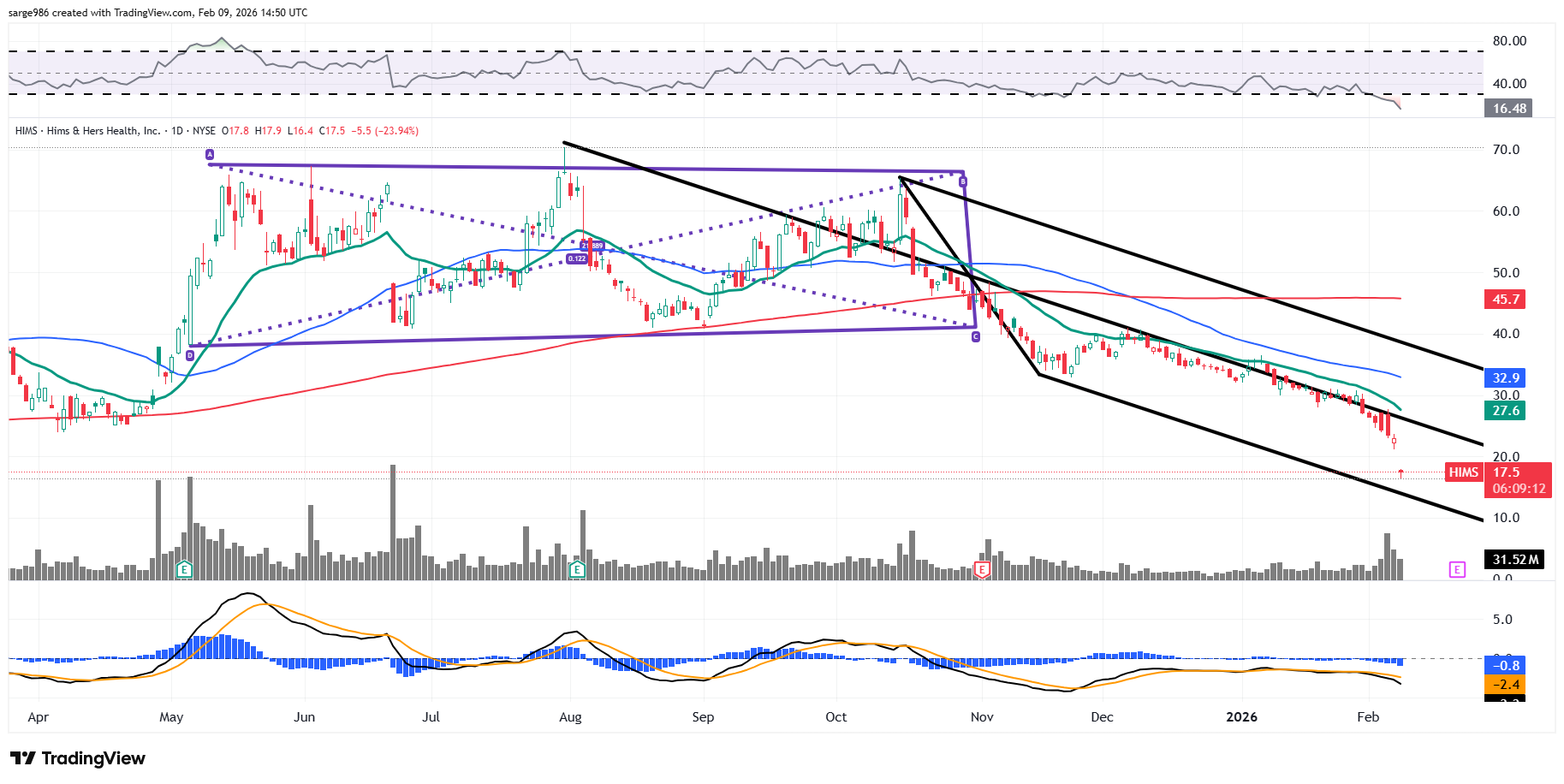
Readers will see that HIMS broke down from a basing period of consolidation that ran from early May into late October. That is when the shares fell out of bed. I have applied an Andrews' pitchfork model to the stock (which the algorithms can see).
It appears that the central trendline of the pitchfork model has provided resistance (meaning that's where the sellers are). The shares may find support at the lower trendline which, in plain English, means that I would not be interested in buying this stock at this price but might close to the $14 level.
Above the chart, the reading for relative strength is in worse shape than Oliver Hardy in his prime. Below the chart, the daily MACD looks like it barely survived a train wreck with all three components in negative territory. My thoughts? I'd rather sell a February 27 $15 put for about $1.20 than lay out $17 and change for the quality on this dip.
At the time of publication, Guilfoyle had no positions in any securities mentioned.