Where to Buy IBM as Rally Drives New Price Target
The legacy tech firm announced an AI collaboration that has sent the shares higher.
You've reached your free article limit
You've read 0 of 1 free Pro articles.
Yes, I know. The shares of International Business Machines (IBM) are already up 28.6% from their mid-August low. I have written that, of all the legacy tech companies that I saw, IBM is the most likely to compete in or buy its way into the race for quantum computing supremacy. IBM is already a player, not a leader, but a player in the AI space. On that note, there is news.
On Tuesday morning, IBM and Anthropic announced that the two firms are collaborating to integrate Anthropic's family of large language models, known as "Claude" into select IBM software products.
First up will be IBM's new AI-first integrated development environment, known as IDE for short. IDE is designed with advanced task generation capabilities for commercial software development lifecycles. Hmm, that was a mouthful. This will become vital to IBM clientele as it becomes necessary for those customers to modernize their software platforms.
Anthropic is backed by both Amazon (AMZN) and Alphabet's (GOOGL) Google. The IDE environment is currently available to select IBM customers testing the service in a private preview. Over 6,000 early adopters are involved at this time. On the matter, Dinesh Nirmal, who is a senior vice president of software at IBM, said, "This partnership enhances our software portfolio with advanced AI capabilities while maintaining the governance, security and reliability that our clients have come to expect. We're giving development teams AI that fits how enterprises work, not experimental tools that create new risks."
Earnings
IBM is set to report in two weeks. Wall Street is expecting for the third quarter, an adjusted EPS of $2.44 on revenue of $16.1 billion. This would compare well to the year-ago comp of $2.30 on sales growth of roughly 7.6%. Of the 15 sell-side analysts that I know of who cover IBM, seven have reduced their earnings estimates since the start of the quarter, while four have increased those estimates and four have left their estimates unrevised. The stock trades at 24-times forward-looking earnings, 46-times trailing earnings and less than 2% of the entire float is held in short positions.
The Conundrum
I am going to ask you, the readers, because I am not sure of what I am looking at:
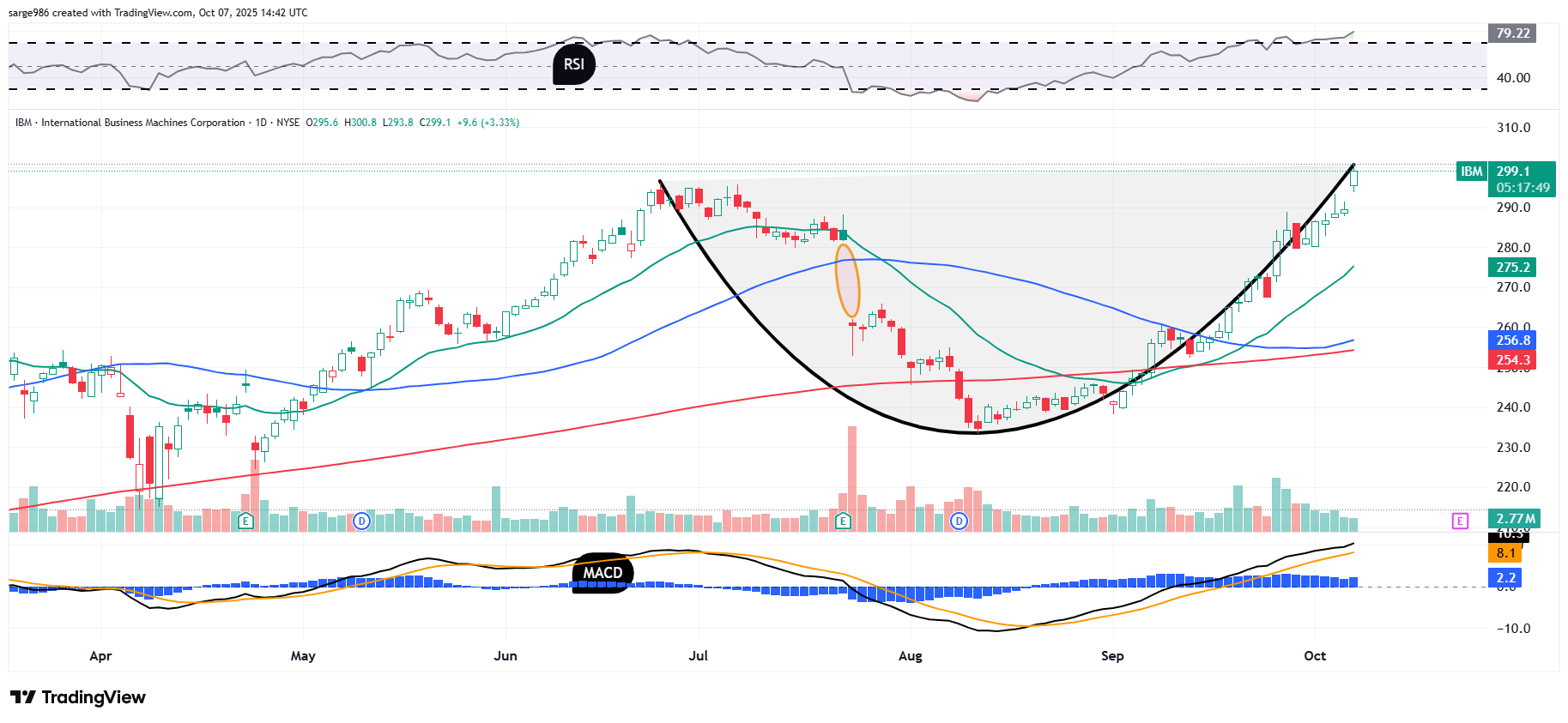
A "cup" pattern is a bullish technical pattern. The pivot, without a handle, is the left side apex of the cup. That's $296 for those of you who cannot see that well. That pivot is in the process of being triggered by Tuesday morning's rally. That would put my target price in the high $350s. Now, check this out:
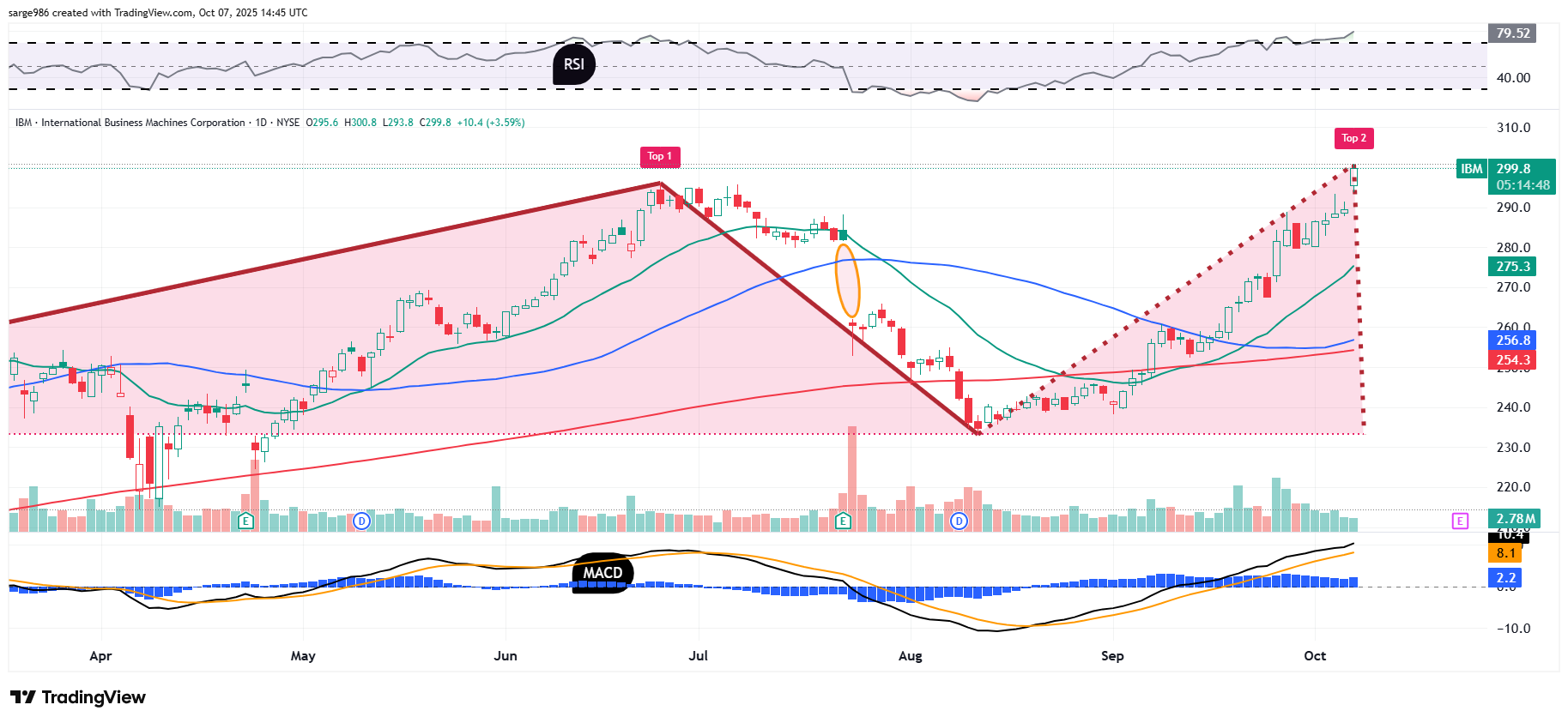
What if this is really a large double top pattern of bearish reversal? This one has a pivot way down at $233 and a downside target even lower than that. So, what to do? What to look at? The indicators are extremely bullish.
Relative strength is so robust that it has been in technically overbought territory since late September. The daily MACD is postured in an aggressively bullish fashion. The histogram of the nine-day EMA has been in positive territory since mid-August. The 12-day EMA is riding above the 26-day EMA (since mid-August) with both of those lines in positive territory (since mid-October).
It really does not get all that much more bullish than that. We cannot discount the possibility that the potential double-top pattern will assert itself and if the cup pattern adds a handle, we may not know the difference right away.
My Idea (Minimal Lots)
With earning due on October 22, this is my idea:
- Purchase 100 shares of IBM at or close to $300.50
- Sell one October 24 $315 call for about $6.90
- Purchase one October 24 $275 put for roughly $3.00
- Net Basis: $296.60
Notes: The trader in this example is taking on an equity stake and selling a covered call (a buy-write) to reduce net basis. The trader then uses a portion of the premium raised to purchase downside protection just in case the worst happens. The trader is fine with either option being exercised and seeing the equity position go forward. Should the shares be called away, the trader would experience a 6.2% profit. Should the trader have to put the shares to some other trader, this trader would suffer a loss of 7.3%.
At the time of publication, Guilfoyle was long GOOGL equity.