Where to Buy Carnival After Disappointing Report
Here's a trade idea for the cruise line.
You've reached your free article limit
You've read 0 of 1 free Pro articles.
I've been trying to plan a late Autumn vacation. I was considering Las Vegas, but I've recently heard mixed reviews about how crowded or not crowded the city of sin has been of late. Then, I see Carnival (CCL) earnings cross the tape.
I haven't been on a pleasure cruise in about 40 years. Was that a sign? No idea, but something to play out in my head. In the meantime, let's take a look at what Carnival is telling us.
For the firm's fiscal third quarter, which ended August 31, Carnival posted an adjusted EPS of $1.43 (GAAP EPS: $1.33) on revenue of $8.153 billion. The revenue print was a record high for the firm. In fact, it was the tenth consecutive quarter that the firm set a record high. Net income and adjusted net income also achieved record highs.
The firm announced that cumulative advanced booked positions for 2026 are strong and in line with 2025 levels which are obviously running at record highs, not to mention historically elevated prices. The firm also informed the public that during the quarter, Carnival had financed $4.5 billion worth of debt, which simplified the firm's capital structure and prepaid roughly $0.7 billion worth of additional debt.
Operations
For the period reported, total revenue increased 3.3% to $8.153 billion. Within that number, ticket sales were up 3.7% to $5.43 billion and onboard revenues grew 2.5% to $2.723 billion. Total cruise operating expenses including fuel and food increased 1.9% to $4.385 billion. After factoring in administrative costs as well as amortization and depreciation, GAAP operating income printed at $2.271 billion (+4.3%).
After accounting for interest, other income and expenses and taxes, GAAP net income landed at $1.852 billion (+6.7%). This works out to $1.33 per fully diluted share. Once adjusted, net income printed at $1.982 billion (+13.2%), which works out to $1.43 per fully diluted share. Adjustments were made primarily for costs associated with debt extinguishment and modification.
Guidance
For the current quarter, Carnival is projecting adjusted cruise costs excluding fuel to grow 5.5% year over year in current dollars or 3.2% in constant currency. Adjusted EBITDA is seen around $1.34 billion while adjusted net income is seen at roughly $300 million. This should lead to an approximate adjusted EPS of $0.23, which would compare to the year ago comp of $0.14 and is better than the $0.21 that Wall Street was looking for.
For the full fiscal year, Carnival is predicting adjusted cruise costs excluding fuel to grow 4.4% year over year in current dollars or 3.3% in constant currency. Adjusted EBITDA is seen around $7.05 billion while adjusted net income is seen at roughly $2.925 billion. This would lead to an approximate adjusted EPS of $2.14, which would compare well to the year ago comp of $1.42, but fell two pennies short of what Wall Street was looking for. That's why the stock struggled as the markets generally opened higher.
Fundamentals
I did not see a statement of cash flows in the material, but from the information provided, it looks like operating cash flow for the period printed at $1.383 billion (+14.8%) as capex spending grew 21.1% to $648 million. This would leave free cash flow of $735 million, up from the year ago comp of $627 million.
Moving on to the balance sheet, the firm ended the quarter with a cash position of $1.763 billion and inventories of $473 million. That put current assets at $3.868 billion. Current liabilities stand at $11.436 billion including $1.417 billion in debt maturing within 12 months and $6.691 billion in customer deposits which is another way to say, "deferred revenues."
At the headline, the firm's current and quick ratios are rather awful looking at 0.34 and 0.29. Once adjusting for those deferred revenues, these ratios improve significantly, but not enough to make one feel good about the balance sheet. The adjusted current and quick ratios stand at 0.82 and 0.72. Not pretty.
Total assets amount to $50.831 billion including an inconsequential amount for goodwill and other intangibles. Total liabilities less equity comes to $38.903 billion including a terrifying $25.064 billion in long-term debt. I get that management is working on this balance sheet, so I am not going to just bash it, but CCL is a long, long, long way from having a quality balance sheet — a long, long way.
My Thoughts
The business is doing well. That we can see. Guidance is solid. The balance sheet will take time and that is a deterrent to investing in this name. That said, the stick trades at 15-times forward looking earnings when the S&P 500 is trading at 22.5 times, so Wall Street is valuing the stock appropriately.
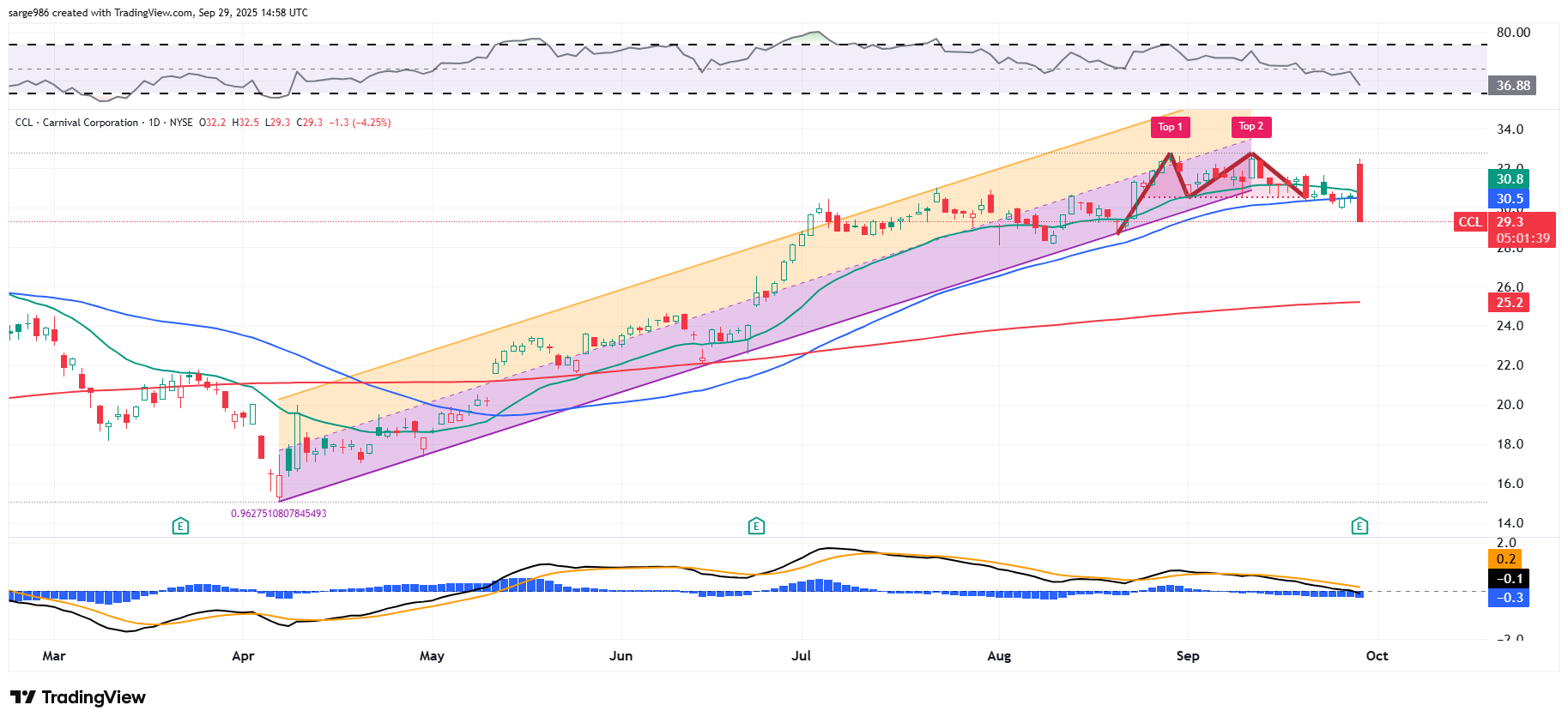
Carnival broke down from a six month upward sloping trend in September with a double-top pattern of bearish reversal with a $31 pivot. That would put the downside target close to the $26 level. On Monday morning, the stock gave up its 21-day EMA, which cost it the swing crowd and its 50-day SMA, which forced some portfolio managers to reduce long-side exposure.
The plan here for investors is to try to buy the shares close to the 200-day SMA, which is just above $25 at present. Not only is that where the professional crowd will get their next chance to defend the stock, that's pretty close to the target that I just gave you.
For those that do not want to watch the stock 24/7, January 16 $26 puts can be sold (written) for about $1.20. If the stock never gets there, the trader pockets the premium. If it does, the trader will own the shares at a net basis of $24.80 with the equity trading below $26 per share.
At the time of publication, Guilfoyle had no positions in any securities mentioned.