Walmart Moves in Wrong Direction as Bulls Face Major Test
The retail giant went to the tape and it's clear that the CFO needs to do better.
You've reached your free article limit
You've read 0 of 1 free Pro articles.
On Thursday morning, America's largest retailer by sales went to the tape with its fiscal second quarter financial results.
For the three-month period ended July 31, Walmart WMT posted an adjusted EPS of $0.68 (GAAP EPS: $0.88) on revenue of $177.402 billion. While the top-line result beat Wall Street and was good enough for 4.8% year-over-year growth, the adjusted bottom-line number disappointed.
Interestingly, while the adjusted EPS print missed by six cents, the GAAP EPS print actually crushed expectations (by about $0.15) as the firm apparently dealt with some one-time expenses, insurance claims and litigation settlements that were difficult for sell-side analysts to project ahead of the release.
In an early morning interview at CNBC, CFO John David Rainey talked about managing the impacts of tariffs on imported goods and trying to keep prices low for consumers on a budget.
Rainey said, “This is managed on an item-by-item and category-by-category basis. There are certainly areas where we have fully absorbed the impact of higher tariff costs. There are other areas where we’ve had to pass some of those costs along.”
Rainey did add ominously that, “Tariff-impacted costs are continuing to drift upwards.”
Impressively, Walmart U.S. comp sales were up 4.6% year over year with strong growth experienced across the grocery and health and wellness categories. E-commerce sales in the U.S. were up 26%. This compares very well to arch rival Target TGT, where comp sales were -1.9% and digital sales were up 4.3%.
Operations
As revenue generation grew 4.8% to $177.402 billion, the cost of those sales increased 4.7% to $132.771 billion, while operating expenses popped 8% to $37.345 billion. This left a GAAP operating income of $7.286 billion (-8.2%). This took the firm's GAAP operating margin down to 4.1% from 4.7%.
After accounting for interest, other income and expenses and taxes, GAAP net income attributable to shareholders hit the tape at $7.026 billion (+50%). Yes, that number is up 50% as "other" gains and losses swing from a loss of $1.162 billion to a gain of $2.708 billion. This works out to a GAAP EPS of $0.88, up from the year-ago comp of $0.56.
After adjusting for those huge gains that were slightly offset by certain legal costs and some small reorganization charges, adjusted EPS lands at $0.68, up a penny versus last year's $0.67.
Segment Performance
- Walmart U.S. generated sales of $120.911 billion (+4.8%), which produced an operating income of $6.72 billion (+2%)
- Walmart International generated sales of $31.201 billion (+5.5%), which produced an operating income of $1.227 billion (-9.8%)
- Sam's Club U.S. generated sales of $23.638 billion (+3.4%), which produced an adjusted operating income of $569 million (-2.1%).
Guidance
For the current quarter, Walmart is projecting net sales growth of 3.75% to 4.75%, which includes a 20 basis-point tailwind from the acquisition of Vizio. Operating income is seen growing 3% to 6%, which will include a 140 basis-point headwind from that same acquisition. Adjusted EPS is seen at $0.58 to $0.60. This takes the low end of the range above the $0.57 that Wall Street was looking for.
For the whole fiscal year, Walmart is now projecting sales growth of 3.75% to 4.75%, which is up from original guidance of 3% to 4% growth. Growth in adjusted operating income was reaffirmed at 3.5% to 5.5%, while full year adjusted EPS is seen at $2.52 to $2.62. This is up from prior guidance of $2.50 to $2.60, which is a positive, but below what Wall Street had hoped for, which was around $2.63.
Fundamentals
For the first six months of the fiscal year, Walmart has generated $18.352 billion (+12.2%) in operating cash flow. Out of that number came capex spending of $11.409 billion (+8.6%). That left free cash flow of $6.943 billion (+18.7%). "Out of that number" came $6.2 billion in the repurchase of common stock and $3.755 billion in cash dividends paid out to shareholders. Yes, this is sloppy free cash flow management.
Turning to the balance sheet, Walmart ended the quarter with a cash position of $9.431 billion and inventories of $57.729 billion. That puts current assets at $82.033 billion. Current liabilities add up to $103.566 billion including $7.848 billion in shorter-term debt. This leaves the firm with a very disappointing current ratio of 0.79, down from 0.82 six months ago. By the way, Walmart's current ratio is considerably worse than Target's and Target's current ratio was less than what I consider to be acceptable.
Total assets amount to $270.837 billion, of which less than 11% is intangible in nature. That is acceptable. Total liabilities less equity comes to $174.287 billion. This includes another $35.64 billion in long-term debt. No, this balance sheet is not a good reason to get involved in this name. This balance sheet is not a strength.
My Thoughts
I really expected to see that Walmart's current ratio was moving in the right direction. It is not. The firm remains a cash flow beast. That is a differentiator from Target, but Walmart must learn to better manage those cash flows. There is hope due to those cash flows.
However, when a firm has just $9.4 billion in cash and has more than $7.8 billion in debt due in less than 12 months, I find it just incredible that the firm would spend $6.2 billion on share repurchases over six months knowing it had to pay shareholders almost $3.8 billion in cash over that same time frame.
They could have bought back fewer shares and reduced that debt load. Instead, over those same six months, shorter-term debt grew by $2.182 billion and total debt load grew by $4.421 billion. What the actual hockey puck is that? Hello! McFly? Is anybody home? Hey, Rainey, instead of appearing on CNBC, manage your cash flows and improve your balance sheet. Do better.
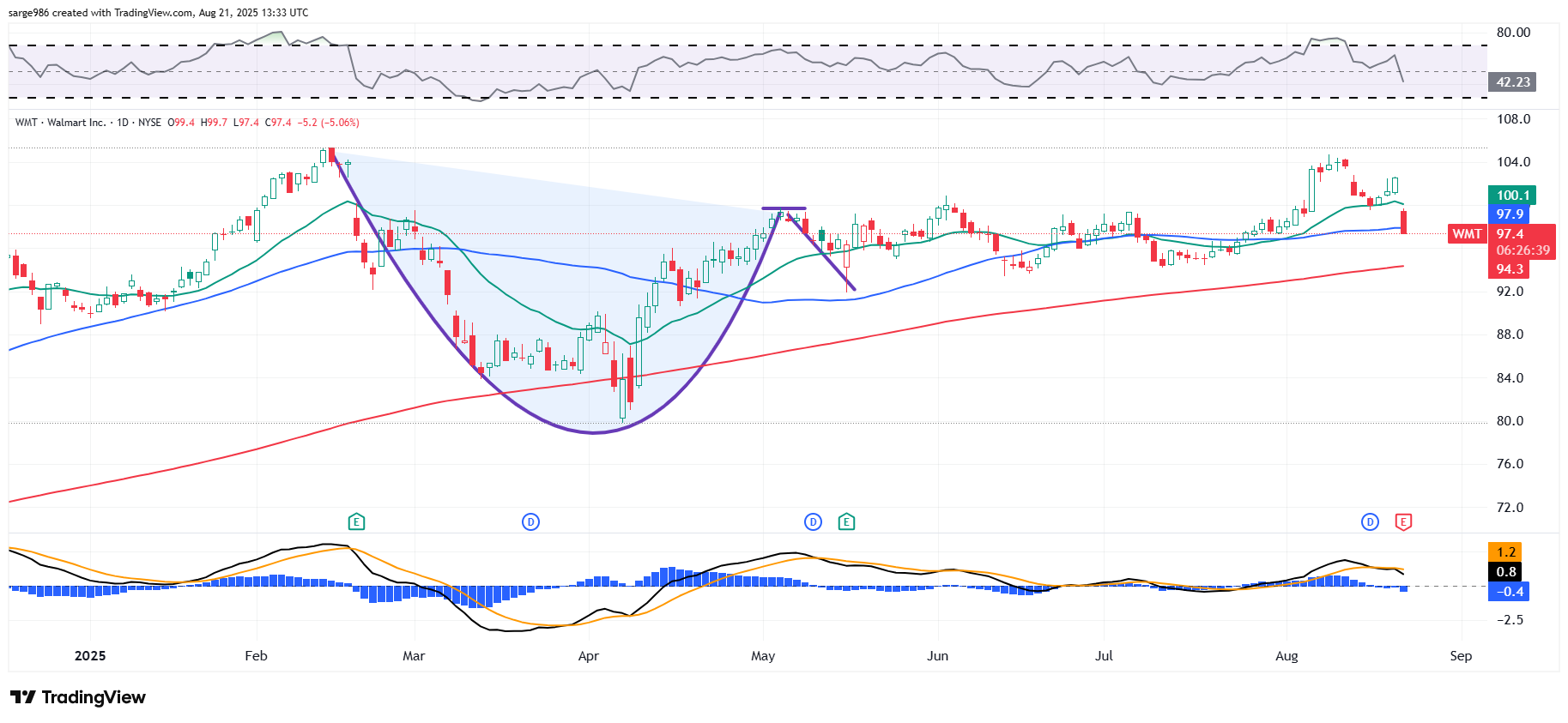
What do you see? A bullish cup-with-handle pattern that didn't pop. Wonder why it failed? Now, close your eyes, spin your office chair around and take another look:
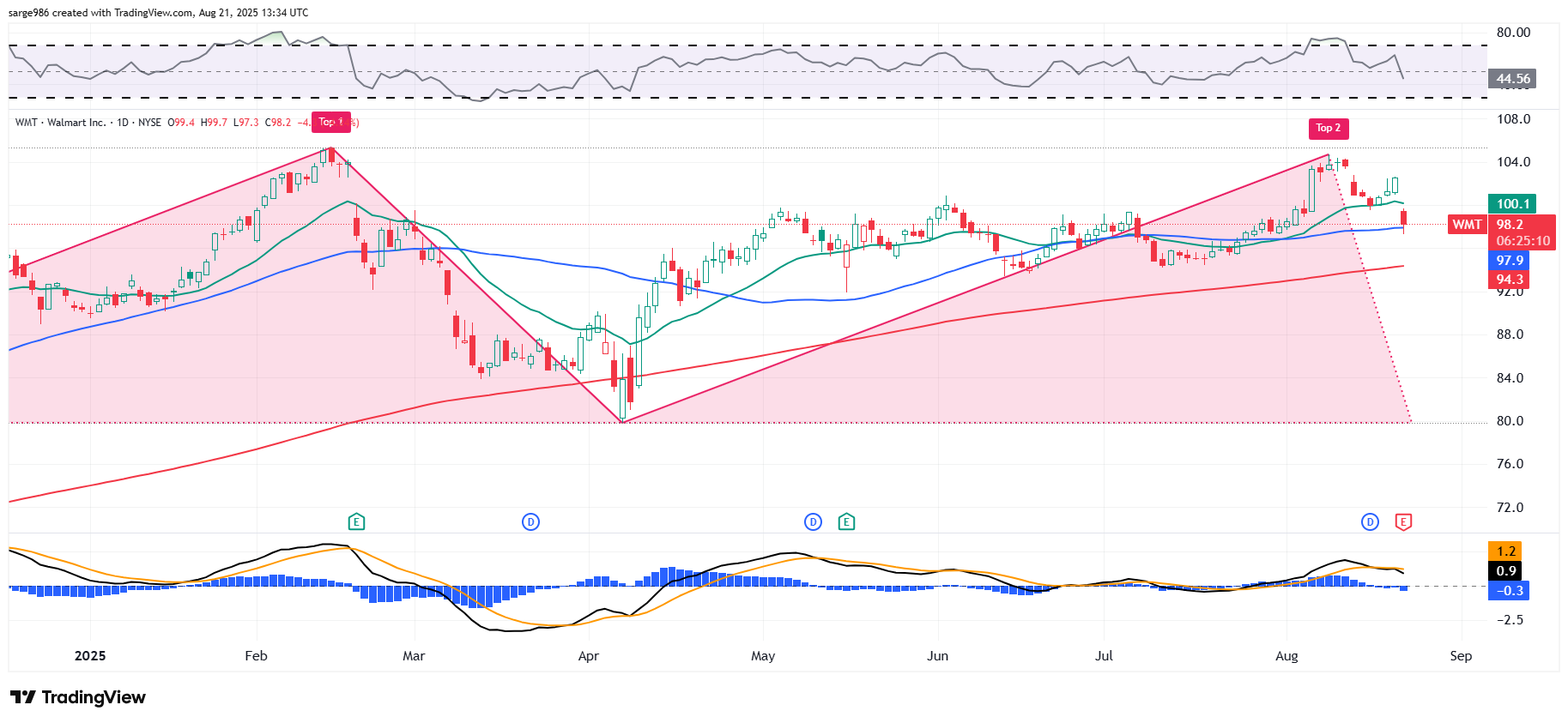
Now, what do you have? A double-top pattern if bearish reversal with an $80 million pivot. That's what. That's also ugly. It is imperative for the Walmart bulls to hold the 50-day SMA at $98. If that line cracks, risk managers will force portfolio managers to reduce exposure, and professionals will start hitting bids.
To make matters worse, within the daily MACD (below the chart), the histogram of the nine-day EMA has dropped below zero. That's short-term bearish. Additionally, the 12-day EMA has crossed below the 26-day EMA. This and two lines are still in positive territory, so it's not as ugly as it could be, but this is not a buy signal.
Target still stinks. Walmart is a better play in my opinion than Target due to it's cash flows. Neither management team is doing anything to impress me. There are better dips to buy in this environment. I'll still shop there. That will be the extent of our relationship.
At the time of publication, Guilfoyle had no positions in any securities mentioned.