Walmart Earnings Reveal a Desperate and Stupid Stock Move
I see no reason to invest in the retail giant following its earnings release.
You've reached your free article limit
You've read 0 of 1 free Pro articles.
Retail king Walmart (WMT) released its fiscal fourth quarter financial results on Thursday morning.
For the period ended January 31, Walmart posted an adjusted EPS of $0.74 (GAAP EPS: $0.53) on revenue of $190.656 billion. While the top-line print easily beat Wall Street, reflecting year-over-year growth of 5.6%, the adjusted bottom-line results beat by just a penny, and the GAAP EPS print fell short. Walmart did announce the authorization of a new $30 billion share repurchase program.
Global e-commerce sales were up by an impressive 24% on an annual basis, led by store-fulfilled pickup and delivery. Global advertising revenue was up 37%, (+41% in the U.S.) including Vizio and Walmart Connect. Membership fees grew 15.1% globally as well.
New CEO John Fulmer commented in the press release:
"The pace of change in retail is accelerating. It’s exciting. And our financial results show that we're not only embracing this change, we're leading it. For our customers and members, the future is fast, convenient, and personalized.”
Operations
As revenues grew 5.6% to $190.656 billion, the cost of sales increased 5.5% to $143.615 billion and total operating expenses grew 5% to $38.333 billion. That left a GAAP operating income of $8.708 billion as GAAP operating margin improved from 4.4% to 4.6%.
After accounting for interest, other income and expenses and taxes, GAAP net income attributable to shareholders landed at $4.237 billion, down 19.4% from the year-ago comparison. That works out to a GAAP EPS of $0.53, down 18.5% from $0.65 for that year-ago period. After adjustments for realized and unrealized investment gains and losses, that EPS rises to $0.74, up from $0.66.
Segment Performance
- Walmart U.S. generated net sales of $129.2 billion (+5.7%) on comp sales growth of 4.6%, producing operating income of $7 billion (+6.6%). Transactions were up 2.6%, while the average ticket grew 2%.
- Walmart International generated net sales of $35.9 billion (+11.5%), producing operating income of $1.9 billion (+36%). Adjusted for constant currency, Walmart International generated net sales of $34.6 billion (+7.5%), producing operating income of $1.8 billion (+26.5%).
- Sam's Club U.S. generated net sales of $23.8 billion (+2.9%) on comp sales growth (ex-fuel) of 4%, producing operating income of $0.6 billion (+3.8%). Transactions were up 5.3%, while the average ticket contracted by 1.3%. Net sales, ex-fuel printed at $21.7 billion, up 4%.
Guidance
For the current quarter, Walmart is projecting net sales growth of 3.5% to 4.5% with Wall Street looking for something close to 5.5%. Not good. Adjusted EPS is seen at $0.63 to $0.65, with expectations up around $0.68. Again, not good.
For the full year just started, Walmart sees net sales growth of 3.5% to 4.5%. Wall Street was looking for an even 5%. Adjusted full-year EPS is being guided towards $2.75 to $2.85. That fell well short of the $3.00 or so that Wall Street had in mind.
Fundamentals
For the full fiscal year completed, Walmart generated operating cash flow of $41.565 billion (+14.1%). Out of that number came capex spending of $26.642 billion, leaving free cash flow of $14.923 billion (+17.9%). Out of that number came $7.507 billion in cash dividend payments to shareholders and repurchases of common stock amounting to $8.088 billion.
Yes, for the past fiscal year, returns to shareholders outpace free cash flow, which is a common sense "no-no," unless a firm has a huge cash position and not so much debt. Anyone else wondering about the potential recklessness of the new $30 billion authorization?
Moving on to the balance sheet, Walmart ended the fiscal quarter and year with a cash position of $10.727 billion and inventories of $58.851 billion. This puts current assets at $84.874 billion. Current liabilities add up to $107.469 billion, including $10.138 billion in shorter-term debt. Yes, that's debt that will require refinancing within 12 months that amounts to nearly the entire firm's cash position. The $30 billion buyback program is looking more and more like a desperate and quite stupid move by the second.
Total assets amount to $284.668 billion, of which $28.735 billion is labeled as "goodwill." At least that's not reckless. Total liabilities less equity comes to $178.781 billion including long-term debt of $34.624 billion. No, this is not a fortress balance sheet. I give it a "D-." Crazy idea, Walmart: instead of a completely unnecessary $30 billion buyback program, use your free cash flow to tamp down the debt-load and fix your dang balance sheet.
Opinion
Obviously, I am not thrilled with what I see. Cash flows are healthy enough to truly strengthen the firm's fundamentals, but the will to do so just is not there. GAAP Operating income crashed year over year due to investment related losses. In my opinion, there is absolutely no investment-based reason to buy the stock on Thursday morning. There may be a short-term trade there, but not in my opinion, an investment thesis.
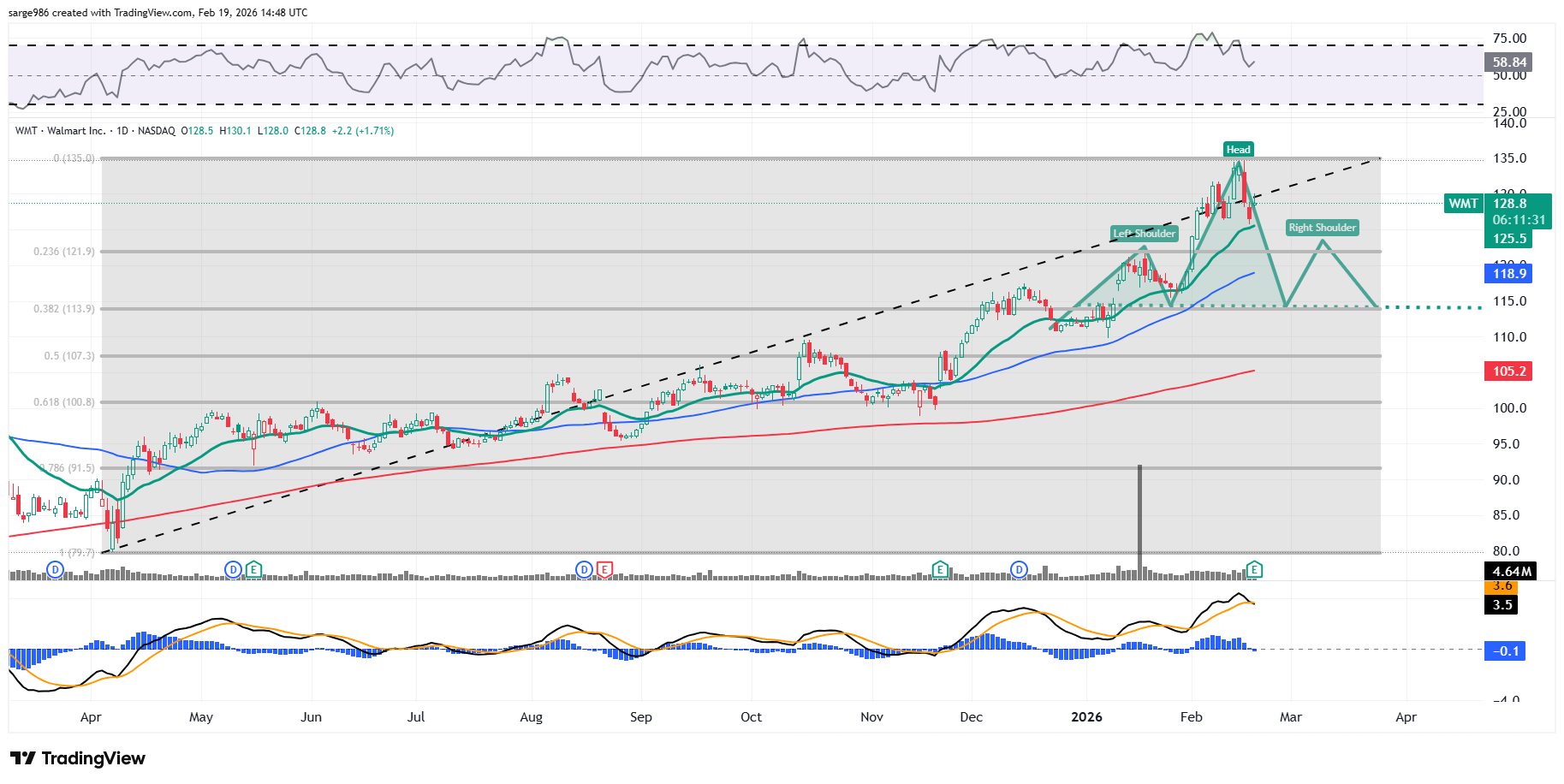
Readers will see that Walmart may be taking a technical turn for the worse. I see a not-yet-completed head-and-shoulders pattern of bearish reversal potentially under construction. The downside pivot for that setup, if it should come to fruition, would run close to $115. This just happens to be slightly above the 38.2% Fibonacci retracement level of the stock's April into February rally.
Relative strength is off of its highs as the daily MACD has shown some chinks in the armor. That said, the stock is still trading above all of its key moving averages, so we do not yet know if the swing crowd or the community of portfolio managers will come to the stock's rescue on any renewed weakness. There's a lot of risk associated with getting entangled with this stock at this time. I might be willing to write $118 puts (50-day SMA) expiring on March 27 for a rough $1.15 per contract, but I am not willing to buy equity at Thursday morning's prices.
At the time of publication, Guilfoyle had no positions in any securities mentioned.