UnitedHealth Is Ill. Is It Ill Enough to Buy?
Let's check the vitals of UNH's earnings and guidance and see if we can come up with a care plan.
You've reached your free article limit
You've read 0 of 1 free Pro articles.
UnitedHealth Group UNH released first-quarter financial results on Thursday morning, and the market reaction has been to sell the shares and then sell some more. The "ugly stick" was making its rounds this morning and when it got to UNH, the stick put up a tent and decided to camp out.
For the three-month period ended March 31, UnitedHealth posted an adjusted earnings per share of $7.20 (unadjusted EPS: $6.85) on revenue of $109.575 billion. The adjusted earnings print fell almost a dime a share short of expectations. If that's not bad enough, the top line number, which was good for year-over-year growth of 9.8%, missed what had been the consensus view by more than $2 billion. The adjustments that were made were for the amortization of intangibles partially offset by the tax effects of that amortization.
Not Just the Top & Bottom Lines
UNH cut its guidance for full-year adjusted earnings per share from $29.50 - $30 down to $26 - $26.50. That's almost a 12% haircut at those respective midpoints and well below Wall Street's consensus projection of $29.74.
The company blamed Medicare costs in the press release, for both the sub-par quarter and for the reduced outlook. For the quarter reported, the insurer's medical care ratio was 84.8%, which compares to 84.3% in 2024. That increase was primarily due to the revenue impact of both the ongoing Medicare funding reductions and member mix as well as senior care activity. This was partially offset by the Medicare Part D program changes which affected seasonality. Days claims payable of 45.5 compared sequentially to 47.0 and to 47.1 for the year ago comp. This was driven by changes to the Medicare Part D program.
Q) What's a medical care ratio?
A) Also, known as a medical cost ratio or medical loss ratio, this metric is used to measure the portion of premium-driven revenue spent on medical expenses.
UNH tried to explain, writing that:
This outlook reflects two factors:
Heightened care activity indications within UnitedHealthcare’s Medicare Advantage businesses, which became visible as the quarter closed, far above the planned 2025 increase which was consistent with the elevated levels in 2024. This activity was most notable within physician and outpatient services.
Unanticipated changes in the profile of Optum Health members impacting planned 2025 reimbursement due to unexpectedly minimal 2024 beneficiary engagement by plans exiting markets. In addition, a greater-than-expected impact to current and new complex patients from the ongoing Medicare funding reductions enacted by the previous administration.
Operations
As revenue generation increased 9.8% to $109.575 billion, total operating expenses grew 9.4% to $100.456 billion. The increase in operating expenses was largely driven by an 11.7% pop in medical costs. Unadjusted operating income printed at $9.119 billion (+15%). After accounting for interest, taxes and other income & expenses, unadjusted net income landed at $6.474 billion, up from $-1.221 billion for the year-ago comparison. On an undjusted basis, this works out to an EPS of $6.85, up from $-1.53. Once adjusted for the above-mentioned amortization of intangibles, EPS printed at $7.20, up from $6.91.
Fundamentals
For the period reported, UnitedHealth generated operating cash flow of $5.456 billion. Out of this number, came capital spending of $898 million, leaving free cash flow of $4.558 billion. Out of that number the firm repurchased $3 billion worth of common stock and paid out $1.912 billion in cash dividends to shareholders. Somehow, with a beastly number for free cash flow, the firm managed to return too much (my opinion) capital to shareholders. Perhaps repurchasing fewer shares would be an intelligent change of direction.
Turning to the balance sheet, UnitedHealth ended the quarter with a cash position of $34.291 billion and current assets of $96.285 billion. Current liabilities add up to $113.371 billion including short-term debt of $9.986 billion. To say that a current ratio of 84.9 is alarming would be an understatement. With a current ratio so far below what is generally considered to be the bare minimum (1.0) of what is considered to be acceptable, one has to wonder why with such robust free cash flow, would that free cash flow have been so badly mismanaged. Just wow.
Total assets amount to $309.79 billion. This includes $51.863 billion in long-term investments that I guess could be turned to cash, even at a discount, in an emergency. So, there is no crisis here. That said, management does have to do a much better job. Total liabilities less equity comes to $208.979 billion, including a daunting $71.285 billion in long-term debt. Another place some of that free cash flow might have been better suited to go rather than in share repurchases.
Thoughts
Huge operation. Improving execution despite the obvious hiccups. Don't at all like how the firm manages its balance sheet or its cash flows. The reduced guidance could truly sow any rebound in coming weeks.
Readers will see that UNH had broken out of a Falling Wedge pattern of bullish reversal about a month ago. If this morning's sell-off were less severe, I could see this as the addition of a handle to a cup stretching from early December to early April. This, however, is obviously too deep a sell-off to explain away as part of a more bullish pattern.
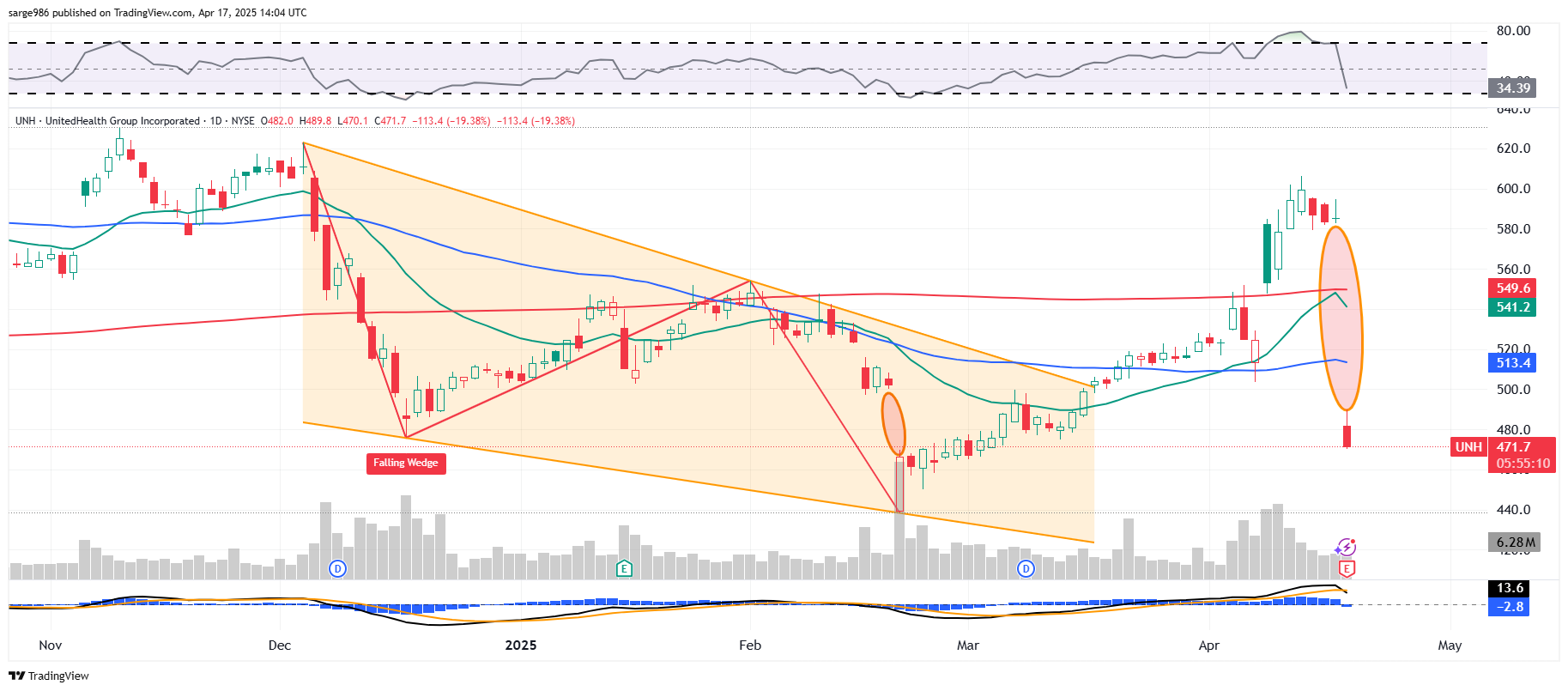
As Relative Strength has suddenly plummeted, and the daily Moving Average Convergence Divergence has suddenly turned sharply more bearish, the stock has in one morning... surrendered its 21-day exponential moving average, 50-day simple moving average and 200-day simple moving average. This has not only turned the swing crowd against the stock, but as we speak (write), is forcing portfolio managers to reduce long-side exposure.
Buy the dip? I'm going to give this some time. The community of sell-side analysts is clearly stunned by this. I have not seen any reaction this morning from the peanut gallery. Earlier this week, we had seen highly rated analysts from Morgan Stanley, Bernstein and Truist Financial not only reiterate "buy" or buy-equivalent ratings but increase their target prices ahead of these earnings. Egg meets face. Ouch! These analysts will obviously have to change their tune publicly. When they do, the stock could fall further.
The stock traded as low as $438.50 in February. The stock traded as low as $436 in late 2021. This stock is less than 7% away from making a multi-year low. Is it possible? We'll know more after those analysts adjust their targets and perhaps their ratings. I do think this stock has a better chance of making a new post-2021 low than it does of trading anywhere near the $660, $664, or $703 targets that the above-mentioned analysts so recently placed on the shares. Bright side? There is now a huge gap that could eventually fill. Might be a while though.
At the time of publication, Guilfoyle had no position in any security mentioned.