Uber Is a Buy and the Balance Sheet Might Be Stronger Than You Think
There is a trade here.
You've reached your free article limit
You've read 0 of 1 free Pro articles.
On Tuesday morning, Uber Technologies (UBER) went to the tap with the firm's third quarter financial results. For the period ended September 30, UBER posted a GAAP EPS of $3.11 on revenue of $13.467 billion. The adjusted EPS print beat Wall Street by a wide margin as did the revenue print. That sales print was good enough for year-over-year growth of 20.2% which is at the high end of the firm's recent growth range.
GAAP net income of roughly $6.6 billion did include a $4.9 billion benefit from a tax valuation release. Hence the tremendous adjustment in the numbers.
Income from operations was up 5% to $1.1013 billion as operating margin dropped from 9.5% to 8.3%. This is probably a big reason why the shares are trading lower on Tuesday morning. Oddly enough, with revenue up more than 20%, gross bookings up 21% and adjusted EBITDA up 33%, operating income was up a whopping 5%.
Fundamentals
For the period, Uber generated operating cash flow of $2.28 billion. Out of that came capex spending of just $98 million, leaving free cash flow of $2.23 billion (+5.7). Out of that number, the firm repurchased $1.463 billion worth of common stock and paid absolutely nothing in the form of cash dividends to shareholders.
Turning to the balance sheet, UBER ended the quarter with a cash position of $7.522 billion and current assets of $12.245 billion. Current liabilities add up to $11.476 billion, which does include some insurance-related reserves but no short-term debt. That puts the firm's current ratio at rather paltry 1.07. However, the firm does have restricted cash and investments and longer-term investments of $17.651 billion on the books, which are not labeled as current. What that means is if these items were all included in the current ratio as they could be, that ratio would stand at a much healthier looking 2.61.
Total assets amount to $51.244 billion, of which less than 10% is labeled as either goodwill or other intangibles. That's no problem. Total liabilities less equity comes to $28.768 billion. This does include long-term debt of $8.347 billion which is simply dwarfed by the firm's true cash position. The firm runs a funny looking balance sheet, but once you figure it out, it is a strong balance sheet.
Guidance
For the current quarter, UBER is projecting gross bookings of $52.25 billion to $53.75 billion, which would be good for year-over-year growth of 17% to 21% in constant currency. Adjusted EBITDA is seen at $2.41 billion to $2.51 billion, which would be good for growth of 31% to 36%. The problem here, and another reason why the stock is weak on Tuesday, is that Wall Street was looking for guidance for adjusted EBITDA of $2.49 billion, which is above the midpoint of the range given.
My Thoughts
This was a good quarter. The tax benefit completely warps the data and the firm's released material is not all that helpful in allowing investors to figure out what would be what without that gigantic boost. Bookings are strong, cash flows are strong and the balance sheet is strong. On the flip side, operating margin fell off of the cliff this quarter and guidance is a little on the weak side.
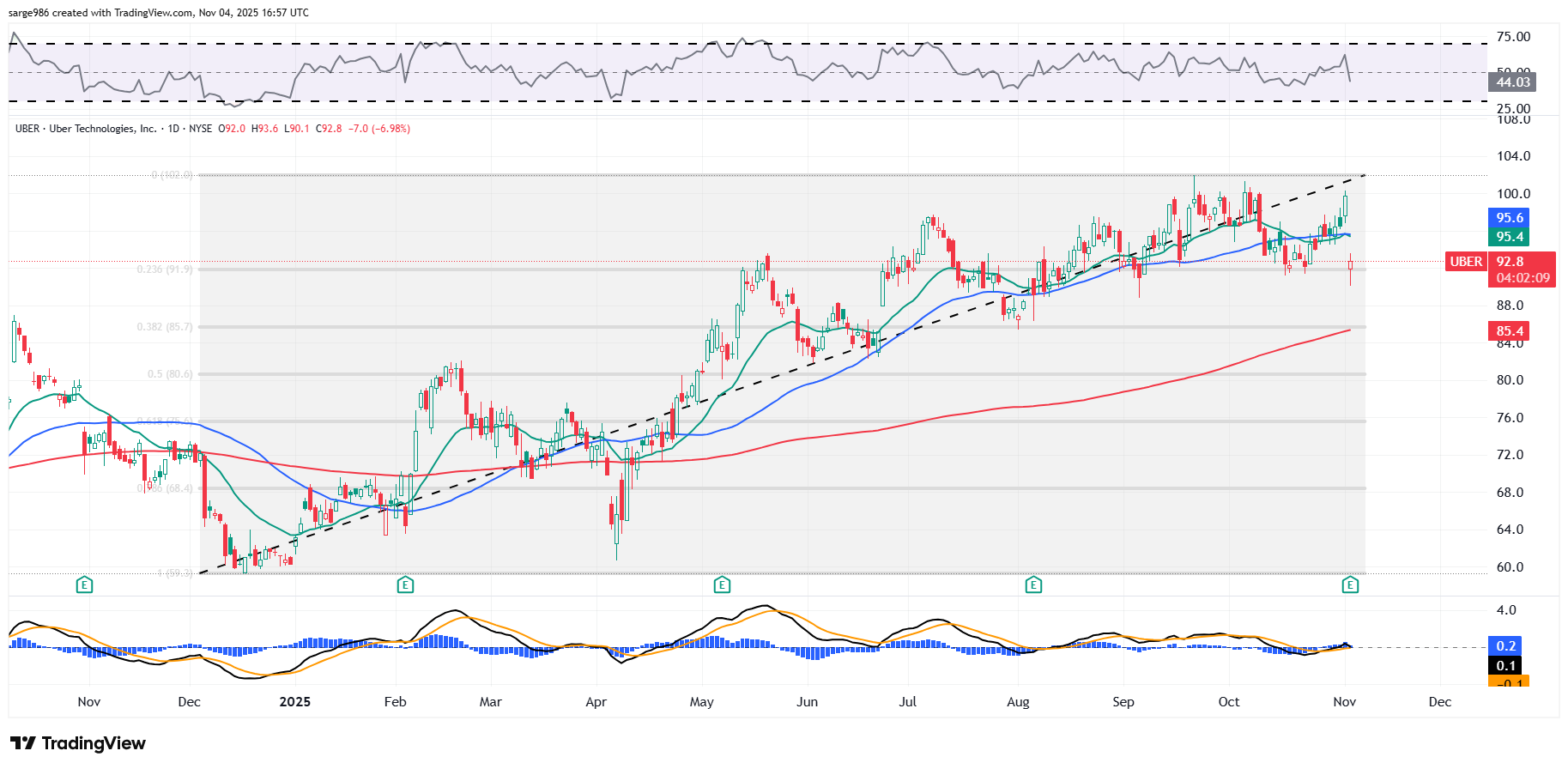
Readers will see that the shares throughout this autumn have formed a base in between the early September high and the 23.6% Fibonacci sequence retracement level of the December 2024 through September 2025 rally. On Tuesday morning, that level was tested for the fourth time since early September and the stock looks to have held the level. Both relative strength and the daily MACD are both basically indicating close to nothing right now.
My opinion is that it is OK to buy this dip in UBER on Tuesday as it is trading at established support. Just understand that the stock has lost its 50-day SMA. If the Fib. level cracks, the stock is going to make a run for the 200-day SMA. On the other hand, that 50-day line is now an upside pivot should that Fib. line hold. I may speculate a little on this one myself after this piece hits publication.
At the time of publication, Guilfoyle had no positions in any securities mentioned.