Trading Strategy for MongoDB Stock After Huge Loss
The big data services provider might have a spot to initiate ahead.
You've reached your free article limit
You've read 0 of 1 free Pro articles.
MongoBD?
No, it's MongoDB (MDB) . Unless, of course, the DB, which stands for "database," is reversed so that a "BD" stands for something like "beatdown."
On Monday evening, big data services provider MongoDB released the firm's fiscal fourth quarter financial results. The reaction on Wall Street was ugly. This is that story.
For the period ended January 31, MongoDB posted an adjusted EPS of $1.65 (EPS: $0.18) on revenue of $695.072 million. These top- and bottom-line results all beat Wall Street's expectations, while that sales number was good for year-over-year growth of 26.8%. So, what's the problem? The firm's flagship database product, known as "Atlas," reported annual growth of 29%, which did not meet expectations, while the guidance was on the soft side. That's what.
Operations
As revenue grew 26.8%, the cost of that revenue increased 25.8% to $187.412 million. This left a gross profit of $507.66 million (+27.1%) on a gross margin of 73% (up from 72.8%). Total GAAP operating expenses came to $507.356 million (+21.4%), leaving a GAAP operating income of $304,000, up from the year-ago comp of -$18.562 million. After adjustments (mostly for expenses associated with stock-based compensation), operating income landed at $158.809 million (+41.2%).
After accounting for interest, other income and expenses and taxes, GAAP net income printed at $15.53 million (-0.2%) as the firm experienced a decrease in what had been a tax benefit for the same period one year ago. That works out to $0.18 per fully diluted share. After adjustments, EPS hit the tape at $1.65, up from $1.28 for the same quarter comp last year. The firm's adjustment for stock-based compensation amounted to a stunning $1.80 per share.
Guidance
For the current quarter, MongoDB is projecting revenue of $659 million to $664 million. At the midpoint, the implied $661.5 million falls short of the $663.3 million that Wall Street had in mind. The firm sees a GAAP operating income/loss of -$48 million to -$44 million and an adjusted operating income of $105 million to $109 million. This would put the firm's GAAP EPS at -$0.34 to -$0.29 and its adjusted EPS at $1.15 to $1.19. Wall Street was looking for $1.18.
For the full fiscal year, MDB sees revenue of $2.86 billion to $2.9 billion. At the midpoint, that falls below the consensus view for $2.9 billion and would amount to year-over-year growth of just 17.1%. That stings.
The firm sees a full-year GAAP operating income/loss of -$117 million top -$97 million and an adjusted operating income of $545 million to $565 million. That gets the firm's full year GAAP EPS expectations to -$0.73 to -$0.49 or when adjusted, to $5.75 to $5.93. Wall Street was looking for something in the $5.75 to $5.80 range, but that does not seem to be helping.
Fundamentals
For the quarter reported, MDB generated an operating cash flow of $179.604 million. Out of that number came just $1.134 million in traditional capex spending and $1.739 million in principal payments on finance leases. This left free cash flow of $176.731 million. The firm does not return capital to shareholders.
Turning to the balance sheet, MongoDB ended the period with a cash position of $2.387 billion and current assets of $3.115 billion. Current liabilities add up to $669.496 million, which includes no debt, but $387.119 million in deferred revenue, which is not a true financial obligation. This puts the firm's headline and adjusted current ratios at an incredibly strong 4.65 and 11.03, respectively.
Total assets amount to $3.759 billion including a very small portion of assets labeled as either goodwill or other intangibles. Total liabilities less equity comes to $806.49 million. There is no debt on this balance sheet, and this balance sheet is in fantastic shape. This is a strength.
Opinion
This is a tough one. MongoDB is in great shape fundamentally. Cash flows are strong and the balance sheet is a fortress. That said, the growth of the business appears to be slowing down, perhaps significantly so. That's not good for a stock that even down sharply in 2026 is still trading at 57-times forward looking earnings and at 11.3 times sales. In theory, this stock could be cut in half from here and still not be inexpensive.
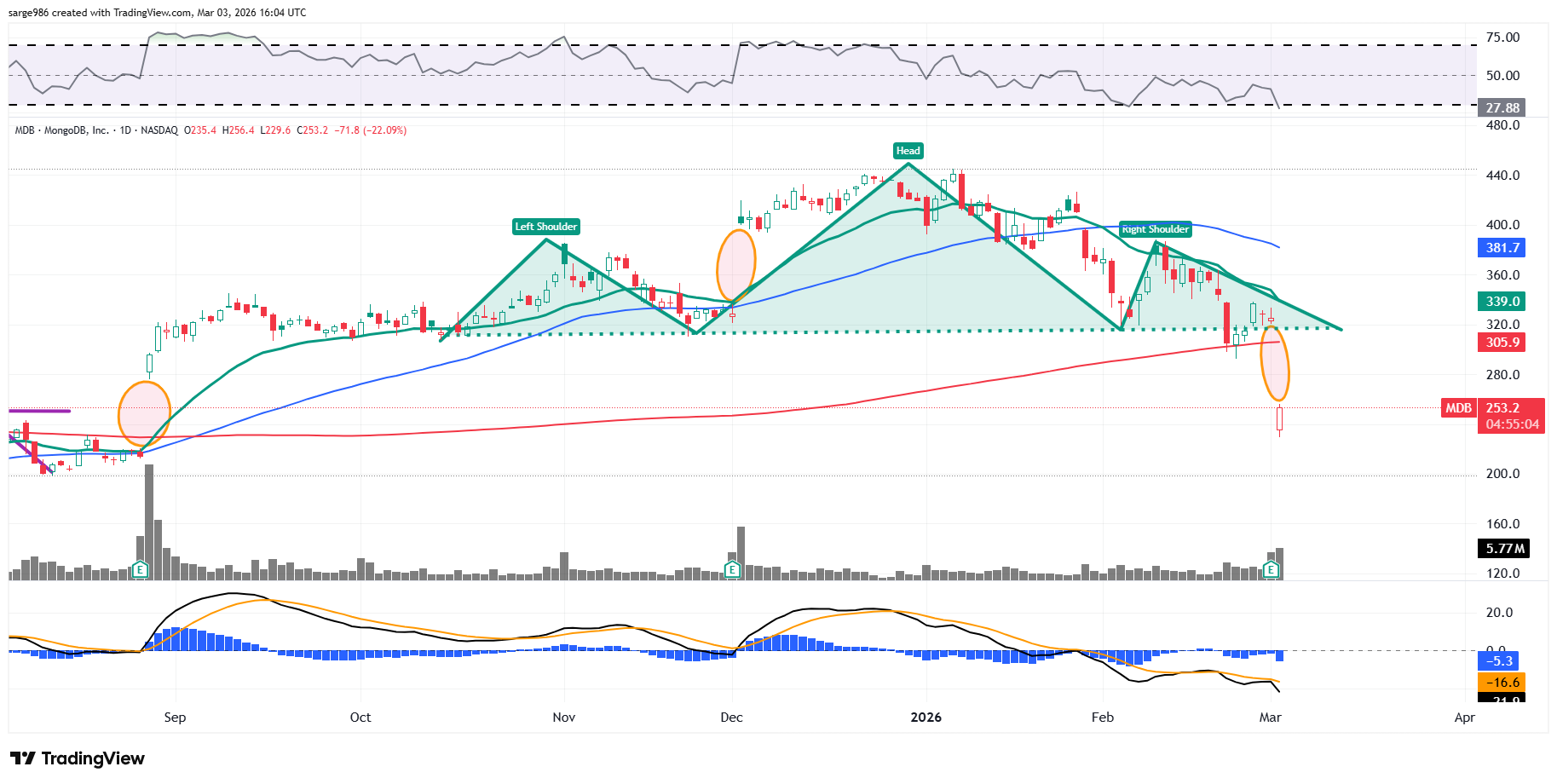
Readers will see that MDB appears to have developed a head-and-shoulders pattern, which is bearish, with a $318 pivot. That puts the downside target at a rough $240, so this particular sell-off may be close to done at this point. That said, the loss of the 200-day SMA is huge. This will force professional money out of the stock, and it won't be back unless the stock can make a new run at that line.
Looking at the indicators, both relative strength and the daily MACD are set up about as bearishly as one can imagine. The one bright spot I see is that the unfilled gap from back in August is now filling. That removes one downside catalyst.
Bottom line? I'd be really slow to get involved in this name until a new technical pattern emerges.
While $240 might be a spot to initiate, there is also a chance that with rates of growth slowing so sharply, that the stock makes an attempt to reach the 78.6% Fibonacci retracement level of the April into early January rally. That would put the stock in the $205 area. If one decides to trade this name, I'd trade the options and do it short-term. The equity is just too risky.
At the time of publication, Guilfoyle had no positions in any securities mentioned.