Time for Amazon? I'm Taking a New Look and Here's What Makes Sense
Suddenly, within days, a shrewd move to get out of a long-time holding had gone from timely, to not so smart after all.
You've reached your free article limit
You've read 0 of 1 free Pro articles.
Frequent readers might remember that I completed my exit from Amazon AMZN a little more than a week ago. I was going to try to hang on to a lightly weighted (non-top-10) allocation, but the tariff news put me over the top.
I made a nice sale. The stock gave up an additional 10.8% after I liquidated those shares. On Wednesday, though the shares underperformed the Nasdaq Composite, Amazon regained nearly 12% for the session, closing at $191.10, and well above where I had made that sale.
Suddenly, within days, a shrewd move to get out the last of a long-time holding had gone from timely to not so smart after all. Is it worth chasing the shares to get back in?
I have read, though the number changes, that between 30% and 40% of the goods sold by Amazon originate in China and Chinese goods are the ones facing tariffs of 125% while everyone else's goods will face duties of "just" 10%. That can't be good. That is if a trade deal between Presidents Trump and Xi is never reached.
There is a big "but" here though.
But...
Overnight, Amazon cancelled orders originating in China (as well as some Southeast Asian countries), which left certain vendors holding uncomfortable levels of unsold inventories. According to Bloomberg News, Amazon is intentionally reducing the firm's exposure to U.S. tariffs on Chinese imports.
Amazon vendors sell goods to Amazon at the wholesale level, and Amazon acts as the retailer. And third-party vendors sell goods directly to consumers on the Amazon platform, making Amazon less a retailer and more a broker.
For those goods purchased by the firm at the wholesale level from Chinese vendors, Amazon would be the "importer of record" and while we have all debated each other on who pays for tariffs indirectly, the importer of record is the one who gets the bill from the government. Interestingly, if the goods in question have already left port, and while in transit, the "importer of record" cancels the order, and those goods are ultimately offloaded onto U.S. soil, the overseas vendor gets stuck with said bill.
There's More
This comes as reports are circulating that Chinese vendors that sell goods directly to Amazon are either preparing to raise prices for U.S. clients or exit the market completely due to the size of President Trump's tariffs on Chinese imports.
Wang Xin, who is head of the Shenzhen Cross-Border E-Commerce Association, representing more than 3,000 vendors that do business with Amazon, told Reuters: "It'll be very hard for anyone to survive in the US market.'
Andy Jassy on AI
What a time for Amazon CEO Andy Jassy to release his annual letter to shareholders, but that's exactly what he did. Jassy wrote that "generative AI is going to reinvent virtually every customer experience we know and enable altogether new ones about which we've only fantasized." He added... "It’s also why AWS is quickly developing the key primitives (or building blocks) for AI development, such as custom silicon AI chips in Amazon Trainium to provide better price-performance on training and inference, highly flexible model-building and inference services in Amazon SageMaker and Amazon Bedrock, our own frontier models in Amazon Nova to provide lower cost and latency for customers’ applications, and agent creation and management capabilities"
Yes, that's a mouthful. He also went into the large capital investment requirement necessary to advance in this area. He said that chips or GPUs are the reason why AI investment is so expensive but added that these costs will be headed lower. Jassy says that the firm's own Trainium2 chips offer 30% to 40% better price performance than what the firm is purchasing from exterior providers.
On that note, the Amazon-backed gen-AI start-up chatbot known as "Claude" has announced two subscription plans, a $200-per-month plan supposedly ideal for daily users who work with AI chatbots to complete most tasks and a $100-per-month plan for frequent users who rely on chatbots a little less often. Competitor OpenAI's ChatGPT, backed by Microsoft MSFT and others, had recently announced the launch of a $200-per-month subscription plan.
Upcoming Earnings
Amazon is set to release its first-quarter performance on or about April 28. Wall Street is looking for GAAP EPS of about $1.36 on revenue of roughly $155 billion. This would be up from the year ago comp of $0.98 and would reflect sales growth of more than 8% annually.
Sounds like a good quarter but it would be a decleration of growth as Amazon hasn't seen year-over-year sales growth of less than 8.5% for any quarter since Q2 2022. I also don't know how Amazon will be able to issue any guidance if the current trade environment has not evolved at all from here at that time.
The Chart
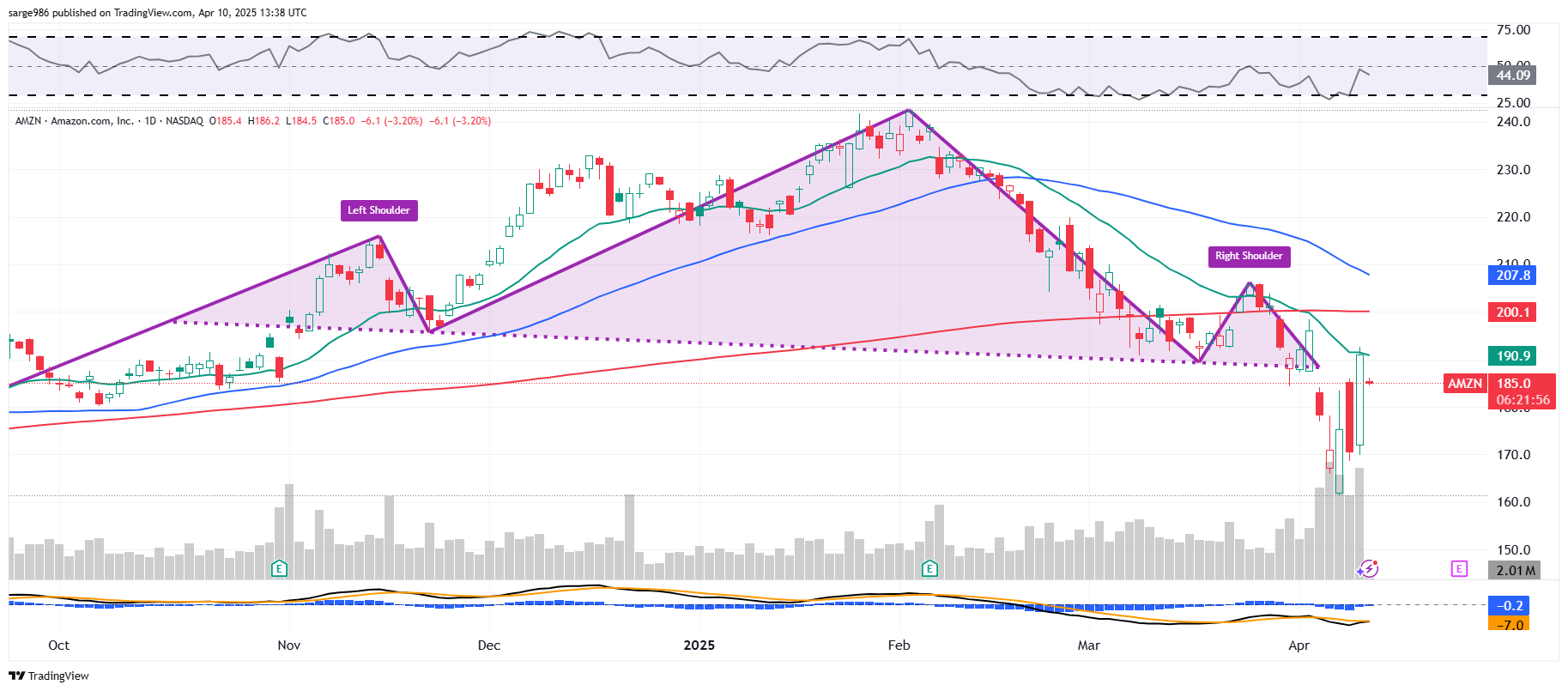
It's a little sloppy, but I would be slow to discount the head-and-shoulders pattern developed by AMZN stock from last autumn into the present. The close above the neckline of the pattern on Wednesday is impressive, but a failure to hold that level today (Thursday) would mean to me that the pattern is still in effect. My target if I had been short the stock instead of just getting out of a long position, would have been $160 based on that pivot.
AMZN did kiss that level earlier this week, so there's no guarantee that those lows are seen again. That said, I would rather wait on a second attempt at those lows than make a purchase the morning after a terrific rally. I would also rather pay up on momentum should the stock take that 21-day expoential moving average (EMA), which is where it failed Wednesday.
Put plainly, there are spots on this chart where putting capital into AMZN could make sense. This spot, however, is not one of them.
That said, writing May 2 $160 puts for about $2.70 might make sense. Just remember to buy a like number of same-dated puts with a lower strike price (Maybe the May 2 $145s for about $1.15), so you don't get your face ripped off if the stock sells hard on earnings.
At the time of publication, Guilfoyle had no positions in any securities mentioned.