This Microsoft Bull Is Disappointed by Underwhelming Earnings
Here is my "line in the sand" as the tech giant underwhelms for the second quarter in a row.
You've reached your free article limit
You've read 0 of 1 free Pro articles.
On Wednesday evening, tech giant Microsoft MSFT reported the firm's second quarter financial results alongside several other "Mag 7" mega-cap stocks.
For the three-month period ended December 31, Microsoft posted a GAAP EPS of $3.23 on revenue of $69.632 billion. These top- and bottom-line numbers both easily beat Wall Street's projections, while the revenue print reflected sales growth of 12.2%. Despite what is, at the headline level, a stellar quarter, the stock has struggled overnight. There are several areas of disappointment in the tale about to be told. Sit down. I've a story to tell.
The C-Suite
Microsoft CEO Satya Nadella commented in the press release last night: “We are innovating across our tech stack and helping customers unlock the full ROI of AI to capture the massive opportunity ahead. Already, our AI business has surpassed an annual revenue run rate of $13 billion, up 175% year-over-year."
CFO Amy Hood added: “This quarter Microsoft Cloud revenue was $40.9 billion, up 21% year-over-year. We remain committed to balancing operational discipline with continued investments in our cloud and AI infrastructure.”
Operations
As revenue generated grew 12.2% To $69.632 billion, product sales contracted 14.4% to $16.219 billion, but sales of services increased 24% to $53.413 billion. The cost of this revenue increased 11.1% to $21.799 billion, leaving a gross profit of $47.833 billion (+12.8%) as gross margin improved from 68.4% to 68.7%.
After operating expenses such as R&D, sales and marketing and administrative costs are accounted for, operating income grew 17.1% to $31.653 billion, as operating margin improved from 43.6% to 45.5%. Once other income and expenses as well as taxes are factored in, net income increased 10.2% to $24.108 billion. This works out to a GAAP $2.23 per fully diluted share, up from $2.93 for the year-ago comparison.
Segment Performance
- Productivity & Business Processes: Revenue grew 13.9% to $29.437 billion, producing operating income of $16.885 billion (+16.3%).
Microsoft 365 Commercial products and cloud services revenue grew 15%, as commercial seats grew 7%. Microsoft 365 Consumer products and services revenue grew 8%. LinkedIn revenue grew 9%. Dynamics products and cloud services grew 15%. - Intelligent Cloud: Revenue grew 18.7% to $25.544 billion, producing operating income of $10.851 billion (+13.6%).
Server products and cloud services revenue grew 21%. Azure-services-driven revenue grew 31%, which is a closely watched metric and fell short of expectations for something more like 31.8%. This is a major reason for the overnight pressure on the stock. Enterprise and partner services decreased 1%. - More Personal Computing: Revenue grew 0.1% to $14.651 billion, producing operating income of $3.917 billion (+32.2%).
Windows and Devices revenue increased 3%. Gaming revenue decreased 7%. Search and news advertising increased 12%.
Fundamentals
For the quarter reported, Microsoft generated operating cash flow of $22.291 billion (+18.2%). Out of that number came capex spending of $15.804 billion, leaving free cash flow of $6.487 billion. This is one other item that investors are disappointed in. Not only did this free cash number fall short of expectations, it also reflected a year-over-year contraction of 29.9%.
Placing even more hair on the issue, though not readily apparent in the statement of cash flows, during the call, Hood said, "Capital expenditures including finance leases were $22.6 billion, in line with expectations." OK, so call me an idiot, but if capex spending is $22.6 billion (I don't care if it's spent on property and equipment, finance leases, baseball cards or Swiss cheese), and operating cash flow is $22.3 billion, then what is free cash flow again?
That $22.6 billion print was up from $11.5 billion for the year-ago comp, by the way. Ugh.
As for the balance sheet, the firm's cash position is down 5.3% from six months ago to $71.555 billion. Current assets stand at $147.08 billion. Inventories are not a significant part of that number. Current liabilities add up to $108.882 billion. This includes shorter-term debt of $5.248 billion, but also $45.508 billion in unearned revenue, which is not a true financial obligation. That puts Microsoft's headline current ratio at 1.35, but its current ratio adjusted for unearned revenue at a very robust 2.32.
Total assets amount to $533.898 billion, of which $144.576 billion is in goodwill and other intangibles. At 27% of total assets, this is not a problem. Total liabilities less equity comes to $231.203 billion. This includes long-term debt of $39.722 billion. All in all, this is a very solid balance sheet. There is more than enough cash on hand to take care of the firm's entire debt-load and not feel strapped for cash.
Guidance
This is another source of disappointment for investors. Microsoft guided current quarter sales below consensus view for all three of the firm's operating segments, which did not please keyword-reading algorithms in after-hours trade on Wednesday night.
The firm guided Product & Business Processes sales to $29.4 billion to $29.7 billion versus estimates for about $29.9 billion. Guidance for sales across the Intelligent Cloud were for $25.9 billion to $26.2 billion, below the $26.9 billion that Wall Street was looking for. More Personal Computing sales are seen at $12.4 billion to $12.8 billion, which is below the $13 billion consensus.
Put it all together and current quarter sales guidance at the midpoint, is for $68.2 billion versus the $69.8 billion that Wall Street had envisioned.
On DeepSeek
During the call, Nadella addressed DeepSeek: "I think DeepSeek has had some real innovations. And that is some of the things that even OpenAI found in o1. And so we are going to, obviously, now that all gets commoditized, and it's going to get broadly used. And the big beneficiaries of any software cycle like that is the customers."
Wall Street
Since these earnings were released on Wednesday night, I have come across 19 highly-rated (four-plus stars out of five at TipRanks) sell-side analysts who have opined on MSFT.
Among the 19, there are 17 "buy" or buy-equivalent ratings and two "hold" or hold-equivalent ratings. One of the "holds" did not set a target price, so we are working with 18 of those.
After allowing for changes, the average target price across these 18 analysts is $506.78 with a high of $600 (Joel Fishbein of Truist Financial) and a low of $425 (Gil Lauria of DA Davidson). Once omitting those two as possible outliers, the average target across the other 16 drops only slightly to $506.06.
My Thoughts
I have to say that, as a long-time shareholder of Microsoft and a long-time public bull in both the firm and in this CEO, I am disappointed. Sure, the quarter was still strong, and the balance sheet is still stellar. There is no need to panic and no need for a fire sale. That said, Azure is growing, but not like a weed. The free cash flow number is certainly wonky. Additionally, guidance was not just conservative, but conservative across every business segment operated by the firm.
I am not ready to give up on Microsoft, but make no mistake, this is a couple of quarters that I have been underwhelmed after earnings. MSFT, after for many years of having been the largest allocation on my most active book (until late 2023), is currently my sixth largest, but that is starting to look more and more like a top ten capital slot that might be better awarded elsewhere.
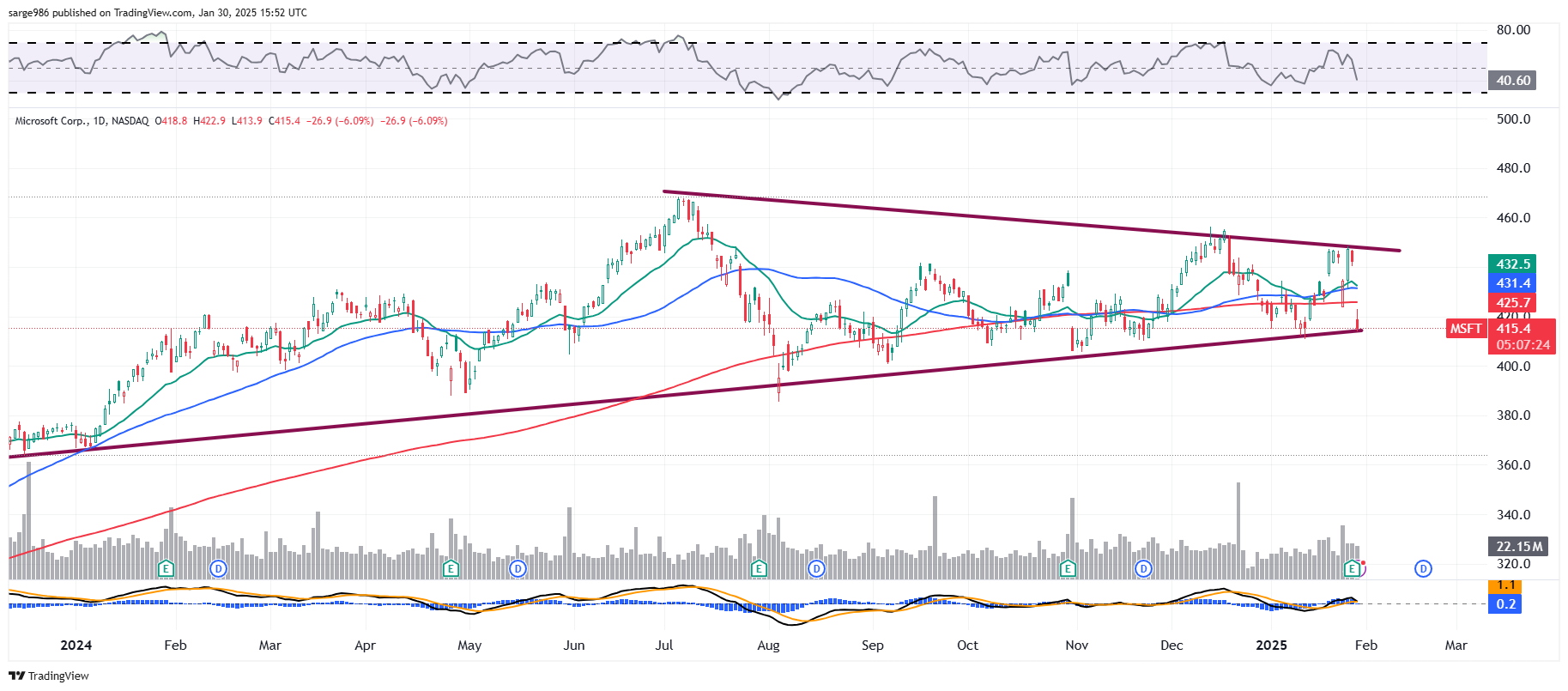
Readers will see that MSFT has been trading sideways for over a year now. What has developed is a triangle or pennant, but this is too long of a time frame to be a true pennant that has not yet closed. Upon closure, a violent move one way or the other could be possible or even probable. Today, we'll find MSFT trying to break through the lower trendline of the model.
Already below the stock's 21-day EMA, 50-day SMA and 200-day SMA with a weak reading for relative strength and a daily MACD that appears to be very close to turning bearish, I will be at the ready to reduce long-side exposure. Should I see that lower trendline act like resistance instead of support and I will aim to cut my long position by 35% to 40%.
I am not optimistic and will not be placing a target price on the stock until it gives me a technical reason. In the meantime, for the bulls, your upside pivot is the 200-day SMA. The low of the day on January 14 was $410. Let's call that my current line in the sand.
At the time of publication, Guilfoyle was long MSFT equity.