The '4-Trillion Dollar Company' Has a New Target Price
Better, stronger, faster ... how I'm handling the world's first 'bionic' company, Nvidia; also, Apple needs new leadership, and Trump fires off more letters and the market shrugs.
You've reached your free article limit
You've read 0 of 1 free Pro articles.
The president of the United States sent more letters on Wednesday. Letters addressed to the heads of state of the Philippines, Brunei, Moldova, Algeria, Iraq, and Sri Lanka informed those leaders that tariffs on goods exported to the United States from their nations were headed higher on Aug. 1. unless they make an effort to come to an agreement with this administration. Markets did not care. Not even a little. The president also sent a sharply worded letter to Brazil's leftist leader Luiz Inacio Lula da Silva threatening tariffs of a whopping 50% on Brazilian goods exported to the U.S.
This letter was different from the rest of more than 20 letters already sent this week. Brazil does not run a goods-based trade surplus with the U.S. This letter concerned the political situation inside Brazil, where the president feels that "free speech" and "free elections" have come under attack.
Brazil is also the "B" in the BRICS acronym, and we all know how the president feels about that group's attempts to find a way around relying upon the U.S., not just as the planet's leading reserve currency, but also for international trade. The U.S. is Brazil's second-largest trading partner. On Wednesday, U.S. financial markets still did not care. Brazil is likely to respond.
In other news, Pres. Trump announced overnight that the already announced 50% tariffs on imported copper would go into effect on Aug. 1, the same deadline date mentioned in the national tariff letters. Nations most impacted by this tariff on copper would be Chile, Canada and Mexico. Industries impacted would be defense, the autos, manufacturers of appliances and to some degree, the homebuilders.
Solid Auction?
On Wednesday, the U.S. Treasury Department auctioned off $39 billion worth of new Ten-Year Notes. The auction came off much better than feared after Tuesday's sloppy Three-Year Note auction, where foreign participation tumbled. A high yield of 4.362% was awarded, which stopped through the "when issued" at the time by 0.3 basis points. This was the fifth consecutive monthly stop-through for this series. Bid to cover printed at 2.61, well above the six-month average of 2.56.
But this auction was not perfect. Foreign participation did slow down here as well. Indirect Bidders, or foreign accounts, took down 65.4% of the issuance. That's not really weak, but it was down from 70.6% a month ago for brand new U.S. Ten-Year paper. Domestic demand, however, soared. Direct Bidders, or domestic accounts, took home 23.7% of the entire auction, which was the largest slice of the pie for the home team for this series since March of 2014.
At the end of the day, Dealers were stuck with just 10.9% of the auction, up from June, but still one of the lowest totals in percentage terms in the history of the Ten-Year. This afternoon, the U.S. Treasury will auction off $22 billion worth of new Thirty-Year Bonds.
The Minutes
The Federal Reserve Bank released the minutes of the June 18 policy meeting on Tuesday afternoon. The markets didn't really care. There was some warning in the Minutes, as a "majority saw slower economic growth going forward." One might think that such forward looking sentiment might result in lower short-term interest rates, but "several said current Fed Funds Rate may not be far above its neutral rate."
Hmm. Still, "Most participants assessed that some reductions in the target rate for the federal funds rate this year would likely be appropriate." The same group noted that "upward pressure on inflation from tariffs may be temporary or modest." Well, no spit, cowboy. Thanks for waking up. The sale of goods only makes up about a third of the U.S. economy in the first place, so there was never the threat of a post-Covid-like surge in the first place, but thanks for scaring the masses.
Oh, I liked this quote: "A couple of participants noted that, if the data evolve in line with their expectations, they would be open to considering a reduction in the target range for the policy rate as soon as at the next meeting (July 30)." Tell me you're writing about Fed Governors Christopher Waller and Michelle Bowman without telling me you're writing about Christopher Waller and Michelle Bowman.
Marketplace
Wednesday was a good day for Treasury debt securities as well as for equities. That said, equity performance was somewhat lumpy. Winners beat losers by about 7 to 4 at the NYSE and by slightly less than 2 to 1 at the Nasdaq. That seems just fine, but the action was definitely much stronger across Nasdaq-listings than it was for those names listed at the NYSE.
The Nasdaq Composite gained 0.94% for the day as the S&P 500 added 0.61%. Small caps were strong, as the Russell 2000 tacked on 1.07%. But both the Dow Transports and the KBW Banks closed in the red for the session. The Philly semiconductors were up a modest 0.44% despite the fact that Nvidia NVDA kissed a valuation of $4 trillion during the session.
Eight of the 11 S&P sector SPDR ETFs closed out the day in the green, led by the Utilities XLU, but lagged by the Staples XLP as no fund among the 11 closed more than 1% away from where they went out on Tuesday afternoon. Advancing volume took a commanding 74.2% share of composite Nasdaq-listed trade as trade across those listings popped for impressive 18.3% day over day growth.
Meaningful? More like hard to ignore. I'd believe it to be more meaningful, though U.S. equities are still in our uptrend, if advancing volume had not taken a share of just 51.4% across NYSE-listings for the day on composite NYSE-listed trade that decreased by a nasty looking 16.1% day over day. Interesting.
Sour Apple
Are investors losing confidence in Apple AAPL? I know I did a long time ago. The company announced this week that COO Jeff Williams would retire later this year but will continue to lead the design team. That was called a demotion back before I abandoned the great American corporate machine to run my own show. The firm will also fill its vacant chief financial officer slot with Sabih Khan, who also comes from operations. This all comes after losing AI executive Ruoming Pang to Meta Platforms META.
Is this time of chaos at the upper levels of Apple, a good time to re-initiate the name after having exited more than half a year ago? I'm not convinced. Apple has had its head up its proverbial tail for some time now. Almost everyone in high-tech is now executing at a higher level than Apple. This is still a great cash flow stock due to its ecosystem that keeps customers captive, but continued complacency will eventually threaten even that built-in advantage.
I am not saying that Apple is a lost cause, far from it. I am saying that Apple is nowhere near the sure thing that the stock historically was. Now, Apple will have to pretend that we're all from Missouri. They have to show us. They could start by searching for a more aggressive (on the innovation side, not on the financial engineering side) chief executive.
Four Trillion Bucks
On Wednesday, shares of Nvidia traded as high as $164.42, before closing at $162.88. At $164.21, the company is worth a cool $4 trillion. For comparison's sake, America's team, Microsoft MSFT is currently worth $3.69 trillion and key competitor Advanced Micro Devices AMD is worth just $223 billion. This morning, Bloomberg News is reporting that CEO Jensen Huang will meet with senior Chinese officials in Beijing next week. Apparently, Huang will try to demonstrate the company's commitment to its probably second most important market, despite export curb restrictions that are holding back his company's total sales and profitability as Chinese competitors play catch up.
How Huang comes out of this meeting will be key. So will be what comes of the continued negotiations between Washington and Beijing that come with their August 12 deadline of their own. The stock? Let's take a look...
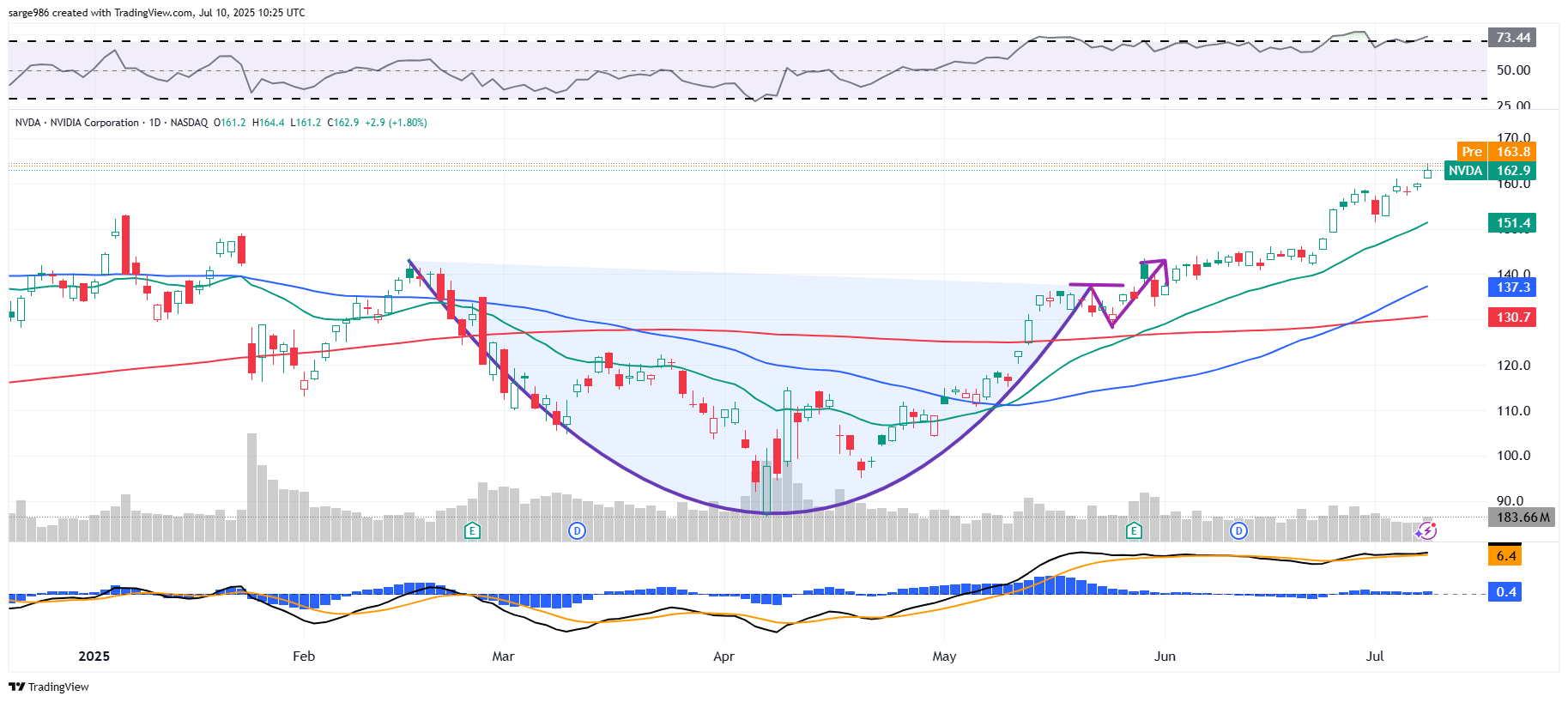
NVDA is still breaking out from the cup-with-handle pattern that I showed readers back on May 29. My $165 target price has essentially been met and will likely be surpassed this week. While we do not yet have anything that could act as a new pivot, we can model a 25%-plus move off of that pivot, which might actually be conservative given Nvidia's history. I had previously modeled for a 20% run from pivot.
Nvidia Target, Strategy
Target Price: $175 (up from $165)
Pivot: $137
Add: Down to the 50-day Simple Moving Average
Panic: Loss of the 200-day SMA
Economics
(All Times Eastern)
08:30 - Initial Jobless Claims (Weekly): Expecting 239K, Last 233K.
08:30 - Continuing Claims (Weekly): Last 1.964M.
10:30 - Natural Gas Inventories (Weekly): Last +55B cf.
1:00 p.m. - Thirty-Year Bond Auction: $22B.
The Fed
(All Times Eastern)
10:00 - Speaker: St. Louis Fed Pres. Alberto Musalem.
1:15 p.m. - Speaker: Reserve Board Gov. Christopher Waller.
2:30 - Speaker: San Francisco Fed Pres. Mary Daly.
Today's Earnings Highlights
(Consensus EPS Expectations)
Before the Open: CAG (.58), DAL (2.08), HELE (.91)
After the Close: LEVI (.14), PSMT (1.13), WDFC (1.40)
At the time of publication, Guilfoyle was long NVDA, MSFT, AMD equity.