Target Urged to Make Drastic Leadership Change After 'Profoundly Awful' Stock Move
The retail giant badly missed on Wall Street's expectations and it's becoming clear there's a problem at the top.
You've reached your free article limit
You've read 0 of 1 free Pro articles.
After a while, it's not the business. After a while, it's not the lay of the land. After a while, when a business so obviously underperforms both its competitors and its own expectations, it has to be something else.
How Target CEO Brian Cornell has managed to hold on to that position over these past few years is simply incredible.
National broadline retailing chain Target TGT released the firm's first fiscal quarter financial results early on Wednesday morning. Those results were not pretty.
For that three-month period, which ended May 3, the firm posted an adjusted EPS of $1.30 (GAAP EPS: $2.27) on revenue of $23.846 billion. Those top- and adjusted bottom-line results both badly missed Wall Street's consensus view, while the revenue print reflected a year-over-year contraction of 2.8%.
Merchandise sales were down 3.1% from the year-ago comparison, as comparable store sales decreased by a stunning 5.7%, partially offset by 4.7% growth in digital sales. Across the chain, the number of transactions decreased by 2.4% as the average ticket size decreased by 1.4%. For the same quarter, key competitor Walmart WMT grew comp sales 4.5%, grew total transactions by 1.6% and grew average ticket size by 2.8%. Walmart also grew its e-commerce business by 22% globally and 21% in the U.S.
Ouch!
For Target, this was the third quarter in five that the firm failed to both meet Wall Street's projections for adjusted profitability and Wall Street's expectations for total revenue generation. Going further back, Target has failed to meet earnings expectations for six of the past 13 quarters.
The firm's results have not measured up well in direct comparison to either Costco COST or Amazon AMZN, whose retail operations are somewhat adjacent in nature, and obviously as just demonstrated, have not measured up well at all against Walmart, which is the firm's closest competitor and arch-rival.
Operations
As revenue generation contracted 2.8% to $23.846 billion, the cost of those sales decreased 2% to $17.128 billion. Operating expenses dropped 10.8% to $4.591 billion, while depreciation and amortization increased 6% to $655 million. That left a GAAP operating income of $1.472 billion, which was good for 13.6% year-over-year growth.
After accounting for interest, non-operating income and expenses and taxes, Target produced a GAAP net income of $1.036 billion (+10%), which works out to $2.27 per fully-diluted share. This compares to the year-ago comparison of $2.03. However, after adjusting for after tax net gains on credit card interchange fee settlements, EPS landed at $1.30 versus that same $2.03.
Guidance
For the full fiscal year, Target now projects a low-single digit decline in sales and a GAAP EPS of $8.00 to $10.00. After adjusting for the same ongoing litigation settlements mentioned in the operations section for the quarter reported, EPS is seen at $7.00 to $9.00. This brings the midpoint of the range well below the $8.59 or so that Wall Street had in mind.
Send in the Clown
Chairman and CEO Cornell commented in the press release:
"In the first quarter, our team navigated a highly challenging environment and focused on delivering the outstanding assortment, experience and value guests expect from Target."
Cornell added:
"While our sales fell short of our expectations, we saw several bright spots in the quarter, including healthy digital growth, led by a 36 percent increase in same-day delivery through Target Circle 360, and our strongest designer collaboration in more than a decade, Kate Spade for Target. While these highlights reinforce our confidence in the underlying health of our business, we're not satisfied with current performance and know we have opportunities to deliver faster progress on our roadmap for growth."
Not satisfied? I should hope not.
Fundamentals
For the period, Target generated operating cash flow of $275 million, down 75% from the year-ago comp. "Out of this number" came capex spending of $790 million, leaving free cash flow of -$515 million, down from the year-ago print of $427 million. It gets worse. During the quarter, Target also repurchased $250 million in common stock while paying out $510 million in cash dividends to shareholders. That's right, the firm returned $760 million to shareholders "out of" negative free cash flow.
Turning to the balance sheet, Target ended the quarter with a cash position of $2.887 billion (-39.4% in just three months) and inventories of $13.048 billion. This puts current assets at $17.759 billion. Current liabilities add up to $18.991 billion including short-term term debt of $1.139 billion. That leaves the firm's current ratio at 0.94, which is better than Walmart's but still not really acceptable.
Total assets amount to $56.185 billion, which does not include any value for intangible assets. We appreciate that. Total liabilities less equity comes to $41.238 billion including long-term debt of $14.334 billion. No, this is not a strong balance sheet. That said, the firm's current ratio is up from 0.86 a year ago, so there is improvement. Maybe not repurchase common stock while burning cash? Just an idea.
My Thoughts
Well, if readers have made it this far, then they likely know that I find Target's stock to be less than investable. Negative free cash flow. Low quality balance sheet. Getting its tail kicked by Walmart, Amazon and Costco. Management blamed the rollback of its DEI hiring practices and tariffs for its poor quarterly results.
Interestingly, while Target's competitors face tariff-related costs every bit as much as Target does and have insisted that price hikes could be on the way, none seemed to have already suffered damage at the level that Target has experienced. I wonder how much the stock would rise in price on any given day if a change at the top were announced. I think at this point, something like that has to be seriously considered.
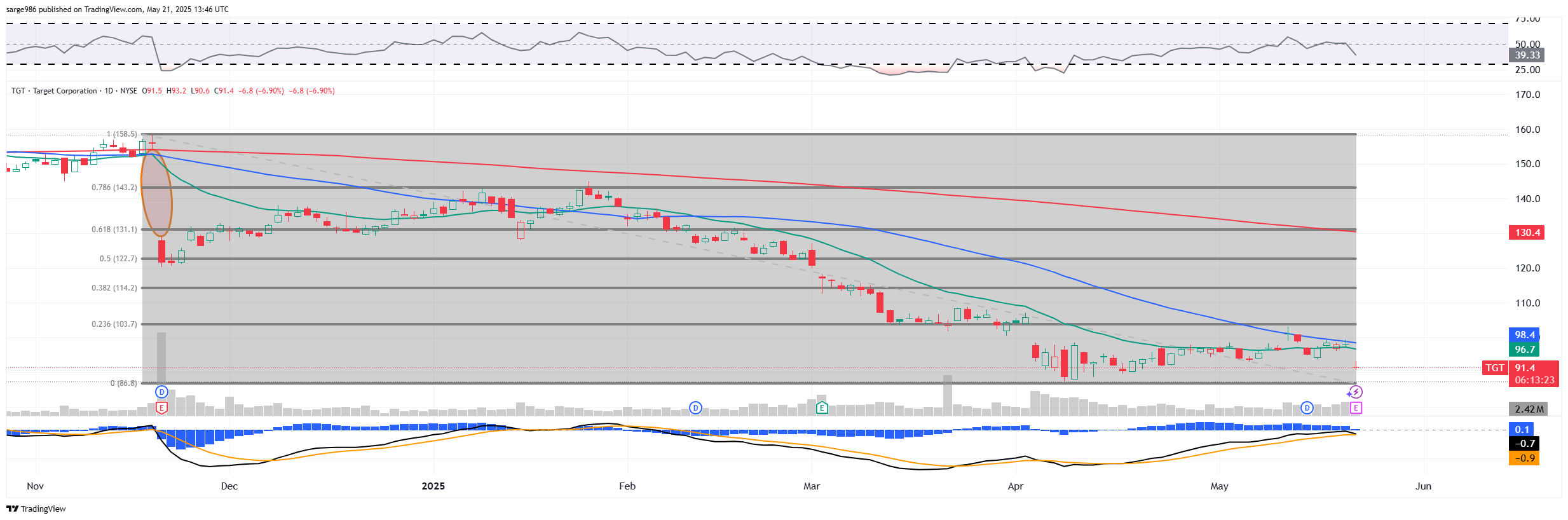
Readers will see that earlier this May, TGT was rejected very close to its 23.6% Fibonacci retracement level of the November through early April sell-off. Let's get rid of the Fib-model so I can show you something else.
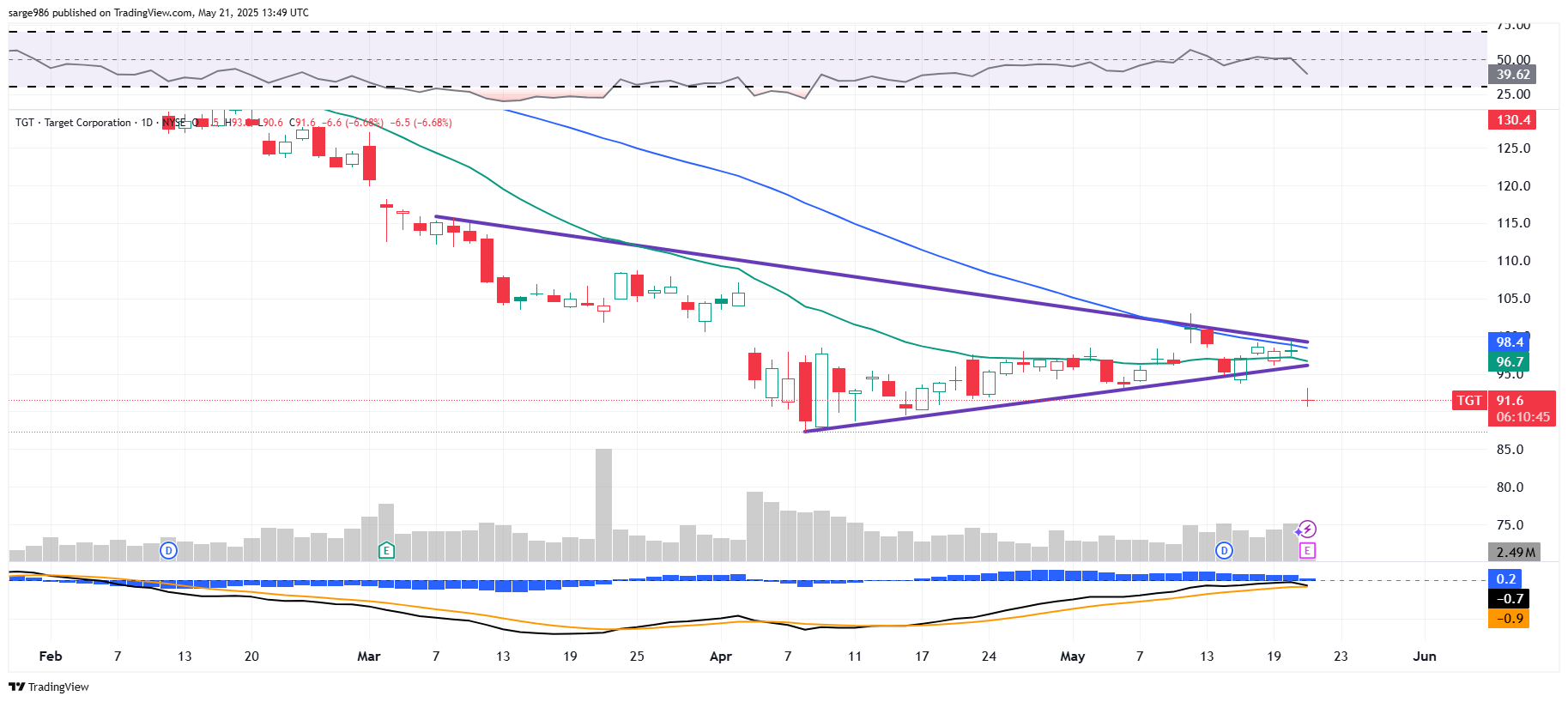
Readers will now see TGT breaking out to the downside, coming out of a closing pennant formation. The stock now trades at a rough 30% discount to its own 200-day SMA, which is profoundly awful. Relative strength is weakening rapidly and the daily MACD is now threatening a likely bearish cross-under of its 26-day EMA by its 12-day EMA with both in negative territory.
Bottom Line?
I wouldn't buy shares of TGT with your money, even if I hated your guts. OK, well, maybe if I hated your guts.
At the time of publication, Guilfoyle had no positions in any securities mentioned.