Can Surprise Guidance Return Apple to Blue Chip Status?
Apple earnings used to be "the" earnings on Wall Street but its market impact has not been the same in recent quarters.
You've reached your free article limit
You've read 0 of 1 free Pro articles.
Apple's AAPL earnings release used to be "the" earnings release of the season. Don't get me wrong, but in recent years, in the hearts and minds of investors, and in terms of market impact, other Magnificent 7 names have taken on greater significance.
Stocks like Microsoft MSFT, Nvidia NVDA, Amazon AMZN and even Tesla TSLA have at times, had more of an overall market impact, even if they were not more widely held than was Apple at the time.
Really, expectations were not the greatest that we've ever seen for Apple this time around. Maybe that's why those long shares of this name have been pleasantly surprising. Oh, sure, iPhone sales disappointed. Performance in China disappointed, but then the improbable happened. For a firm best known for not even offering guidance or offering vague guidance at best, the guidance is what saved the overnight session for the stock.
For the firm's fiscal first quarter, which ended December 28, Apple posted a GAAP EPS of $2.40 on revenue of $124.3 billion. These top- and bottom-line results both exceeded Wall Street's expectations, while that sales print was good enough for year-over-year growth of 3.9%. That earnings number, $2.40 per share, was not only reflective of 10% year-over-year growth, but also landed as a new all-time quarterly record for the firm.
Operations
Within that $124.3B revenue print, product sales increased 1.6% to $97.96 billion, while services-generated sales grew 13.9% to $26.34 billion. The product number was a slight miss, while the services number was a slight beat. The cost of those sales grew 2% to $66.025 billion (up 1.7% for products, +4.7% for services). This left a gross profit of $58.275 billion (+6.2%) on a gross margin of 46.9%, up from 45.9%. Product gross profit was up 1.3% as product gross margin dropped from 39.4% to 39.3%. Services gross profit was up 17.4% as services gross margin improved from 72.8% to 75%.
Operating expenses increased 6.6% to $15.443 billion, leaving an operating income of $42.832 billion (+4.7%) as operating margin grew from 33.8 to 34.5%. After accounting for other income and expenses, interest and taxes, GAAP net income printed at $36.33 billion, up 7.1% from the year-ago comparison. This works out to $2.40 per fully-diluted share, up from $2.18 for the same quarter last year.
Apple Sales Performance
By Category:
- iPhone generated revenue of $69.138 billion (-0.8%), falling short of estimates
- Mac generated revenue of $8.987 billion (+15.5%), decisively beating estimates
- iPad generated revenue of $8.088 billion (+15.2%), decisively beating estimates
- Wearables, Home & Acc. generated revenue of $11.747 billion (-1.7%), falling short of estimates
- Services generated revenue of $26.34 billion (+13.9%), beating estimates
Geographically:
- Americas generated revenue of $52.648 billion (+4.4%), beating estimates
- Europe generated revenue of $33.861 billion (+11.4%), decisively beating estimates
- Greater China generated revenue of $18.513 billion (-11.1%), falling well short of estimates
- Japan generated revenue of $8.987 billion (+15.7%), decisively beating estimates
- Rest of Asia/Pacific generated revenue of $10.291 billion (+1.3%), falling short of estimates
Apple Stock Fundamentals
For the period reported, Apple generated operating cash flow of $29.935 billion. Out of that number came capex spending of $2.94 billion, leaving free cash flow of $26.995 billion. From that number came $23.606 billion worth of repurchase common stock for the firm's treasury and cash dividends of $3.856 billion paid out to shareholders. Yes, capital returned to shareholders is usually considered to be sloppy cash flow management. In Apple's case, they are trying to zero out free cash flow to those returns and if they are off small, the cash on the balance sheet certainly is available.
Turning to the balance sheet, the cash position labeled as current stands at $53.775 with inventories at $6.911 billion. This places current assets at $133.24 billion. Current liabilities add up to $144.365 billion, including short-term debt of $12.843 billion and deferred revenue of $8.461 billion. These numbers are somewhat misleading as Apple has another $87.593 billion in marketable securities not labeled as current but would be considered to be current by most firms and most analysts. This makes the cash position something more like $141.368 billion and would make current assets more like $220.833 billion.
Total assets stand at $344.085 billion. The firm does not claim any value for goodwill or other intangibles, which we appreciate. Total liabilities less equity comes to $277.327 billion. The firm has long-term debt of $83.956 billion on the books, and that is a lot, but also more than enough cash to cover that debt and much of that debt was borrowed at much lower than market interest rates. This balance sheet is healthy.
Apple Guidance
During the call, Apple guided the current quarter towards revenue growth of low to mid-single digit growth on a percentage basis.
Wall Street was looking for about 4.1% growth, so this is in line with expectations. The firm accounted for a 2.5% negative impact from currency exchange rates when making these projections. Services revenue is seen growing in the low double digits, with the street looking for 11%. Gross margin is seen between 46.5% and 47.5%, putting the midpoint at 47%, which is just a hair better than the 46.9% that Wall Street had in mind. This guidance was enough to turn a sell-off into a rally overnight.
Wall Street
Since these earnings were released, I have come across 22 highly-rated (four-plus stars at TipRanks) sell-side analysts who have opined on AAPL. Among the 22, there are 15 "buy" or buy-equivalent ratings, four "hold" or hold-equivalent ratings and three "sell" or sell-equivalent ratings. One of the "holds" did not set a target price, so we are working with 21 of those.
The average target price across these 21 analysts is $255.33 with a high of $294 (Mike Ng of Goldman Sachs) and a low of $197 (Tim Long of Barclays). Once omitting those two as possible outliers, the average across the remaining 19 rises to $256.37. because I know you wanted to ask, the average "buy" target is $271,13, the average "hold" target is an even $232, and the average "sell" target is $199.67.
My Thoughts on Apple Stock
Not a bad quarter considering the obviously disappointing iPhone sales and the sagging performance in China. The guidance was a game changer, but as we see here, there are still many more highly-rated analysts rating this name a hold or a sell than we are used to seeing for tech stocks or really any blue-chip name. Cash flows are excellent, and the balance sheet is still strong. Is that enough?
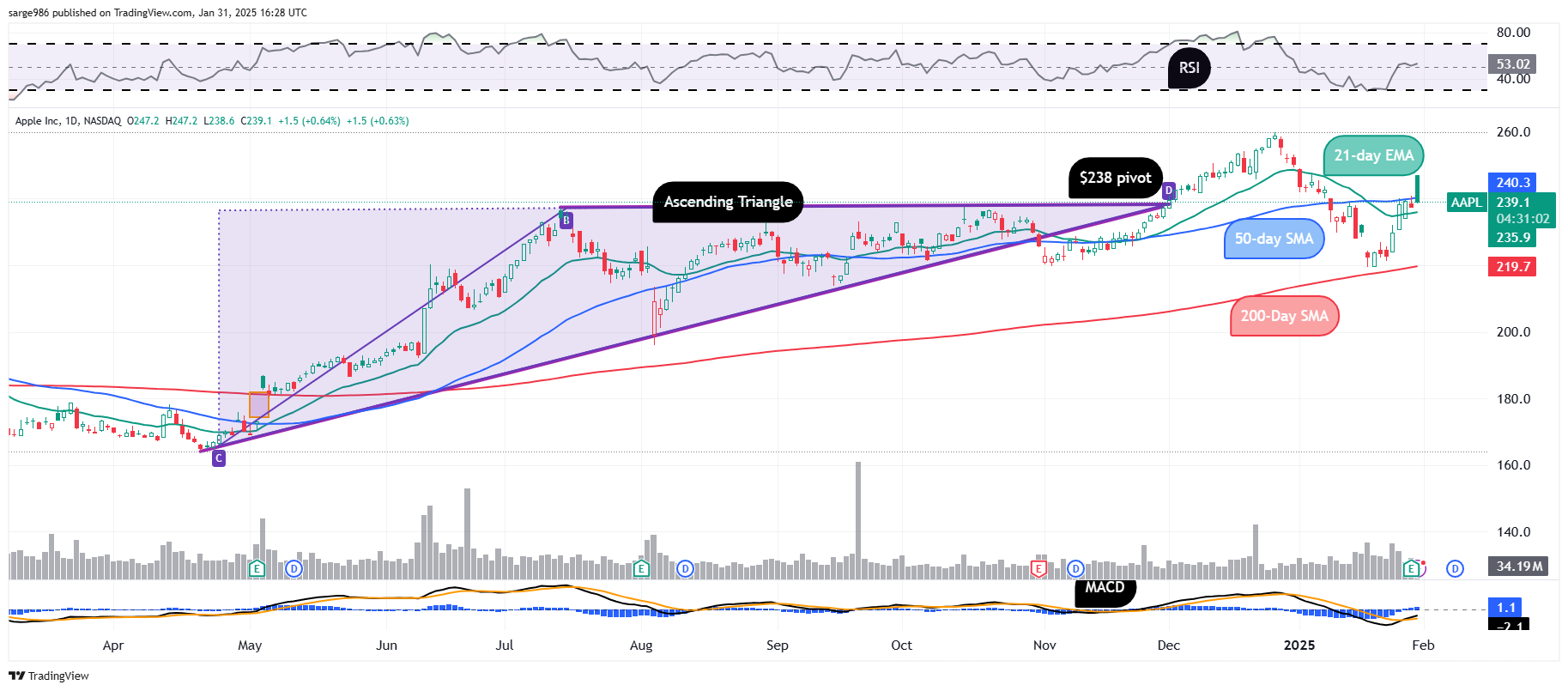
Readers will see that AAPL broke out from that ascending triangle in early December and then failed to hold that breakout. The stock has waffled since, without developing any kind technical pattern that I am familiar with. I got out of this name shortly after it was obvious that the breakout had failed. I really do not see a catalyst for owning this stock technically unless that 50-day SMA, taken back on Friday morning, can be held.
Relative strength is better, but still not good. The daily MACD is still set up somewhat bearishly despite the crossover of the 26-day EMA by the 12-day EMA. Both of those lines remain below the zero-bound. I had written to you weeks ago, warning that AAPL was likely to test its 200-day SMA. The stock passed that test. Could there be a re-test? Of course.
Put it this way, if the stock does hold the 50-day line, it could trade as high as $275 to $280, in my opinion. If that happens, I'll probably own the stock, but I'll be late to the party. Is $275 more likely than $220? I don't know. If the stock makes a new post January 21 low, it could be messy. AAPL will not be a cornerstone of my portfolio anytime soon.
At the time of publication, Guilfoyle was long MSFT, NVDA and AMZN equity.