Snowflake Stock Takes Beating After Stunning Deterioration
Is it time to buy the dip or has the name entered strong sell territory?
You've reached your free article limit
You've read 0 of 1 free Pro articles.
On Wednesday evening, big data warehouser and analytical services provider Snowflake (SNOW) released the firm's fiscal third quarter financial results.
For the period ended October 31, Snowflake posted an adjusted EPS of $0.35 (GAAP EPS: -$0.87) on revenue of $1.213 billion. These top- and bottom-line numbers, adjusted or not, all beat Wall Street's expectations, while that revenue print was good enough for year-over-year growth of 28.4%.
The firm now boasts 688 customers that contributed at least $1 million in product-driven revenue. The firm now has 766 Forbes Global 2000 customers. Remaining Performance Obligation is up 37% year over year to $7.88 billion. Yet, the stock has taken a rather serious beating overnight. The firm did increase its forward-looking guidance, and above consensus view too.
Yet, some are pointing toward the firm's product-driven FQ4 revenue guidance as less than they had hoped for. That and a forward-looking PE ratio of about 221 were enough for traders to reduce exposure since the closing bell in New York. This is that story. Let's get started.
Operations
As revenue was growing 28.4% to $1.213 billion, the cost of that revenue increased 21.8% to $390.873 million. This left a gross profit of $822.036 million (+32.3%) on a gross margin of 67.8%, up from 65.9%. On a GAAP basis, operating expenses printed at $1.152 billion (+16.7%), leaving a GAAP operating income/loss of -$329.473 million, up from last year's comp of -$365.457 million. After accounting for interest, other income and expenses and taxes, GAAP net income/loss attributable to the shareholders landed at -$293.957 million, up from -$324.279 million. This worked out to a GAAP EPS of -$0.87, up from last year's -$0.98.
After adjusting primarily for stock-based compensation (of $442.392 million), the firm adjusted operating income up to $131.313 million (+123%) on an operating margin of 11%, up from 6%. The firm also adjusted its net income up to $131.183 million (+79.2%). This works out to an adjusted EPS of $0.35, up from the year ago comp of $0.20.
Once again, I will briefly lament firms that adjust for stock-based compensation. Operating expenses that recur every quarter are ordinary. Ordinary operating expenses are part of the business and are not adjusted for. If that means that your business is not profitable, then it is not profitable.
Either stop camouflaging your losses or stop paying the talent so much when you could reward shareholders. Maybe you could consider it a re-investment in the business adjacent to capex spending, but that would put a dent in free cash flow.
OK, rant over. Even some of my favorite companies do this. I just don't have to like it.
Guidance
For the current quarter, Snowflake is guiding product revenue to $1.195 billion to $1.2 billion. This takes the low end of the range slightly above the $1.9 billion that Wall Street was looking for. The firm is also projecting an adjusted operating margin of 7%, which would be down sequentially from the third quarter's 11%.
For the full year, the firm sees product revenue of $4.446B, which would be good for 28% annual growth. That was up slightly from prior guidance of $4.4B and above the street's consensus view which was for $4.41B. The firm also projects a full year adjusted operating margin of 9% and a free cash flow margin of 25%.
Fundamentals
For the period, Snowflake generated operating cash flow of $137.519M. Out of that number came capex spending of $23.905M. This left free cash flow of $113.614M, which works out to a 9% free cash flow margin by the way. It also means that the firm almost quadrupled free cash with stock-based compensation. Yikes. I'd still knock them if those were dividend payments to shareholders, but this? The firm also repurchased $232.896M in common stock during the quarter.
Snowflake ended the quarter with a cash position of $3.353 billion (-27.7% over nine months) and current assets of $4.623 billion. Current liabilities add up to $3.383 billion at the headline, but that does include $2.424 billion in deferred revenue. This puts the headline current ratio at 1.37, which is still healthy. However, once adjusted for those deferred revenues, which are not true financial obligations (unless undelivered), that ratio adjusted to 4.82. That is very strong.
Total assets amount to $8.23 billion. Entries for goodwill and other intangibles make for just 17% of that total, which is fine. Total liabilities less equity comes to $6.097 billion. That does include convertible senior notes of $2.278 billion. The firm does have the cash to take care of this, but know that it could at some point, dilute the equity. Overall, though not what it used to be, this is still a very healthy balance sheet.
Opinion
I've noticed at least 27 reiterations across the street for SNOW on Thursday morning. Twenty six of them were either "buy" or buy-equivalent ratings. I have noticed 12 target price increases. As a "Palantir" guy, and maybe the Palantir (PLTR) guy, I really cannot throw stones at valuation. Unless everything is not perfect. Unlike Palantir, everything is not perfect.
Wall Street is punishing SNOW on Thursday morning, and I am not buying the dip. I had intended to get long this stock if it came in. Writing this article, I changed my mind.
I don't like that the firm sets so much aside for stock-based compensation, which forces it into a position where this is not a profitable company. In fact, it is not even close to becoming one. Palantir pays its people, too, but it does allow the firm to remain profitable. The guidance is not bad, but good enough for a firm valued at 221 times forward looking earnings? That's a lot to ask.
Cash flows are not that impressive. The balance sheet is still healthy, but the stunning deterioration of the cash position in less than a year is something to keep an eye on.
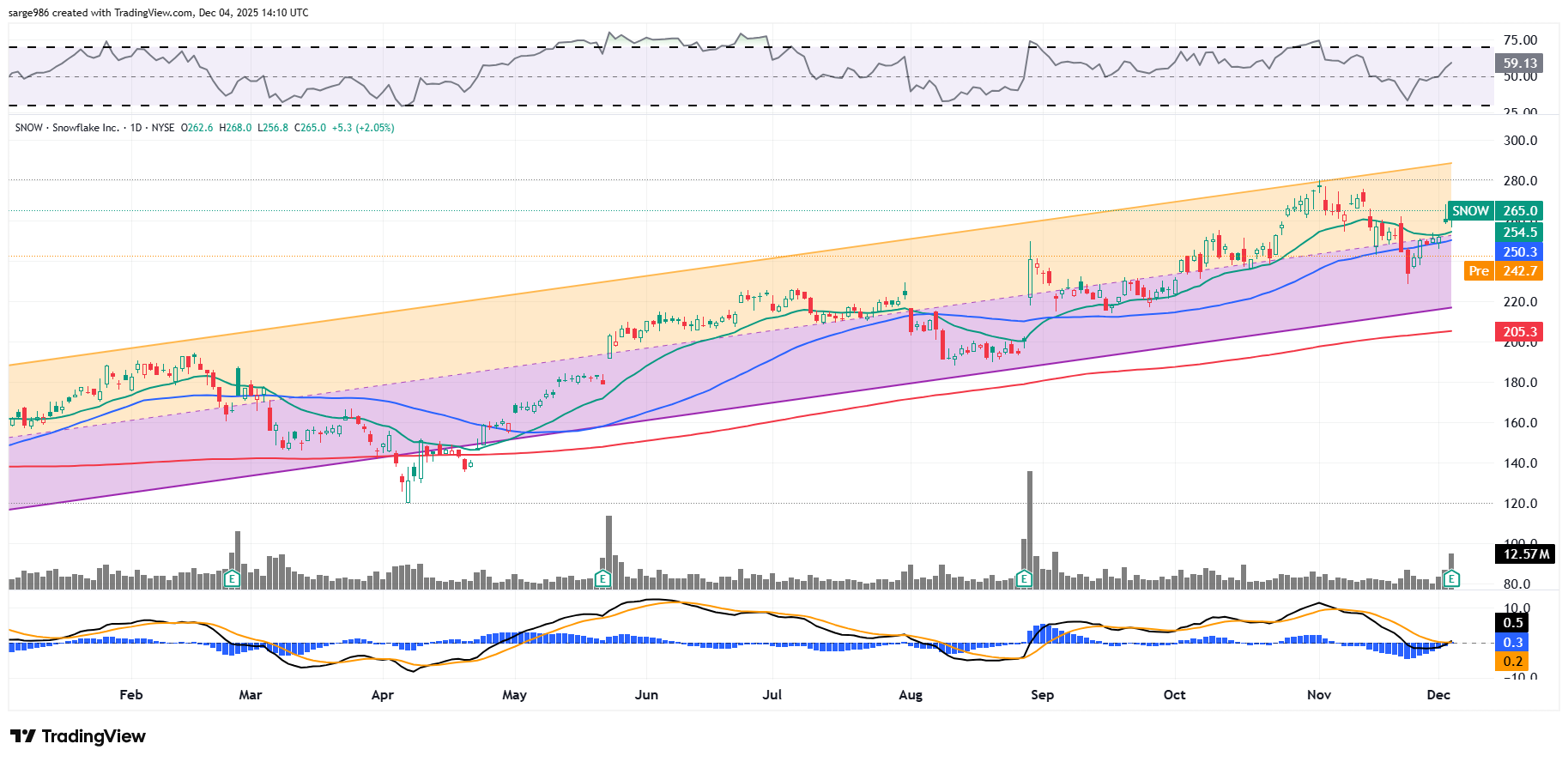
The general bullish trend in this stock is not yet in danger of collapsing. That said, the stock will likely lose its 50-day SMA and 21-day EMA this morning. If not retaken, this will most likely cost the stock the support of both the swing crowd and at least some portfolio managers. As far as the indicators are concerned, relative strength tumbled after the opening and the daily MACD, which was set up to go bullish on Thursday morning, will enter into a danger zone as the nine-day EMA, 12-day EMA and 26-day EMA are all likely to fall below the zero-bound.
Is Snowflake a "strong sell?" I don't know if I would go that far. For me, this stock is definitely not, at this time, a "buy."
At the time of publication, Guilfoyle was long PLTR equity.