PepsiCo Is Now a Screaming Short Sitting on a 'House of Cards'
Pepsi posted an earnings beat, but its balance sheet belongs in the junk food aisle.
You've reached your free article limit
You've read 0 of 1 free Pro articles.
Early on Tuesday morning, PepsiCo (PEP) released its fiscal fourth-quarter financial results. For the period ended December 27, Pepsi posted adjusted EPS of $2.26 ($1.85) on revenue of $29.343 billion. These top and bottom-line results both beat Wall Street expectations, while revenues grew 5.6% on a year-over-year basis.
The company also announced a 4% increase of its annual dividend to $5.92 per share for a forward yield of 3.81%. The stock is trading higher in response to the release and is now up 11% year to date versus an S&P 500 that's up 1.6%. Kudos to Doug Kass who made PEP his stock of the year for 2026.
Operations
As revenues rose 5.6%, the cost of those sales grew 4.1% to $13.723 billion. This left a gross profit of $15.62 billion (+6.9%) on a gross margin of 53.2%, up from 52.6% for the year-ago comp. On a GAAP basis, operating expenses dropped 2.4% to $12.063 billion, leaving GAAP operating income of $3.557 billion (+58.1%, no joke). That put the GAAP operating margin at 12.1%, up from just 8.1%.
After accounting for interest, other income & expenses and taxes, GAAP net income attributable to shareholders lands at $2.540 billion (+66.8%). That works out to $1.85 per fully diluted share, up from $1.11 for the year-ago period. After adjustments, mostly for restructuring charges, fully diluted EPS prints at $2.26, up from the year-ago comparison of $1.96.
Segment Performance
- PepsiCo Foods North America generated revenue growth of 1.5% but suffered a 6% drop in operating income.
- PepsiCo Beverages North America generated revenue growth of 4%, producing a change in operating income considered less than meaningful.
- International Beverages Franchise generated revenue growth of 3.5%, producing a 116% increase in operating income.
- Europe, Middle East & Africa generated revenue growth of 12%, producing a 72% increase in operating income.
- Latin America Foods generated revenue growth of 11%, producing a 15% increase in operating income.
- Asia Pacific Foods generated revenue growth of 5%, producing a change in operating income considered less than meaningful.
Guidance
For the full year, PepsiCo sees organic revenue growth of between 2% and 4%. Core constant (ex-FX) EPS is projected to grow between 4% and 6%.
The company also sees capital spending at less than 5% of net revenue and a free cash flow conversion ratio of 80%+.
Fundamentals
For the full fiscal year 2025, PepsiCo generated operating cash flow of $12.087 billion. Out of that came capex spending of $4.415 billion, leaving free cash flow of $7.672 billion. Out of that number came $7.638B in cash dividends to shareholders and $1 billion in repurchased common stock for the corporate treasury. No, that does not exactly add up.
Turning to the balance sheet, PepsiCo ended the period with a cash position of $9.53 billion and inventories of $5.845 billion. That puts current assets at $27.949 billion. Current liabilities add up to $32.764 billion, including short-term debt of $6.861 billion. If you were about to say, "Wow, Sarge, Pepsi's balance sheet looks more like a train wreck than a fortress" you'd be right. This puts its current and quick ratios at 0.85 and 0.67, respectively.
Given that Pepsi does generate healthy cash flows, this balance sheet is truly a disgrace for a major firm. Management should be, but probably does not have the common sense to feel humiliated to have published this mess. I would just resign if it were me and get a job in the lumber aisle of my local building materials distributor. Sorry, it is what it is.
Total assets amount to $107.399 billion, only 18.8% of which is labeled as either goodwill or intangible. At least that's acceptable. Total liabilities less equity comes to $86.852 billion, including $42.321 billion in long-term debt. Another black eye for a company that only has a cash position of $9.5 billion and has to manage short-term debt of more than $6.8 billion. Yet, the dingbats on Wall Street have run the stock up going into earnings and are still buying it on Tuesday morning. No wonder Dougie took a hike on a sizable portion of his trade near the highs.
My Thoughts
If you've made it this far, then you know that I am far from impressed.
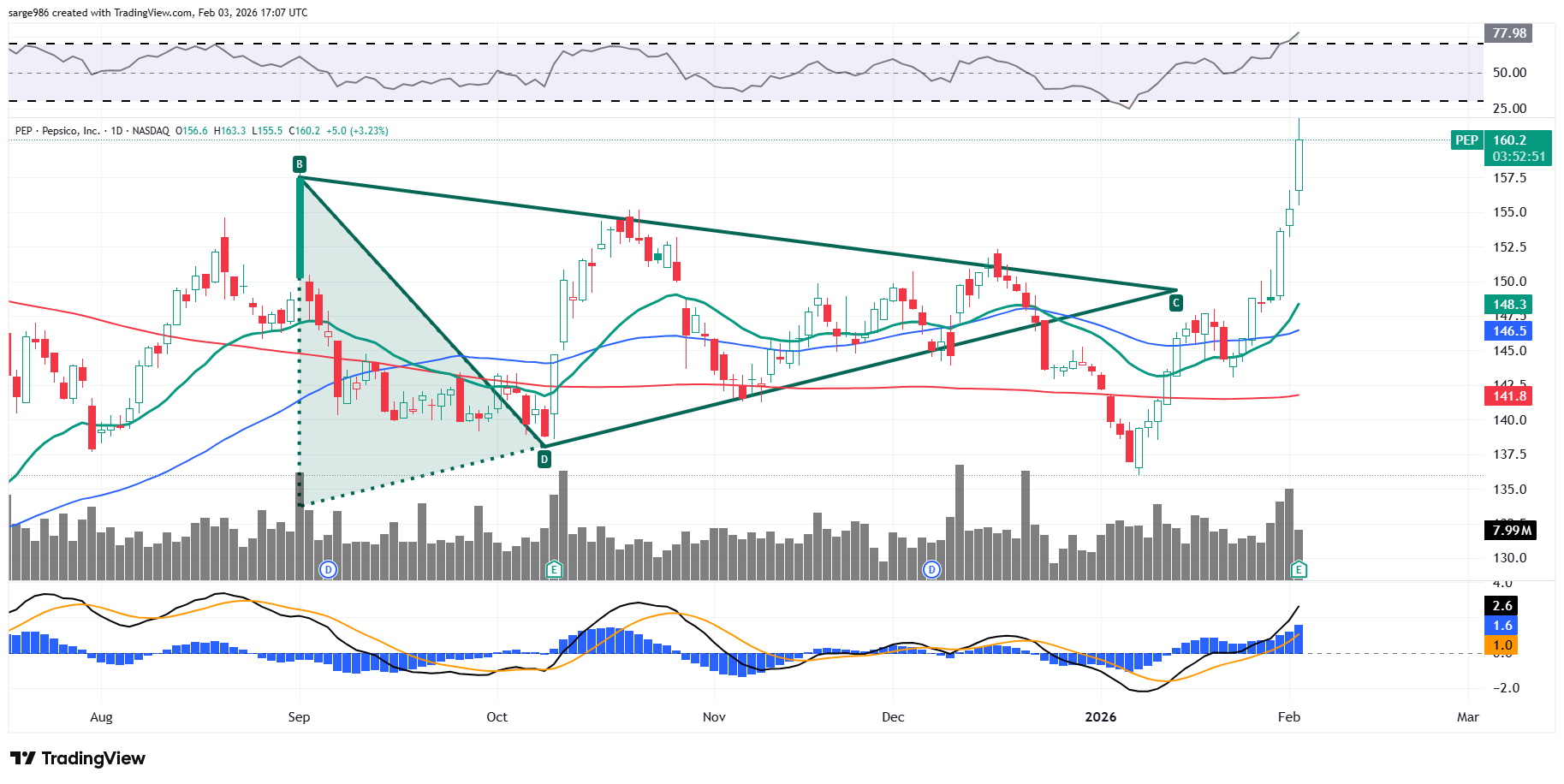
Readers will see in the chart above that PEP fell out of bed in early January coming out of a triangle pattern of coming volatility. The stock jerked high after that and has basically gone parabolic in February. Now we see that the castle is really a house of cards.
I believe that PEP is a screaming short and will be getting myself on that side of the football once this article becomes public information, so I don't front-run my own opinion. Sarge out.
At the time of publication, Guilfoyle had no positions in any securities mentioned.