Oracle Slides as OpenAI Controversy, 'Modern Fraud' Claim Weigh on Stock
AI stocks continue to slump as Oracle is accused of questionable accounting practices.
You've reached your free article limit
You've read 0 of 1 free Pro articles.
Shares of Oracle (ORCL) have been in a tailspin in recent weeks. After the stock’s recent pullback, is the Austin, Texas- based enterprise software provider worthy of consideration, or should investors steer clear?
Oracle is at the center of a controversy surrounding AI-related stocks, as the company has made a major investment in OpenAI’s Stargate project. OpenAI came under scrutiny last week when CFO Janet Friar suggested that AI projects deserve partial backing from the U.S. government.
Accusations of Fraud
Oracle has also been swept up in the latest Michael Burry drama. The hedge fund manager behind "The Big Short" recently questioned Oracle’s accounting practices.
According to Burry, Oracle and Meta Platforms (META) are using accounting tricks involving depreciation. Specifically, Burry claims they are understating depreciation expenses.
Let’s say a company purchases a product with a life span of two years, after which time the product will presumably become outdated. By stretching the depreciation expenses across, say, six years instead of two years, the company is able to claim lower depreciation expenses on a per-year basis. This lowering of expenses results in higher earnings on a per-year basis.
Burry claimed on social media platform X that this tactic is “One of the more common frauds of the modern era.” According to his calculations, through 2028, Oracle will overstate earnings by 27%, and Meta Platforms by 21%.
Oracle’s Chart Tells the Story
I opened a small position in Oracle after the company’s recent earnings announcement, as explained here. Generally, I won’t buy a stock as it hits a fresh high, as I normally wait for a pullback.
Oracle’s chart provides a good explanation as to why buying at the highs can be risky. Oracle has broken below its 50-day moving average (blue line), and appears to be headed for its 200-day moving average (red), currently located near $209.
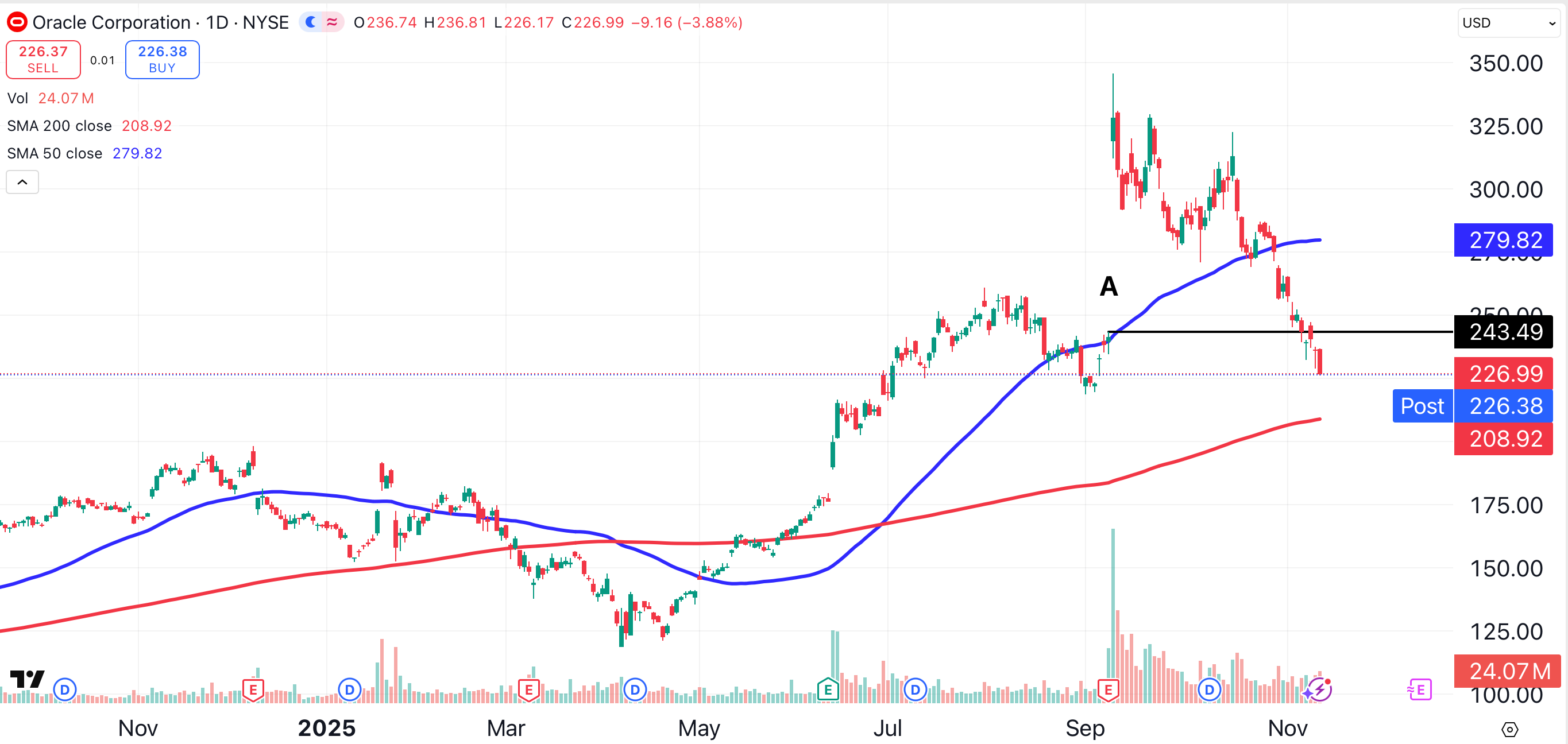
I was considering adding to my initial shares, but only if the stock managed to bounce from the lower end of its September 10 gap (point A). There was no bounce, and Oracle broke below the bottom of the gap, which came in at $243 (black solid line). That move took me out of the trade completely, and I'm not considering re-entry.
Is OpenAI an anchor dragging Oracle down? Is the company using accounting tricks to puff up its profitability?
By the time we’re able to answer those questions with certainty, it may be too late. There’s no fire, but there’s plenty of smoke surrounding Oracle, so I'd avoid this stock.
The Bottom Line
For a time, it seemed as if every AI-related trade had a chance of success. Now it’s possible that institutions are selling these stocks into rallies and rotating away from AI-related tech.
If that’s the case, we need to think more like the institutions — be less aggressive in this space, and use rallies to lighten up on existing positions. AI stocks have been very good to us until recently, so we must be careful not to overplay our hand.
At the time of publication, Ponsi had no positions in any securities mentioned.