Oracle Heading Toward 'Strong Sell' After Price Target Change
The software giant is up huge overnight but the lemmings aren't doing their homework.
You've reached your free article limit
You've read 0 of 1 free Pro articles.
It's hard to explain. Oracle ORCL is up huge overnight on Wednesday. I'm not sure it's warranted.
Software/data center/AI platform providing giant Oracle released the firm's fiscal first quarter financial results on Tuesday evening. The results were not stellar by any measure. The firm posted an adjusted EPS of $1.47 (GAAP EPS: $1.01) on revenue of $14.926 billion. While that top-line result was "good enough" for year-over-year growth of 12.3%, these top- and adjusted bottom-line numbers both fell short of Wall Street's expectations.
I thought about shorting these shares overnight. I really did. Only 1.35% of the float was held in short positions coming in, so this move is organic. That said, something just doesn't smell right.
Here's The Rub...
- Remaining performance obligation (RPO) was up 359% to $455 billion. This line is the primary reason why the stock has gone parabolic (+30%+) overnight.
- Cloud Revenue (IaaS and SaaS) was up 28% to $7.2 billion
- Cloud Infrastructure Revenue (IaaS) was up 55% to $3.3 billion
- Cloud Application Revenue (SaaS) was up 11% to $3.8 billion
- Fusion Cloud ERP Revenue (SaaS) was up 17% to $1 billion
- NetSuite Cloud ERP Revenue (SaaS) was up 16% to $1 billion
Operations
As mentioned above, revenue generation increased 12.3% on an annual basis to $14.926 billion. Within that number, Cloud sales grew 28% to $7.186 billion, software sales decreased 1% to $5.72 billion, hardware sales increased 2% to $670 million and services drove revenue of $1.349 billion (+7%). Total GAAP operating expenses grew 14% to $10.649 billion, leaving GAAP operating income of $4.277 billion (+7%).
After accounting for interest, other income and expenses and taxes, GAAP net income lanced at $2.927 billion (down small year over year). This works out to $101 a fully diluted share, down from the year ago comparison of $1.03.
The firm made adjustments for $1.124 billion in stock-based compensation, $420 million for the amortization of intangible assets and $402 million in restructuring costs. I guess I'll just have to look past the fact that it's absolutely ridiculous for a mature company that went public in 1986 to still be making adjustments for stock-based compensation. If you've been doing it for almost 40 years, little dudes, it's an ordinary operating expense. 'Nuff said about that.
On an adjusted basis, Operating income was up 7%, net income was up small and the $1.47 per share in earnings compares to $1.39 for the year-ago comp.
Guidance
There was no forward-looking guidance issued in the press release. During the call, CEO Safra Catz said, "For fiscal year 2026, we remain confident and committed to full year total revenue growth of 16% in constant currency."
For the current quarter, Catz added, "Total revenue are expected to grow from 12% to 14% in constant currency and are expected to grow from 14% to 16% in U.S. dollars at today's exchange rate. Total cloud revenue is expected to grow from 32% to 36% in constant currency and is expected to grow from 33% to 37% in USD. Non-GAAP EPS is expected to grow between 8% to 10% and between — be between $1.58 and $1.62 in constant currency. Non-GAAP EPS is expected to grow 10% to 12% and be between USD $1.61 and USD 1.65."
Q) Does anything there really knock your socks off?
A) Yeah, me neither.
Fundamentals
For the quarter, Oracle generated operating cash flow of $21.534 billion (+12.6%). "Out of that number" came capex spending of $27.414 billion (+249%), leaving free cash flow of -$5.88 billion (down from $11.271 billion). Despite a grotesquely negative print for free cash flow, Oracle still paid out $1.413 billion in cash dividends to shareholders.
Looking at the balance sheet, Oracle ended the period with a cash position of $11.005 billion and current assets of $24.634 billion. Current liabilities add up to $39.874 billion including shorter-term debt of $9.079 billion, but also deferred revenue of $12.098 billion (which is not a true financial obligation). That puts the firm's headline current ratio at an awful-looking 0.62. Once adjusted for those deferred revenues, this ratio rises to a still less than acceptable 0.88.
Total assets amount to $180.449 billion including $66.378 billion in goodwill and other intangibles. At almost 37% of total revenue that's a little bit on the high end of my comfort zone. Total liabilities less equity comes to $155.783 billion. That includes a jaw-dropping $82.236 billion in long-term debt and no non-current deferred revenues.
Doug Kass Was All Over This
Q) If RPO stands at a stunning $455 billion (+359%), then how is deferred revenue for the coming twelve months (current) just $12.098 billion and how is there no entry for non-current deferred revenue?
A) I can only think that not too many of Oracle's clients have paid anything to nail down these future orders. These orders likely are not guaranteed as there has been no down payment made.
Our dear friend and colleague Dougie Kass was all over that RPO print on Tuesday night at his Diary and he went back to it on Wednesday morning. I very likely only caught this bizarre mismatch between deferred revenue and remaining performance obligation as early as I did because I pay attention to Doug.
My Thoughts...
I don't care who is upgrading ORCL on Wednesday morning. I don't care what the lemmings are doing with the respective target prices. Half of them don't do their own homework anyway. The questions for me are as follows:
Do I want to pay up more than 30% for a firm with negative free cash flow?
Do I want to pay up more than 30% for a firm that is suffering firm margin contraction?
Do I want to pay up more than 30% for a firm that was already trading at 35 times forward looking earnings?
Do I want to pay up more than 30% for a firm whose balance sheet any CFO should be too embarrassed to publish?
You know the answers to these questions. For me, they are "no." I have no position. If I were long the stock, I would take profits on at least a significant partial on Wednesday.
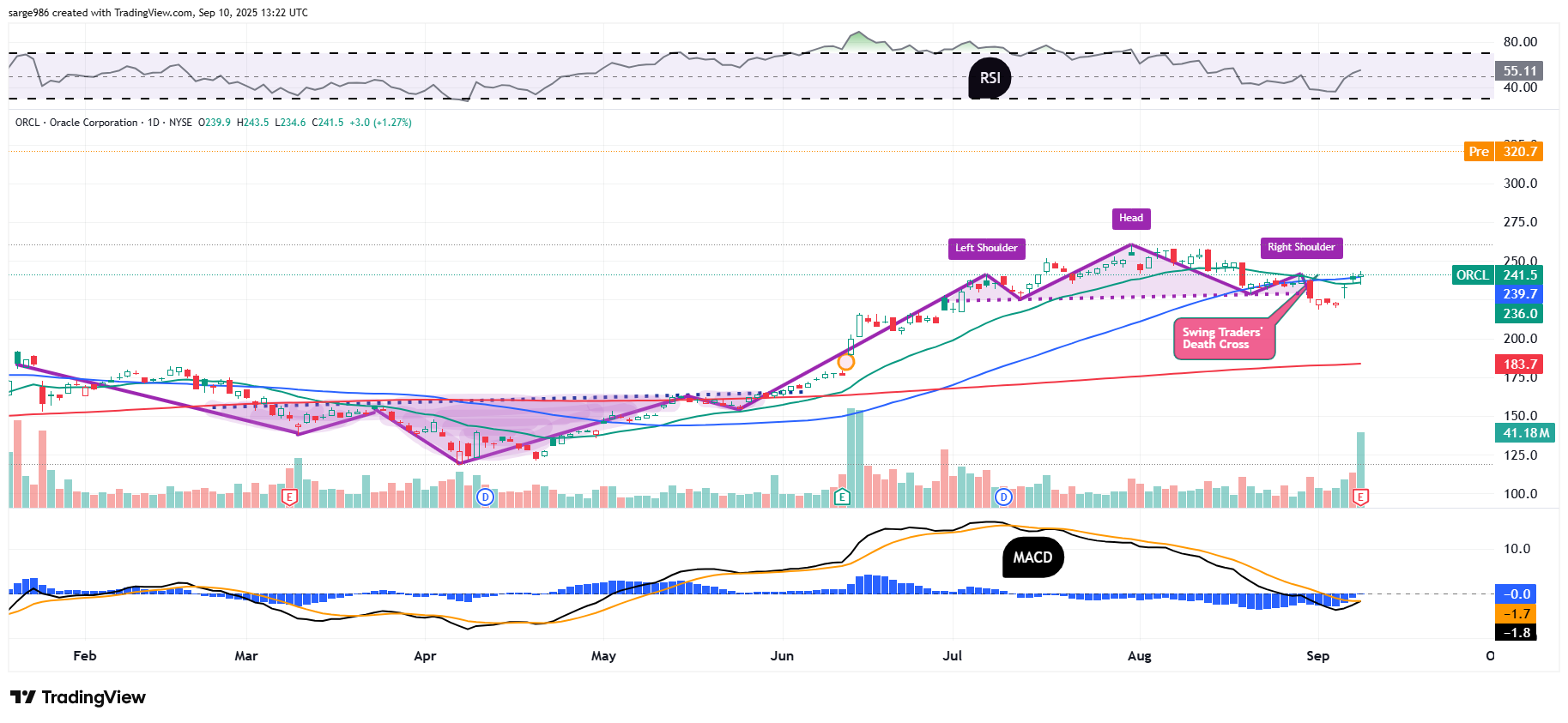
The stock will shatter the head-and-shoulders pattern of bearish reversal that had been in place coming in. The algos will chase each other higher as the target price increases. Then there will be a huge unfilled gap that at some point those same algos will try to fill.
We are not there yet, but this is turning into an epic opportunity for a short sale. ORCL is fast approaching "strong sell" territory. An aggressively dovish Fed is the only reason for hesitancy I see.
At the time of publication, Guilfoyle had no positions in any securities mentioned.