Oracle Beats, With Solid Numbers. But I'm Not Sold
Let's dive into the report and see what I might just do with this software giant soon.
You've reached your free article limit
You've read 0 of 1 free Pro articles.
 My Call on Sagging Oracle: Wait for Clear Support to Develop
On Tuesday evening, Oracle (ORCL) released fiscal third-quarter financial results, posting an adjusted earnings per share of $1.79 (unadjusted: $1.27) on revenue of $17.19 billion. These top- and bottom-line results beat Wall Street's expectations, while that sales number was good for year-over-year growth of 21.7%. This pace of revenue growth was the fastest for any quarter for Oracle in many years and good for the fourth consecutive quarter of accelerating annual growth as well.
Long-time readers know darn well that I have for some time been a critic of the quality of Oracle's balance sheet and overall cash flow management. That said, these results are solid. And management reiterated last night their confidence in Oracle's ability to transform itself into a recurring-revenue, accelerated sales growth AI-focused cloud-based business. Wall Street is reacting well to the release and how the firm handled the call afterward.
Inside the Report
Oracle reports:
- Remaining Performance Obligation of $553 billion, up 325% year over year.
- Q3 Cloud Revenue (IaaS + SaaS) of $8.9 billion, +44% y/y.
- Q3 Cloud Infrastructure (IaaS) Revenue of $4.9 billion, +84%.
- Q3 Oracle Cloud Database (IaaS) Revenue +35%.
- Q3 Multi-Cloud Database Revenue +531%.
- Q3 Cloud Application (SaaS) Revenue of $4 billion, +13%.
- Q3 Fusion Cloud ERP (SaaS) Revenue of $1.1 billion, +17%.
- Q3 NetSuite Cloud ERP (Saas) Revenue of $1.1 billion, +14%.
Operations
For the period reported, Oracle generated sales of $17.19 billion. While that number amounted to year-over-year growth of 21.7%, it needs to be pointed out that cloud-based businesses exhibited sales growth of 44%, while non-cloud-based sales of both traditional software and hardware grew in the low single digits.
Total unadjusted operating expenses added up to $11.726 billion, leaving an unadjusted operating income of $5.464 billion (+19%) as operating margin improved from 31% to 32%. Once adjusted, operating income grew 14% to $7.378 billion, as operating margin dropped from 44% to 43%.
After accounting for interest, other income & expenses and taxes, unadjusted net income attributable to shareholders printed at $3.699 billion (+18%) as as fully diluted unadjusted EPS landed at $1.27, up from the year-ago comp of $1.02. After adjustments, net income attributable to shareholders printed at $5.201 billion (+17%) as EPS landed at $1.79, up from $1.47. The company adjusted operating expenses primarily for the purpose of stock-based compensation as well as for the amortization of intangible assets and for restructuring charges.
Guidance
For the current quarter, Oracle is guiding revenue toward growth of 19% to 21% with total cloud revenue growing 46% to 50%. Adjusted EPS is seen in between $1.96 and $2, which would be good for growth of 15% to 17%. Wall Street was looking for an adjusted EPS of roughly $1.94. Full year revenue is projected at $67 billion, which is slightly above Wall Street's expectations.
For fiscal 2027 (starting with the August quarter), the company sees total revenue of $90 billion, which is well above where Wall Street was on that metric. Consensus had been for something in between $86 billion and $86.5 billion. This guidance is the primary reason why the street is treating this stock so well this morning.
Fundamentals
For the period reported, Oracle generated operating cash flow of $23.514 billion (+13.4%). Out of that number came capital spending of $48.25 billion (+223%), which reflects the company's commitment to building out its AI-focused infrastructure and being a player in that future. That left "free" cash flow of at -$24.736 billion, down from $5.812 billion for the year.
Turning to the balance sheet, Oracle ended the quarter with a cash position of $39.132 billion and current assets of $54.874 billion. Current liabilities add up to $40.737 billion. This includes shorter-term debt of $9.887 billion, but also deferred revenues of $9.881 billion, which is not a true financial obligation. This brings Oracle's headline current ratio to 1.35, which is adequate. Once adjusted for those deferred revenues, the ratio rises to a more robust 1.78.
Total assets amount to $245.24 billion. This includes goodwill and other intangibles of $65.915 billion. At less than 27% of total assets, this is not awful. Total liabilities less equity comes to $206.189 billion, including an additional $124.718 billion in longer-term debt. That number is daunting and is up a scary 46.2% in just nine months' time.
Are these just handshake deals? Are none of these "clients" actually making any payments in order to secure the cloud-based platforms, software and hardware promised? This, I think, is a justified concern.
The total debt is frightening. The current situation is fine, however. Oracle can meet its short to medium-term obligations with ease. I have a question, though. There are no non-current deferred revenues on the balance sheet. Current deferred revenues amount to just $9.881 billion as mentioned above. That said, the company boasts a remaining performance obligation of $553 billion. Are these just handshake deals? Are none of these "clients" actually making any payments in order to secure the cloud-based platforms, software and hardware promised? This, I think, is a justified concern.
My Take
Yes, I know that Wall Street is all hopped up on Oracle this morning. If I were easily influenced by Wall Street, I would not have shaken its dust from my shoes 10 years ago and struck out on my own. I have obviously done a lot better mentally, spiritually and financially without relying on Wall Street to provide my markets-based living than I did when I thought that I had to play their incestuous game.
The negative free cash flow bothers me. So does the incredibly huge remaining performance obligation that for some inexplicable reason has not produced a lot of deferred revenue. The balance sheet is still "OK" for the short-term, but its longer-term deterioration in quality is both rapid and quite significant. Too "ugly" to ignore.
ORCL is trading up more than 1% this morning. Readers will see that the stock traded down from early September into early February. This is represented here neatly in a channel illustrated by my Raff Regression model. From there, the stock has developed what I see as a bear flag. A bear flag is a pattern of trend continuance.
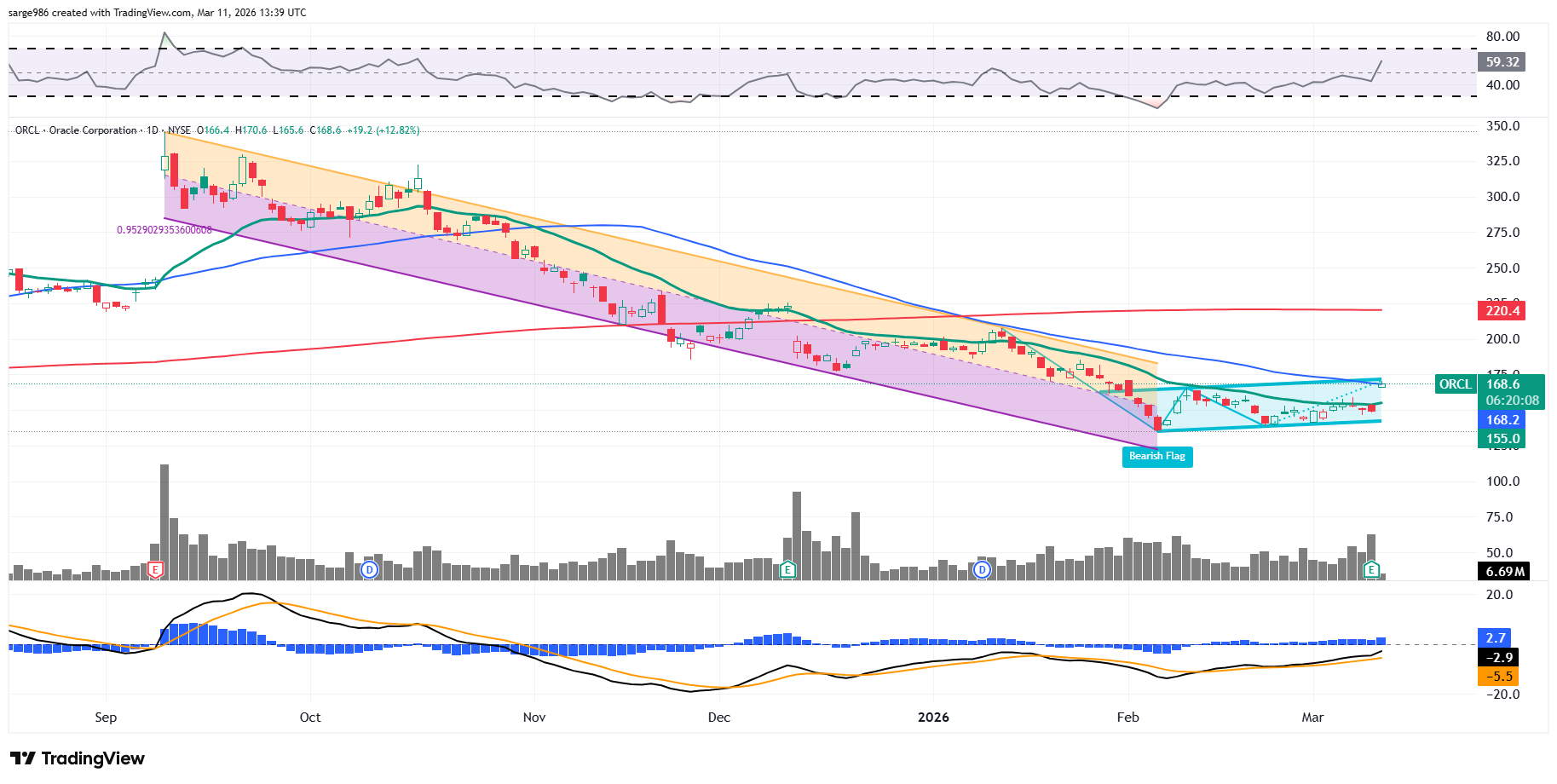
The possible deal-breaker is this: The stock is trying to retake its 50-day simple moving average. If that level can be held, portfolio managers will be forced to increase long-side exposure. If not, the shares will sell off. I am likely to short ORCL after this piece is published and becomes public information (I cannot front-run my own articles) as I have done in recent years when the shares pop after earnings. That strategy has, in the recent past, produced several winners and a couple of large winners.
Related: I'm Cautiously Picking Up This Stock, Eyeing Another
At the time of publication, Guilfoyle had no position in any security mentioned.