Nvidia Offers Straightforward Trade as Earnings Grab Wall Street Attention
It's clear how traders can move with the coming flow of capital on the AI giant after it has beat expectation yet again.
You've reached your free article limit
You've read 0 of 1 free Pro articles.
Nvidia NVDA impressed me. Maybe not everyone, but Nvidia impressed me.
On Wednesday evening, the coolest kid on the block, the mightiest bat in the lineup and the undisputed heavyweight champion of the world, the AI-infrastructure building leader of what is likely to be the next industrial revolution, Nvidia went to the tape with the firm's fiscal fourth quarter financial performance.
For the three-month period ended January 36, the firm posted a GAAP EPS of $0.89 (easily beating expectations) on revenue of $39.33 billion (absolutely crushing expectations). This amounted to earnings growth of 82% on revenue growth of 78% from the same period the year prior. Forward sales guidance was also strong.
This kind of sales growth would be incredible for every other large firm in our universe. For Nvidia, however, this pace of growth is actually a sharp-ish deceleration from the 94% growth for the quarter prior and the 122% growth for the quarter before that. Call this the law of large numbers. As mentioned in Thursday morning's Market Recon column, this pace of growth will continue to reflect a year-over-year deceleration for the rest of this fiscal year, ending up in the mid-40% range. Just bear in mind that most of the S&P 500 would love to be able to post sales growth that even approaches 20%.
Nvidia Operations Update
As revenue grew 78% to $39.331 billion, the cost of that revenue increased 99.7% to $10.608 billion. This left a gross profit of $28.723 billion (+71.1%) as gross margin dropped from 76% to 73%. Operating expenses increased 47.6% to $4.689 billion, which left an operating income of $24.034 billion (+76.5%) as operating margin fell slightly from 61.6% to 61.1%.
After accounting for interest, other income and expenses and taxes, GAAP net income printed at $22.901 billion (+86.4%). This works out to $0.89 per fully-diluted share, up 82% from the year-ago GAAP comp of $0.49.
Nvidia Segment Performance
- Data Center generated revenue of $35.58 billion (+93%), crushing expectations by more than $2 billion.
- Gaming and AI PC generated revenue of $2.544 billion (-11%), falling well short of expectations.
- Automotive and Robotics generated revenue of $570 million (+103%), easily beating expectations.
- Professional Visualization generated revenue of $511 million (+10%), narrowly beating expectations.
Nvidia Stock Fundamentals
For the period reported, Nvidia generated operating cash flow of $16.628 billion, which was up 45% from the year-ago period, but shy of expectations. Capex spending printed at $1.109 billion, leaving free cash flow of $15.519 billion, good for year-over-year growth of 38%. For the full year, free cash flow landed at $60.724 billion (+125%). For the quarter, out of free cash, the firm repurchased $7.81 billion worth of common stock and paid $245 million in cash dividends out to shareholders.
Turning to the balance sheet, the firm ended the quarter with a cash position of $43.21 billion and inventories of $10.08 billion putting current assets at $80.126 billion. Current liabilities add up to $18.047 billion, which includes no short-term debt. At quarter's end, the firm's current ratio and quick ratio stood at 4.44 and 3.88, respectively. These ratios are very strong and reflective of a corporation in a very healthy fiscal condition.
Total assets amount to $111.601 billion, including just $5.995 billion in goodwill and other intangibles. At little more than 5% of total assets, this is no issue whatsoever. Total liabilities less equity comes to $32.274 billion. This includes long-term debt of $8.463 billion, which is something that Nvidia could take care of out of pocket more than five times over.
Nvidia Stock Guidance
For the current quarter, Nvidia is projecting total revenue of $43 billion, give or take 2%. That's well above the slightly more than $42 billion that Wall Street was looking for. Obviously, though this beat is quite large, Wall Street can no longer be blown away by the firm's large sales projections. Additionally, $43 billion would amount to revenue growth of about 65%. That's the continuance of deceleration in the pace of growth that I wrote about above.
The firm sees a GAAP gross margin for the current quarter of 70.6% and an adjusted gross margin of 71%, plus or minus 50 basis points in each case. This was slightly below the consensus view. Operating expenses are also expected to rise more than expected, which will pressure operating margins.
Wall Street on Nvidia Earnings
Since these earnings were released on Wednesday night, I have been able to find 24 highly-rated (four-plus stars at TipRanks) sell-side analysts that have opined on NVDA. Among these analysts there are 22 "buy" or buy-equivalent ratings and two "hold" or hold-equivalent ratings. One of the "holds" did not set a target price, so we have just 23 of those.
The average target price across these 23 analysts is an even $180 with a high of $220 (Kevin Cassidy of Rosenblatt Securities) and a low of $135 (Gil Lauria of DA Davidson). Once omitting these two as potential outliers, the average target price across the other 21 rises slightly to $180.23.
My Thoughts on Nvidia
The quarter was strong. The guidance is strong enough. Cash flows are excellent. The balance sheet is pristine. Going forward, it really is all about capex spending across the hyperscalers, the potential impact of innovative ways (such as DeepSeek) to do this less expensively, the firm's own moat and the potential for or lack of potential for improved business conditions with Chinese clientele.
Nvidia CEO Jensen Huang Comments on Earnings
- On DeepSeek:
"Models like OpenAI, Grok-3, DeepSeek-R1 are reasoning models that apply inference time scaling. Reasoning models can consume 100x more compute. Future reasoning models can consume much more compute. DeepSeek-R1 has ignited global enthusiasm — it's an excellent innovation. But even more importantly, it has open source a world-class reasoning AI model. Nearly every AI developer is applying R1 or chain of thought and reinforcement learning techniques like R1 to scale their model's performance." - On AI spending:
Despite Microsoft's MSFT denial of the report released by TD Cowen this week, the ability of Microsoft, Amazon AMZN, Meta Platforms META and Alphabet GOOGL to keep spending as they have is a concern. On this Huang commented: "We have a fairly good line of sight of the amount of capital investment that data centers are building out towards. We know that going forward, the vast majority of software is going to be based on machine learning. And so accelerated computing and generative AI, reasoning AI are going to be the type of architecture you want in your data center. We have, of course, forecasts and plans from our top partners. And we also know that there are many innovative, really exciting start-ups that are still coming online as new opportunities for developing the next breakthroughs in AI, whether it's Agentic AIs, reasoning AI or physical AIs. The number of start-ups are still quite vibrant and each one of them (will) need a fair amount of computing infrastructure."
Nvidia CFO Colette Kress Comments on Earnings
- On China:
"Now as a percentage of total Data Center revenue, data center sales in China remained well below levels seen on the onset of export controls. Absent any change in regulations, we believe that China shipments will remain roughly at the current percentage. The market in China for data center solutions remains very competitive. We will continue to comply with export controls while serving our customers. Networking revenue declined 3% sequentially."
Nvidia Stock Chart
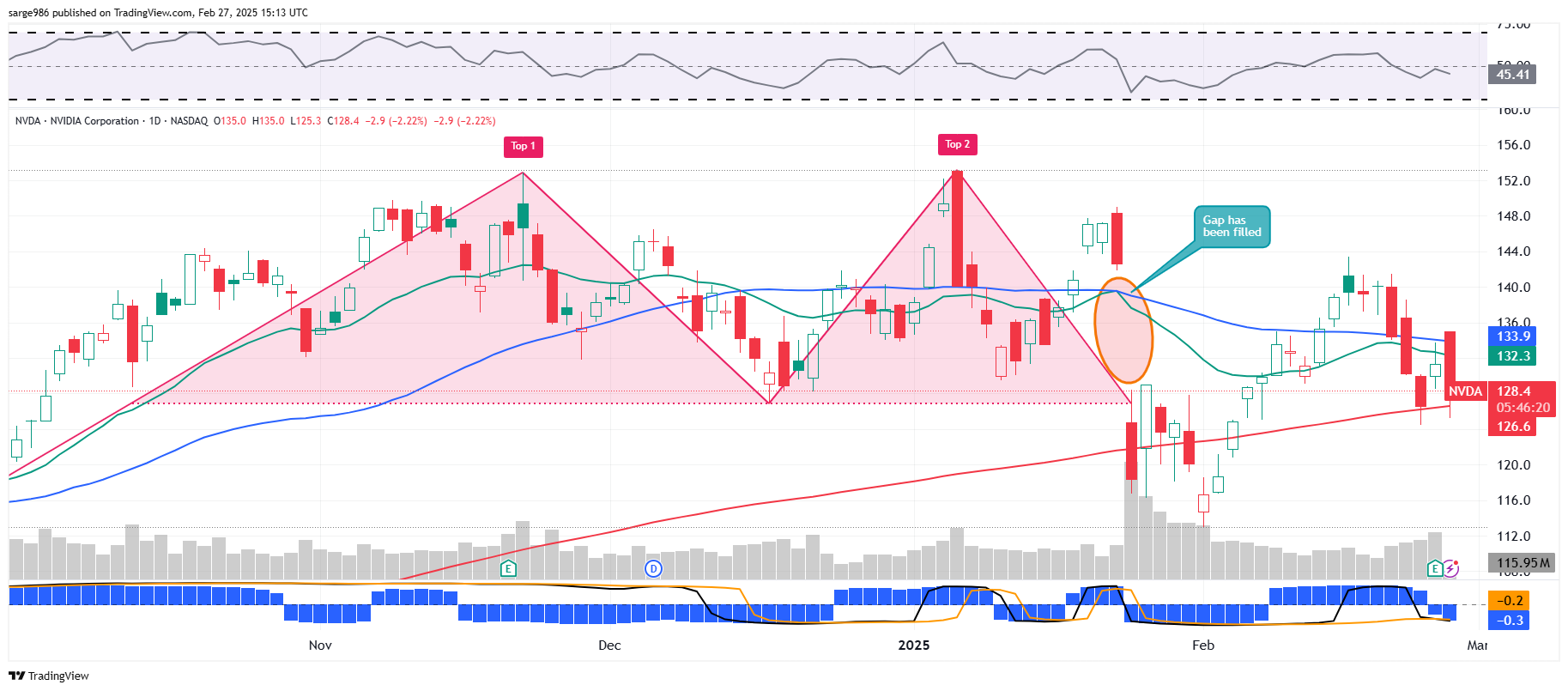
This is very close to the same chart that I showed you on Tuesday. The difference is that on Tuesday and Thursday morning, the shares have tested the stock's 200-day SMA from above and so far, survived. Conversely, on Wednesday and so far on Thursday morning, the stock has tested its 50-day SMA from below and been rejected.
A trader might play that game, try to add at the 200-day line and sell at the 50-day line for as long as it works. One of them will break. Should the 200-day line crack first, Wall Street will reduce long-side exposure of this name and so will I. Should the 50-day SMA crack first, Wall Street will add long-side exposure and so will I. This isn't rocket science. We know what pressures risk managers will place upon portfolio managers and moving with the flow of capital is usually a wise idea.
For the longer-term investors? If the stock can deliver us that 50-day SMA, I think $155 is realistic, and if $155 is realistic, then so are new highs well beyond that.
Conversely, lose that 200-day SMA and the $113 level stats to look likely.
At the time of publication, Guilfoyle was long NVDA, MSFT and AMZN equity.