Nvidia Drops a Bomb, Palantir Powers Up & Rocket Lab Runs Toward Resistance
Let's see what sparked a storm in the semiconductors and chart two Sarge-folio names.
You've reached your free article limit
You've read 0 of 1 free Pro articles.
Equity markets, for the most part, closed lower on Tuesday. Not drastically lower, but lower than they had closed on Monday. Growth stocks, or more specifically tech stocks, though, had held their own throughout the session. That is until after the closing bell when some of those stocks quickly gave back what had been built during the day's regular hours. Only four S&P sector SPDR exchange-traded funds closed out the Tuesday session in the green, led in a northerly direction by Technology XLK, Communication Services XLC, and the Financials XLF. Yes, the banks were hot on Tuesday too. Cyclical and defensive sectors lagged behind, closing in the red.
Interestingly, within tech, the Dow Jones U.S. Semiconductor Index gained 0.87%, led by Marvell Technology MRVL, ASML Holding ASML and Nvidia NVDA. Those three stocks gained 2.03%, 1.53%, and 1.35% respectively before it all started to unravel. Remember my Advanced Micro Device AMD trade from back on Monday? While I had initiated with a small tranche to get started, I had not yet added and had only been down small. After Tuesday night's events, I see AMD trading 6% lower and threatening to trigger my 8% rule. We'll have to see where it opens before I make any decisions on either adding or liquidating. Currently, this is a very small position, and I have no interest in throwing good money after bad.
So, What Gives?
Nvidia, it was reported on Tuesday afternoon, had filed a Form 8-K, informing investors and the Security and Exchange Commission of a significant impact to the company's financials. The report reads:
On April 9, 2025, the U.S. government, or USG, informed NVIDIA Corporation, or the Company, that the USG requires a license for export to China (including Hong Kong and Macau) and D:5 countries, or to companies headquartered or with an ultimate parent therein, of the Company’s H20 integrated circuits and any other circuits achieving the H20’s memory bandwidth, interconnect bandwidth, or combination thereof. The USG indicated that the license requirement addresses the risk that the covered products may be used in, or diverted to, a supercomputer in China. On April 14, 2025, the USG informed the Company that the license requirement will be in effect for the indefinite future.
What this does is inform all interested parties that Nvidia's H20 GPUs are no longer available for sale to Chinese customers or to customers elsewhere with Chinese parent companies without what would be a difficult to obtain export license. Nvidia's H20 chip is considered comparable to the H100, and H200 AI chips sold in the U.S. and to customers in allied nations. The H20 was considered China-complaint by the Biden administration as it has slower interconnection speed and bandwidth than the H100 and H200. The H20 is based on Nvidia's Hopper architecture, which was introduced in 2022 and is one generation behind the current Blackwell architecture.
Then, still from the 8-K filing, Nvidia dropped this bombshell:
The Company’s first quarter of fiscal year 2026 ends on April 27, 2025. First quarter results are expected to include up to approximately $5.5 billion of charges associated with H20 products for inventory, purchase commitments, and related reserves.
When I wet the beak back on Monday in AMD, I very nearly decided to initiate Nvidia as well. (AMD is also highly exposed to China, though I have not yet seen anything about its latest AI-capable chips being banned for sale to nations like China except under government license.) At least I only have the one mess to clean up and at least it's still small. It should be noted that this move did not surprise everyone. Chinese companies, Alibaba BABA, Tencent TCEHY and ByteDance (BDNCE) had placed orders for at least $16 billion worth of Nvidia H20 server chips from January through March ahead of this Trump administration ban.
When It Rains...
On Wednesday morning, Dutch semiconductor equipment and services provider ASML Holding, reported Q1 earnings that beat Wall Sreet, but also revenue and bookings that fell short of consensus view. Bookings, it should be noted, missed the mark by more than 8.5%. It is key to remember that ASML's largest customer is Taiwan Semiconductor TSM, which just happens to be the "foundry to the world." What ramifications this has for the industry at large, just became vastly more uncertain.
On the Bright Side
Equity markets traded lower on Tuesday, but it was not a rout by any means. The S&P 500 gave up just 0.17%, while the Nasdaq Composite only lost 0.05%. The Nasdaq 100 managed a gain of 0.18%. Smaller cap stocks behave similarly. Winners beat losers by a rough 5 to 4 at both the NYSE and the Nasdaq. Advancing volume took a more impressive than you probably expected 55% of composite Nasdaq-listed trade and a 47.4% share of composite NYSE-listed activity. The key item on Tuesday was the lack of trading volume.
There were a few lumpy news items released on Tuesday. First, the Empire State (NY) Manufacturing survey for April, while still mired in month-over-month contraction, showed prices paid and prices received both at their highest level since August 2022. Additionally, new orders remained in contraction and employment was negative for a fifth month in the past six.
Separately, EU trade chief Maros Sefcovic reportedly left Monday's meeting in D.C. indicating that little progress had been made and that the bulk of U.S. tariffs imposed by the Trump administration on the E.U. would remain in place. The E.U. has offered to remove all tariffs on industrial goods, including vehicles, but so far, the president has rejected the proposal.
Aggregate trade, dropped by 22.6% on a day-over-day basis across Nasdaq-listings, and by 14.2% across NYSE-listings. Aggregate trade across the membership of the S&P 500 fell 20% short of the 50-day simple moving trading volume average for that index. Tuesday was the fourth consecutive day that activity across the S&P 500 contracted from the day prior. Does this make the price discovery that we are experiencing less meaningful? It might, especially if portfolio managers are participating to a lesser degree as the three-day weekend approaches.
Palantir: Going the Right Way?
AMD may have been a dud, but we have caught some lightning in a bottle of late. Last Thursday, we increased our target price for Palantir Technologies PLTR from $110 to $116, based upon using the 50-day simple moving average as the pivot. PLTR was trading at $89.70 when that article was published, and some readers may recall that we added all the way down to $68 on April 7. The stock closed up 48.8% from that April 7 low on Tuesday.
Readers will recall that the PLTR broke out of a Falling Wedge pattern of bullish reversal late last week and took that pivot (the 50-day SMA) on Monday. On Tuesday, that line served as support. I would expect that line to be tested from above again on Wednesday morning. The point is that the stock has broken out of the pattern in place and that the latest upside pivot has been triggered.
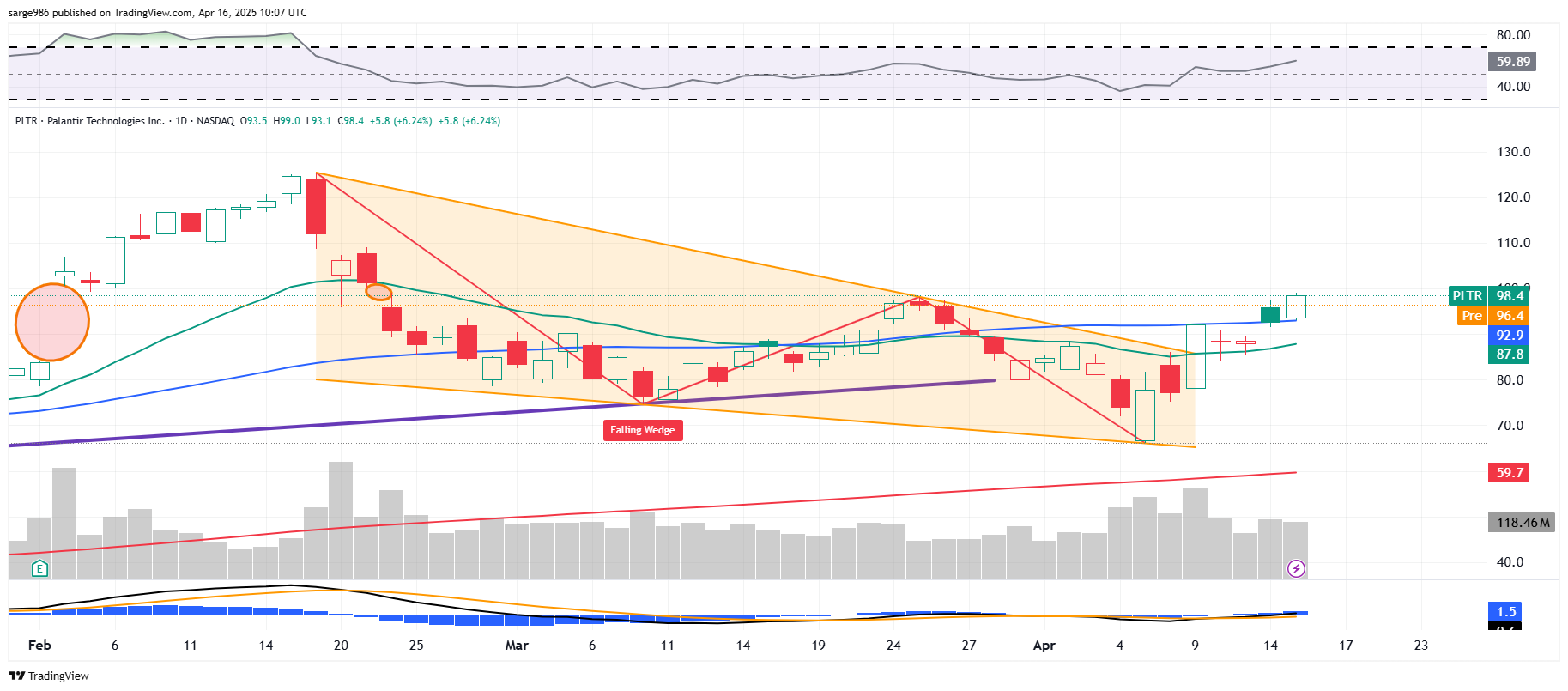
We have been long this name since it was a core holding in our "Stocks Under $10" portfolio, with a $6 handle. PLTR is my largest allocation by weight. Holding that 50-day simple moving average and holding the 21-day exponential moving average just below it would be key to keeping both portfolio managers and swing traders at increased levels of long-side exposure.
Rocket Lab Resistance...
Another Sarge-name, my fourth heaviest-weighted name, Rocket Lab USA RKLB also had a very nice day on Tuesday, but as readers will see, ran into resistance at its 50-day simple moving average and so far, has failed to retake that line.
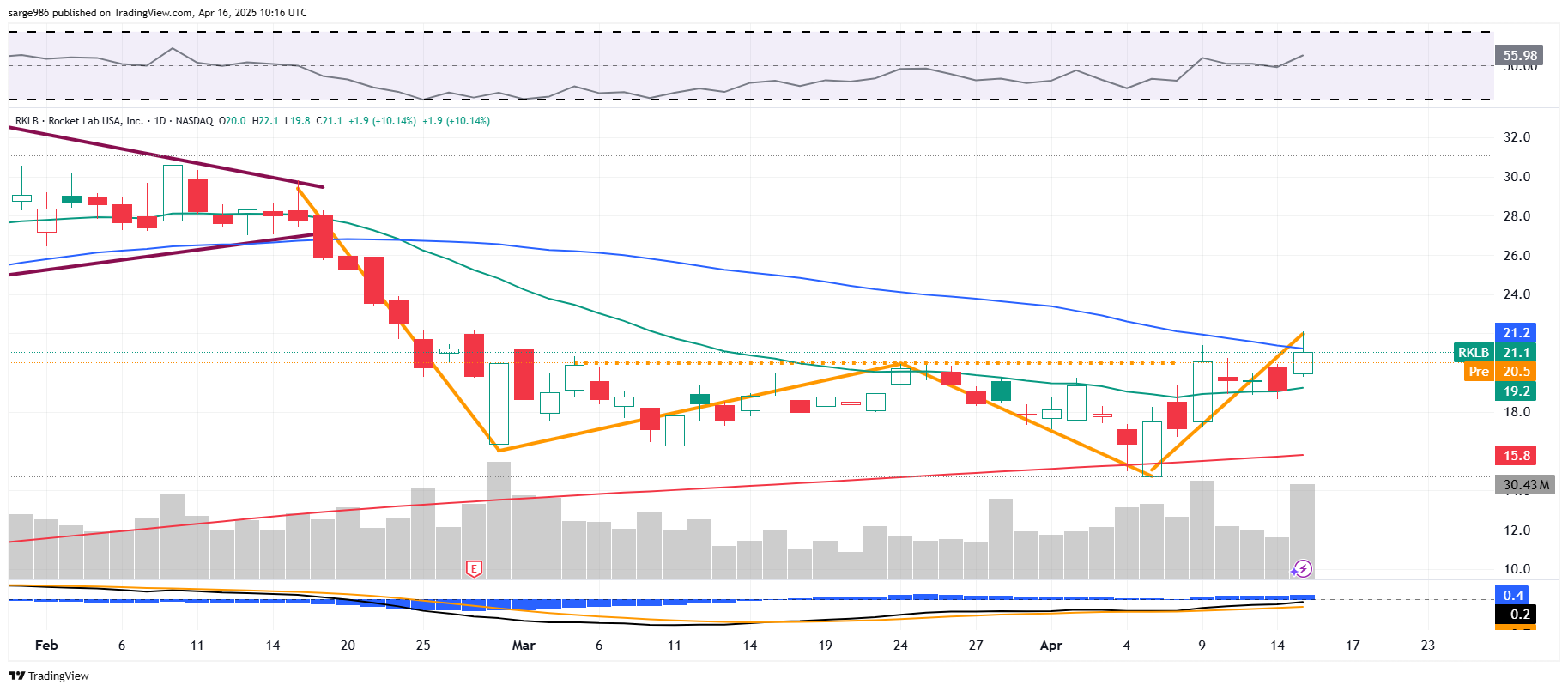
The stock is breaking out of a Double Bottom pattern of bullish reversal. We already have the swing crowd on board, with the shares comfortably above their 21-day exponential moving average. Taking and holding that 50-day line is key to dragging portfolio managers as a group toward an increased level of capital exposure. For those that missed Tuesday's piece, we have a $28 target price on this stock.
Economics (All Times Eastern)
07:00 - MBA 30 Year Mortgage Rate (Weekly): Last 6.61%.
07:00 - MBA Mortgage Applications (Weekly): Last 20% w/w.
08:30 - Retail Sales (Mar): Expecting 1.2% m/m, Last 0.2% m/m.
08:30 - Core Retail Sales (Mar): Expecting 0.2% m/m, Last 0.3% m/m.
09:15 - Industrial Production (Mar): Expecting -0.2% m/m, Last 0.7% m/m.
09:15 - Capacity Utilization (Mar): Expecting 78%, Last 78.2%.
10:00 - Business Inventories (Feb): Expecting 0.3% m/m, Last 0.3% m/m.
10:00 - NAHB Housing Market Index (Apr): Expecting 38, Last 39.
10:30 - Oil Inventories (Weekly): Last +2.553M.
10:30 - Gasoline Stocks (Weekly): Last -1.6M.
1:00 p.m. - Twenty-Year Bond Auction: $13B.
4:00 - Net Long-Term TIC Flows (Feb): Last $-45.2B.
The Fed (All Times Eastern)
Noon - Speaker: Cleveland Fed Pres. Beth Hammack.
1:30 p.m. - Speaker: Federal Reserve Chair Jerome Powell.
7:00 - Speaker: Kansas City Fed Pres. Jeffrey Schmid.
Today's Earnings Highlights (Consensus EPS Expectations)
Before the Open: ABT (1.07), ASML (5.76), TRV (.80), USB (.98)
After the Close: CSX (.37), SNV (1.12)
At the time of publication, Guilfoyle was long AMD, PLTR, RKLB equity.