Nobody's Buying Adobe Shares — And for Good Reason
As the CEO's exit overshadows a strong quarter, the stock may be cheaper than it's ever been. What's going on here? Let me explain.
You've reached your free article limit
You've read 0 of 1 free Pro articles.
 Jim Cramer: FedEx and Adobe Misses Are All About Fierce Competition
Remember when Jim Cramer named his "Cloud Kings" and Adobe (ADBE) was a charter member? Oh, those were the days for Adobe shareholders.
The shares apexed at $699.54 in late 2021 and bottomed at $244.28 about two weeks ago. Top to bottom, that's a beat-down of 65.1%.
That's likely, though not stated, why CEO Shantanu Narayen announced his resignation from the top job at Adobe on Thursday evening. Narayen held that post for 18 years and will stay on the job until a successor is hired. He won't exactly disappear either. He will stay on as Chairman and he will have influence in selecting whoever replaces him as chief executive.
While the shake-out in the C-Suite dominated the Adobe-focused portion of the news cycle, the company did release its first-quarter financial results. For the period ended February 27, Adobe posted adjusted EPS of $6.06 (GAAP EPS: $4.60) on revenue of $6.398 billion. These top and bottom-line results exceeded Wall Street's expectations, while that sales print was good enough for year-over-year growth of 12.1%.
Adobe releases these earnings and tries to evolve into a new era of leadership as concerns over the capabilities of generative and especially agentic artificial intelligence have had a huge impact on firms still offering traditional cloud-based software platforms.
The stock is inexpensive fundamentally, but that has not enticed investors. Stocks like Adobe may be less expensive in terms of trading multiples than they have ever been prior, for good reason.
Operations
As revenue expanded 12.1% to $6.398 billion, the cost of revenue grew 6.8% to $664 million. That left a gross profit of $5.734 billion as gross margin improved to 92.5% from 89.1%.
GAAP operating expenses increased 13.2% to $3.316 billion, leaving GAAP operating income of $2.418 billion (+11.8%). This took the company's GAAP operating margin down to 37.8% from 37.9%. After adjustments operating income increased 11.8% to $3.035 billion and operating margin improved to 47.4%.
After factoring in interest, other income & expenses and taxes, GAAP net income printed at $1.889 billion (+4.3%). That works out to $4.60 per fully diluted share, up from the year-ago comp of $4.14. Once adjusted, net income grew 11.9% to $2.488 billion and EPS became $6.06 versus $5.08 for the comparison against the same quarter last year.
Of course, $1.25 of the entire adjustment was made for the purpose of stock-based compensation, which is just about as amateurish as it gets. Adobe has been publicly traded since 1986. If you have been reporting earrings for 40 years and have been adjusting earnings for 40 years for the same operating expense four times a year, that's called "ordinary." We do not adjust for ordinary operating expenses. At least the pros do not. Somebody needs to go back to freshman year accounting class.
Guidance
For the current quarter, Adobe sees revenue of $6.43 billion to $6.48 billion, bringing the midpoint of the range above the $6.43 billion that Wall Street had in mind. The company sees GAAP EPS for the quarter of $4.35 to $4.40 and adjusted EPS of $5.80 to $5.85. This was far better than the $5.68 consensus estimate as well.
The problem may have been in AI-first offerings, which is off because that product boasted numbers that tripled year over year. During the call, when discussing guidance, CFO Daniel Durn stated, "we continue to expect total Adobe ARR growth of 10.2%." That seemed a bit light to investors and is a primary reason for the overnight selloff.
Fundamentals
For the period reported, Adobe generated operating cash flow of $2.958 billion. Out of this number came capex spending of just $37 million, leaving free flow of $2.921 billion. Out of that number, the company repurchased $2.478 billion worth of common stock. Adobe does not pay shareholders a cash dividend.
Turning to the balance sheet, Adobe ended the quarter with a cash position of $6.89 billion and current assets of $10.386 billion. Current liabilities add up to $11.39 billion, including a small amount of short-term debt, but deferred revenue of $7.275 billion, which is not a true financial obligation. Once adjusted for those deferred revenues, the current ratio rises to a healthy 2.52.
Total assets amount to $29.704 billion. Goodwill and other intangibles add up to $13.323 billion. At 44.9% of total assets, that is a bit much for me. Total liabilities less equity comes to $18.271 billion, including longer-term debt of $5.379 billion.
Overall, this is a better-than-good balance sheet.
My Opinion
Cash flows are solid. The balance sheet is in good shape. The quarter reported was strong. The guidance was not even that bad. In addition, the firm is swapping out the old CEO, who will still be around.
This is about the firm's susceptibility to the AI threat as much as anything else. The company is fundamentally sound, and the stock, as mentioned above, is inexpensive. That does not mean that investors should buy the shares, however.
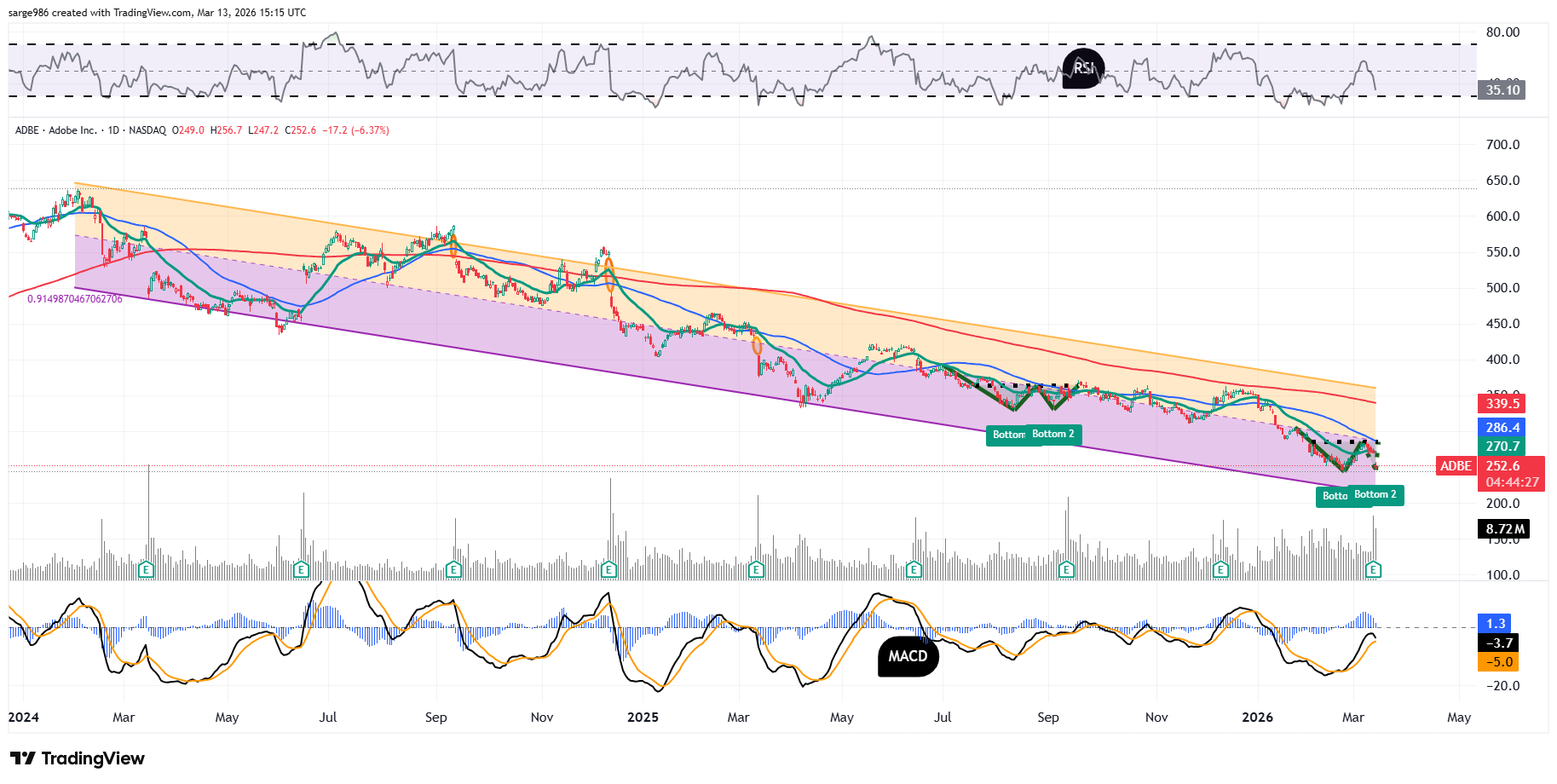
Just look at this trend. Even multiple double-bottom patterns of bullish reversal have failed. There is no way in heck that I can be interested in this stock until a bullish technical pattern that I recognize actually develops and starts to work.
The stock is now trading at a 12% discount to its own 50-day simple moving average (SMA) and a 25% discount to its 200-day SMA. Do you realize how incredibly difficult that is to accomplish? It literally means that nobody is buying the shares.
Neither am I.
Related: Nvidia’s 'Herculean Effort' and the One Chart You Need to See Right Now
At the time of publication, Guilfoyle had no positions in any securities mentioned,