No Sense Buying Apple After Cook Fails to Impress on AI Plans
Managers of the big tech giant have some reason to be embarrassed after the latest quarter.
You've reached your free article limit
You've read 0 of 1 free Pro articles.
I like apples. I mean I like apples more than most folks. As a rule, I eat at least one apple a day. Not just to keep the doctor away. Mooshi likes apples too. Mooshi, for folks who do not know, is America's most patriotic wonder pup. She's pushing 14 years of age and has been my best pal for about 12 years. When I was so sick with Covid and then Long Covid a few years ago, the wonder pup stood guard over me and wouldn't leave.
Then she got sick with Covid because she wouldn't leave my side. The two of us locked ourselves in my office for 14 days to protect the rest of the family. We got each other through something awful. Now, we eat apples together every morning. It's our thing. I hope she lives to 100, but I know better.
Apple APPL, America's all-time greatest consumer electronics company, and not a fruit company, has been on the ropes in 2025. Sales growth had slowed to a crawl. Innovation? What's that? AI? Some day. The stock had been left behind by investors. Until Thursday night, when the firm released its fiscal third quarter financial results.
Is it possible? Is Apple a tired old dog from the early days of big tech, or is Apple back in the saddle, faith renewed? Let's dig in.
The Quarter
For the three-month period ended June 28, Apple posted a GAAP EPS of $1.57 on revenue of $94.036 billion. The earnings print beat Wall Street by 14 cents a share. The top-line number not only beat Wall Street's expectation by nearly $5 billion, but it was also good enough for year-over-year growth of 9.6%. This was the fastest pace of annual sales growth for Apple for any single quarter since the quarter ended December 2021.
What's impressive? The firm's Services sector delivered record sales, as did Cloud Services within that segment. Sales in China seem to be healthy enough too and that was an area of concern. What's less than impressive? CEO Tim Cook and company still appear to be unable to communicate to investors a coherent strategy concerning the development and monetization of generative artificial intelligence for use in the firm's mobile devices.
Operations
As mentioned above, revenues grew 9.6% to $94.036 billion. Within that number, sales of products increased 8.2% to $66.613 billion and service-driven revenue increased 13.3% to $27.423 billion. The cost of those sales came to $50.318 billion (+9.2%), leaving a gross profit of $43.718 billion (+10%) as gross margin improved from 46.3% to 46.5%.
Total operating expenses grew 8.3% to $15.516 billion. This left an operating income of $28.202 billion (+11.2%) as operating margin improved from 29.6% to 30%. After accounting for interest, other income and expenses and taxes, net income printed at $23.434 billion (+9.3%). This works out to $1.57 per fully diluted share, up from the year-ago comparison of $1.40.
Category Performance
- iPhone sales increased 13.5% to $44.582 billion, crushing expectations
- Mac sales increased 14.8% to $8.046 billion, beating expectations
- iPad sales decreased 8.1% to $6.51 billion, missing expectations
- Wearables, Home & Accessories sales decreased 8.6% to $7.404 billion, missing expectations
- Product gross margin dropped from 35.3% to 34.5%
- Services sales increased 13.3% to $27.423 billion, beating expectations
- Services gross margin improved from 74% to 75.6%
Geographic Sales Performance
- Americas sales increased 9.3% to $41.198 billion, slightly missing expectations
- Europe sales increased 9.7% to $24.014 billion, beating expectations
- Greater China sales increased 4.4% to $15.369 billion, beating expectations
- Japan sales increased 13.4% to $5.782 billion, beating expectations
- Rest of Asia Pacific sales increased 20.1% to $7.673 billion, easily beating expectations
Guidance
Apple, as has become the firm's policy, does not officially issue forward-looking guidance. That said, management does, in the call, give investors unofficial clues as to what the firm sees ahead. Current quarter revenue is seen growing by mid-to-high single digits in percentage terms. That's better than Wall Street was looking for, but off of the pace of the quarter just reported, which was an upward surprise.
The firm allows that Services-driven revenue should be similar in the pace of growth to the quarter just reported. This is the firm's higher margin segment, so that is a positive. Gross margin is seen landing in between 46% and 47%, including an expected tariff-related headwind of $1.1 billion. Operating expenses are projected at $15.6B billion to $15.8B, which was slightly above Wall Street consensus.
Fundamentals
For the quarter reported, Apple generated operating cash flow of $27.867 billion (-3.4%). Out of this number came capex spending of $3.462 billion (+60.9%), which left free cash flow of $24.405 billion (-8.6%). Both operating and free cash flows, while still quite robust, fell short of expectations.
"Out of that number" — as, in theory, returns to shareholders come out of free cash — the firm repurchased $21 billion worth of common stock and paid out $3.9 billion on cash dividends to shareholders.
Turning to the balance sheet, Apple ended the quarter with a cash position of $133 billion, of which $77.614 billion is in investments that the firm considers to be longer-term. So that leaves $55.372 billion for the current assets portion of the balance sheet. Over nine months, the firm's cash position has dropped by 15.1%. Is that alarming?
Not yet, but the firm has, in my opinion, abused the repurchase of common stock with its cash balance. I think shareholders might have better appreciated a larger dividend. The current dividend yields just 0.5%, which should embarrass management when they run cash flows like this and have had that much cash on hand.
The firm has current debt of $19.268 billion on the books and a longer-term debt load of $82.43 billion. That leaves a net cash position of "just" $31.302 billion. While Apple still has a very healthy balance sheet, it should be noted that it is not in the fortress-like condition that it was just a few short years ago.
My Thoughts
Apple had a nice quarter. The firm executed well in a broad sense. The "unissued" guidance might be intentionally conservative. During the call, Cook did leave the door open to using acquisition as a method to catch up to the pack on AI.
Put it this way: I am a little impressed. I am not that impressed. I am not sure that whether I want to re-initiate a long position in Apple on a day that the entire market is selling off or put some dough into names that I like better that are being oversold in the wake of the weak labor market data and the president's actions on big pharma and global tariffs. The tariffs should have already been produced in, by the way, and to a degree, so should have the attack on big pharma.
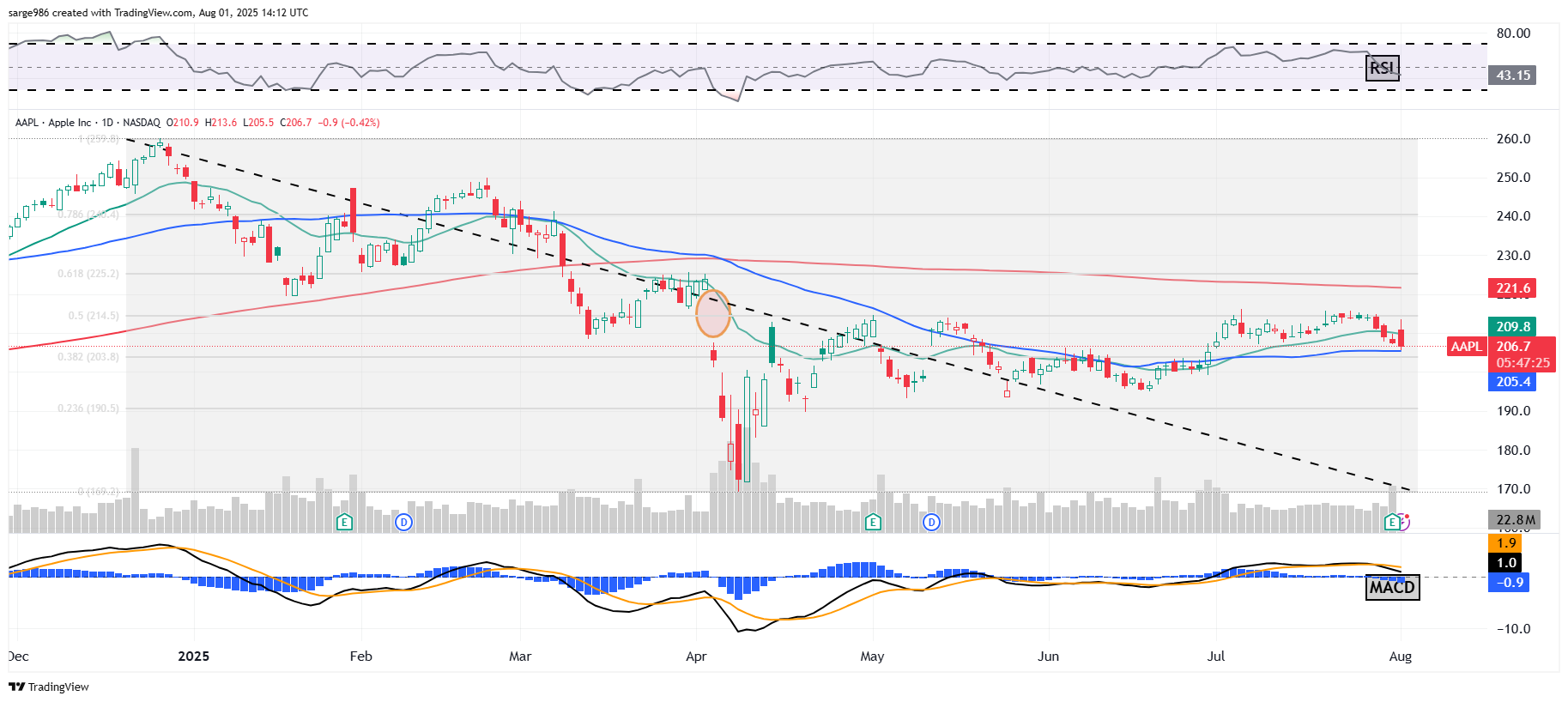
Readers will see that AAPL has hit resistance at least four times at the 50% retracement level (or half-way back point) of the late 2024 into early April sell-off. Relative strength is relatively weak. The daily MACD is postured quite bearishly. Within that indicator, the histogram of the nine-day EMA is negative, and the 12-day EMA has crossed below the 26-day EMA. There is nothing bullish about that.
I want readers to watch the 50-day SMA. That's the blue line and that's where professional managers will make an attempt to defend the stock. Should that line crack, risk managers will force portfolio managers to reduce exposure. In that case, the April lows close to 4170 is possible for this name. No, I am not buying AAPL today and if the 50-day SMA breaks, I would consider a short sale.
At the time of publication, Guilfoyle had no positions in any securities mentioned.