New Walmart Price Target After Stock Listing Update
The retail giant could see $19 billion flow in after a decision to move its stock.
You've reached your free article limit
You've read 0 of 1 free Pro articles.
First, there was news that absolutely stunned at least one career trader.
On November 20, 2025, Walmart (WMT) announced that the firm would transfer the listing of the firm's common stock from the New York Stock Exchange to the Nasdaq Global Select Market or "The Nasdaq" on December 9, 2025.
In what had to be a humiliating defection for both the New York Stock Exchange and for its parent company, Intercontinental Exchange (ICE) , that transfer was indeed consummated as scheduled. Walmart also transferred the listing of nine of its bonds over to Nasdaq.
At the time of the announcement, Walmart CFO David Rainey commented, “Moving to Nasdaq aligns with the people-led, tech-powered approach to our long-term strategy. Walmart is setting a new standard for omnichannel retail by integrating automation and AI to build smarter, faster and more connected experiences for customers, while enabling our associates to deliver even greater value at scale. We are appreciative of our long partnership with such a storied institution as the New York Stock Exchange. We are excited about partnering with Nasdaq on this next chapter of our growth story,”
Personal Aside
As a long-time human NYSE floor trader, it is still sometimes difficult for me not to root for the New York Stock Exchange. The truth is that it has been a decade since I was a member on that trading floor. I had adapted as the exchange left my beloved open outcry market model behind and became very similar in method, in my opinion, to exchanges that did not incorporate human interaction.
Ultimately, I no longer saw any advantage to being present at the exchange. As time moved along and my independent business developed, then flourished (knock on wood) into what it ultimately became, I realized that I was most often involved in stocks that traded elsewhere. I was really more of a Nasdaq trader than an NYSE trader just because that's where the action really was.
More News
Incredibly, Walmart, which on the surface would appear to represent the old economy (though that's not really true) must have felt much the same way. As if moving away from the exchange that, by reputation, is home to most well-known retailers, industrial stocks, energy stocks, large financials, utilities and the like was not enough, Walmart was headed to the exchange known as the primary home to tech stocks both large and small.
Sam Walton brought Walmart public on October 1, 1970. The stock traded "over the counter" at first. Before the Nasdaq market was founded in February 1971, unlisted (non-NYSE, non-Amex) stocks traded through a network of broker-dealers and market makers and that network was referred to as "over-the counter." On October 1, 1972, Walmart was listed at the NYSE, which at the time was considered quite prestigious. Walmart just got some new prestigious news.
Last Thursday, Walmart announced the appointment of Shishir Mehrotra to the company's board of directors. Mehrotra is a high-end tech type who has served as chief technology officer at the YouTube division of Alphabet's (GOOGL) Google and is the current CEO of Superhuman (formerly known as Grammarly), which is an AI-powered productivity platform. This gives readers an idea of where Walmart thinks it is going.
On Friday, Nasdaq Global Indexes announced the decision to include Walmart in the Nasdaq 100. This prestigious inclusion will be effective Tuesday, January 20 and will come at the expense of AstraZeneca (AZN) . This key benchmark tracks the performance of the 100 largest non-financial firms listed at the Nasdaq and is considered to be very tech centric.
Many funds, most notably including the Invesco QQQ Trust Series 1 ETF (QQQ) , operate with mandates that will force investment in any stock, such as Walmart, going into that index as well as withdrawing investment from any stock leaving the index. Other Nasdaq indices likely to now also include Walmart would be the Nasdaq 100 Equal Weighted Index and the Nasdaq 100 Ex-Tech Sector Index.
There are estimates that project that the inclusion in the Nasdaq 100 could generate as much as $19 billion in additional capital inflows into the stock. For that reason, I am now long WMT. Long-time readers know that this is not a fundamentals-based investment, but more of a trade for my book.
The Chart
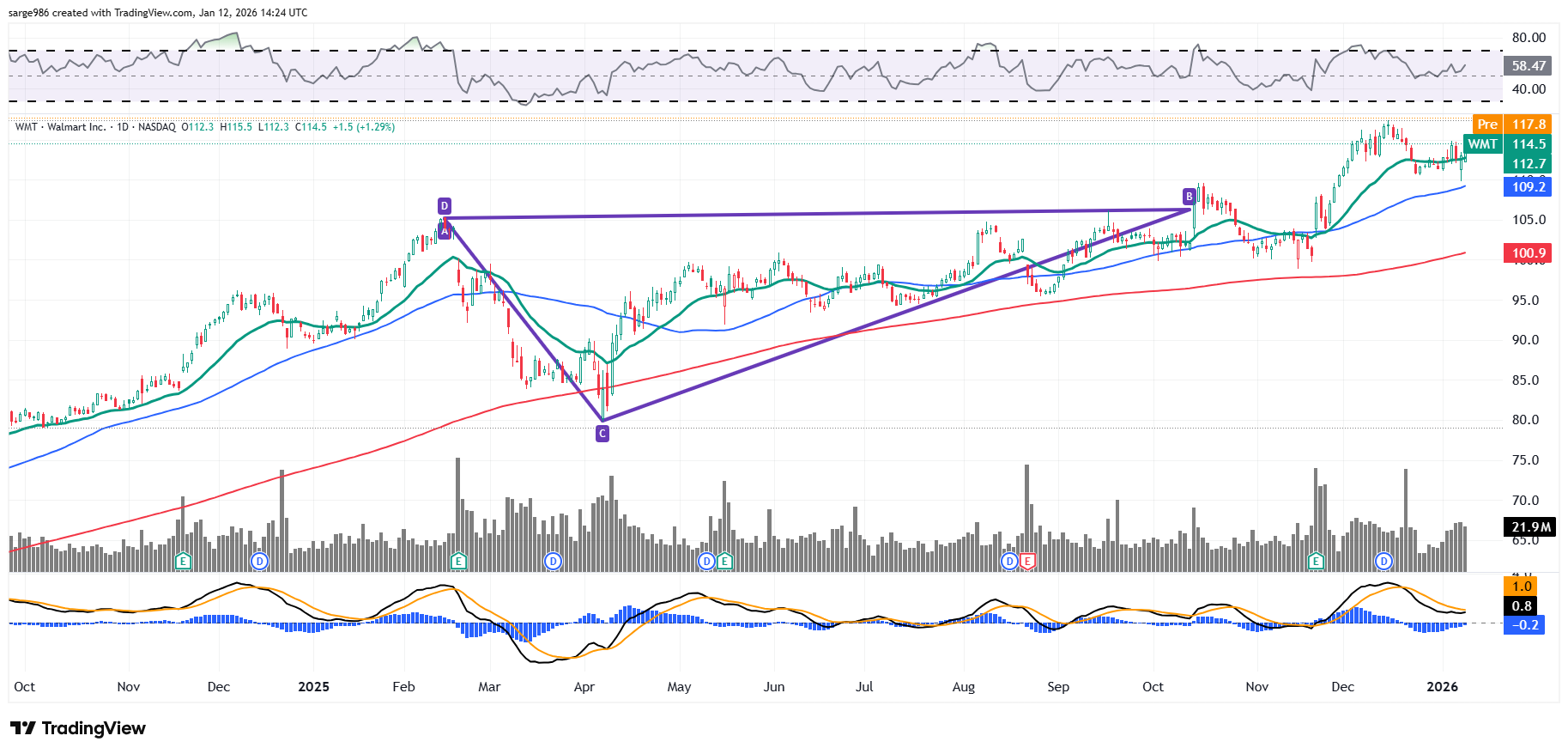
Readers will see that the stock broke out of an ascending triangle of bullish continuance in October. That breakout failed and the shares were rescued by support above their 200-day SMA, implying professional interest at that level. The stock has recently waffled around its 21-day EMA. This pivot has likely been used of late by swing traders trying to generate short-term profits as the stock went back and forth.
Now that we know the professional money will be forced to chase the recent move, I am trying to take advantage of that pivot. Using the 21-day line, my target price for the trade is $126. I am out of this trade by early next week whether or not I am successful. I have no intention of remaining long this stock as the enthusiasm dies down. Readers know darned well that I am not crazy about Walmart's balance sheet.
Within the daily MACD look for a crossover of the 26-day EMA over the 12-day EMA to give the stock an algorithmic boost after the opening bell. In English, below the chart, look for the thin black line to cross above the thin gold line. The algos will eat that up.
At the time of publication, Guilfoyle was long WMT equity.