New Trade Idea for Carnival as Revenue Expands and Fuel Prices Grow
The cruise giant turned some heads on Wall Street with its latest financial results.
You've reached your free article limit
You've read 0 of 1 free Pro articles.
 Carnival Is Not the Same Cruise Line it Was Pre-Covid
On Friday morning, Carnival Corporation (CCL) released the firm's fiscal first quarter financial results. For the period ended February 28, the firm posted an adjusted EPS of $0.20 (GAAP EPS: $0.19) on revenue of $6.165 billion. These top- and adjusted bottom-line results both beat Wall Street's expectations while the sales print was good enough for year-over-year growth of 6.2%.
That revenue number was also an all-time record for the firm's first quarter. Bookings for the entirety of fiscal-year 2026 are up double digits, and the firm announced that operational improvements now expected for 2026, which were not expected as recently as December, may be enough to at least partially mitigate the recent spike in fuel prices.
The firm also announced its PROPEL program, which is a new set of long-term goals designed to maintain momentum in earnings growth while maximizing shareholder distributions.
CEO Josh Weinstein commented in the press release:
"We remain on track to deliver solid yield growth, continued cost discipline and $7 billion in adjusted EBITDA this year, underscoring the strength of demand across our portfolio, progress on our long-term strategy, and the advancements we have made positioning the business to perform across a range of environments."
On PROPEL, Weinstein added:
"With this strong foundation in place, we are focused on the next chapter of value creation for Carnival. Today, we are introducing PROPEL: Powering Growth and Returns, Responsibility — our new set of long-term targets. At its core, PROPEL is about converting strong demand into higher returns, earnings growth and cash flow while maintaining disciplined capacity growth and a strong balance sheet."
Operations
As revenue generation expanded 6.2% to $6.165 billion, selling expenses grew 9% to $924 million, depreciation and amortization expenses grew 6.4% to $696 million and operating expenses increased 4.6% to $3.939 billion.
That left a GAAP operating income of $607 million (+11.8%). After accounting for interest, other income and expenses and taxes, GAAP net income/loss attributable to shareholders landed at $258 million, up from the year-ago comparison of -$78 million. This works out to a GAAP EPS of $0.19, up from -$0.06. After adjustments, that EPS print gains a penny to $0.20, up from $0.13 a year back.
Guidance
The firm's outlook was a bit weak, that's why the stock is off almost 5% as I write on Friday morning. For the current quarter, Carnival sees an adjusted EBITDA of $1.48 billion. Wall Street was looking for something close to $1.6 billion. Adjusted EPS for the quarter is now projected at $0.34. Wall Street has something like $0.39 in mind.
For the full year, adjusted EBITDA is forecast at $7.19 billion, down from prior guidance for $7.63 billion and below the consensus $7.46 billion. Adjusted full-year EPS is seen at $2.21, down from prior guidance of $2.48 and below the $2.36 that Wall Street was looking for.
Fundamentals
For the period reported, Carnival generated operating cash flow of $1.263 billion. Out of that number came capex spending of $566 million, leaving free cash flow of $697 million. Out of that number, the firm made cash dividend payments of $208 million. The firm has now announced the authorization of a new $2.5 billion share buyback program.
Turning to the balance sheet. Carnival ended the period with a cash position of $1.424 billion and inventories of $510 million. This takes current assets to $3.716 billion. Current liabilities add up to $12.42 billion, but this does include $7.472 billion in customer deposits (deferred revenue) and $1.502 billion in shorter-term debt. That puts the firm's current and quick ratios, once adjusted for those deposits, at 0.75 and 0.65, respectively. Yes, those ratios are sub-optimal at best.
Total assets amount to $51.567 billion, including only a negligible amount of goodwill or other intangibles. Total liabilities less equity comes to $38.536 billion including a tough to look at $23.788 billion in long-term debt. No, this is not one of the better balance sheets we've looked at. Not even close. Probably should be paying down debt instead of repurchasing stock.
Opinion
The quarter reported was solid. The guidance is soft. Cash flows are strong. What they're doing with those cash flows is questionable. I don't like the balance sheet.
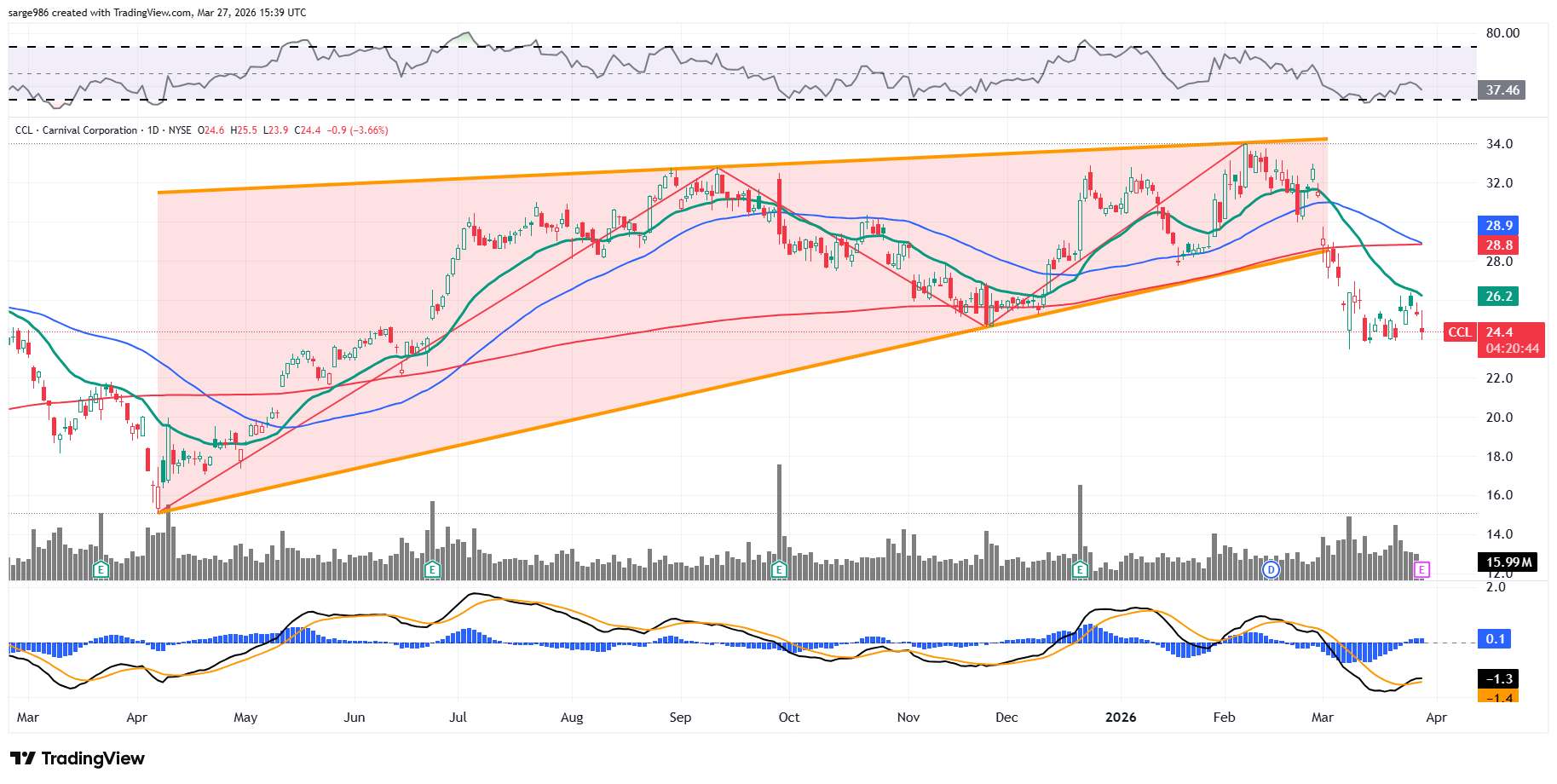
Readers will see that CCL fell out of bed in early March when it broke to the downside out of a rising-wedge pattern of bearish reversal. The stock lost its 50-day SMA, 200-day SMA and 21-day EMA on the way down and the stock does appear to be on the verge of experiencing a "death cross"
Relative strength is weak. The daily MACD is improving, believe it or not. Though not strong, the histogram of the nine-day EMA is trying to stay above the zero-bound and the 12-day EMA has crossed above the 26-day EMA.
Overall, this is a bearish chart. That said, should the war in the Middle East come to a conclusion and fuel prices moderate, CCL could see a nice pop in the share price as a reflex. Timing such an occurrence is a near impossibility. That makes, for those willing to try and play such an event, getting long something like a bull call options' spread make more sense, from a risk-averse sort of perspective, than an actual equity purchase.
An inexpensive play might be getting long something like a $26/$29 April 17 bull call spread for a net debit of just $0.55 or so. Does risking $0.55 to try to win back $3.00 make sense? I think it might.
Related: Asia Preps for Worst-Case Energy-Disruption Scenarios
At the time of publication, Guilfoyle had no positions in any securities mentioned.