New Price Target for Oracle After 'Astronomical' Demand Drives Surge
Is the stock still a buy after comments from Larry Ellison fuel a breakout?
You've reached your free article limit
You've read 0 of 1 free Pro articles.
Cloud-based software/artificial intelligence giant Oracle ORCL released the firm's fiscal fourth quarter financial results on Wednesday afternoon and wow, was Wall Street ever impressed.
The stock is up sharply on Thursday morning in response as investors play catch up. If this looks familiar to some readers, I wrote a piece last week on TradeView (for MooMoo Technologies) entitled "Oracle's Chart Shows Bullish Signs Ahead of Earnings." That piece was posted to my X (Twitter) account for my followers, which is where you may have seen it. We have winners and we have losers. That piece was a winner.
For the three-month period ended May 31, Oracle posted an adjusted EPS of $1.70 (GAAP EPS: $1.19) on revenue of $15.903 billion. Total Cloud Revenue (IaaS and SaaS) amounted to $6.7 billion, which was up 27% year over year. Adjustments were made for stock-based compensation and the amortization of intangible assets. While those top- and adjusted bottom-line numbers both beat Wall Street's expectations, that sales sprint was good enough for year-over-year growth of 11.3%. This was the fastest pace of annual sales growth for the firm since the May quarter of 2023 two years ago. Going forward, Wall Street is projecting continuously accelerating year-over-year sales growth for Oracle for each quarter over at least the next four quarters.
Operations
Within that revenue growth of 11.3%, sales driven by Cloud Services and License Support ramped 14% to $11,698 billion, sales driven by Cloud License and On-Premise License increased 9% to $2.007 billion, Services-driven sales contracted 2% to $1.348 billion, and Hardware-driven sales grew 1% to $850 million.
Total operating expenses grew 12% to $10.794 billion, leaving a GAAP operating income of $5.109 billion (+9%) as operating margin dropped from 33% to 32%. Once adjusted, operating income grew 5%, as operating margin dropped from 47% to 44%.
After accounting for interest, other income and expenses and taxes, GAAP net income printed at $3.427 billion (+9%). This works out to a GAAP EPS of $1.19 per fully-diluted share, up from the year-ago comp of $1.11. Once adjusted, net income grew 6%, as EPS per fully diluted share printed at $1.70, up from $1.63 for the same period one year ago.
Guidance
For the current quarter, the firm is looking for total revenue growth of roughly 11% to 13% in constant currency. Total cloud revenue is seen up 26% to 30%, while adjusted EPS is projected to print in between $1.44 to $1.48. That would be growth of 4% to 6%.
For the full fiscal year, Oracle increased revenue guidance to at least $67 billion, which would be good for year-over-year growth of 16% in constant currency. Total cloud revenue is seen growing more than a whopping 40%, up from 24% growth for the fiscal year just concluded. Cloud infrastructure growth alone is projected to grow more than 70%.
Oracle is predicting more than 100% growth in remaining performance obligation (RPO) for the coming fiscal year, as the firm expects to exceed targets that had been set for the year after the year just started.
On Demand
"We have so much in (the) pipeline right now, that — and of course, we have so much in RPO, meaning those are non-cancelable contracts, and we see the demand," said CEO Safra Ada Catz. "I am still in a position where our supply is not meeting our demand. We actually currently are still waving off customers from — or scheduling them out into the future so that we have enough supply to meet demand. This is a situation that we have not seen in our history. And the numbers themselves are so enormous."
"The demand is astronomical. Now we have — but we have to do this methodically," said chairman and CTO Larry Ellison. "The reason demand continues to outstrip supply is we can only build these data centers, build these computers so fast. And we're also doing a lot of engineering around high-speed networking. You'll see us making — we are making large engineering investments to speed up the networking, the reliability of the network and lower the cost of the networking. So, we're doing a bunch of things — we are doing a bunch of things to lower our CapEx costs. But even if we do that, CapEx is going to go up because the demand right now seems almost insatiable."
Fundamentals
For the full year, Oracle generated operating cash flow of $20.821 billion. Out of this number came capex spending of $21.215 billion, leaving free cash flow of -$394 million. The firm also repurchased $600 million worth of common stock and paid out $4.743 billion in cash dividends to shareholders.
Looking at the balance sheet, the firm ended the period with a cash balance of $11.203 billion and current assets of $24.579 billion. Current liabilities add up to $32.643 billion. While this includes short-term debt of $7.271 billion, it also includes deferred revenues (which are not true financial obligations) of $9.387 billion. That puts the firm's current ratio at a wonky looking 0.75, but once adjusted for those deferred revenues, this ratio rises to a less awful looking, but still not great 1.06.
Total assets amount to $168.361 billion, out of which 39.7% are in goodwill and other intangibles. That's a little bit elevated for my comfort. Total liabilities less equity comes to $147.392 billion including a rather daunting looking $85.297 billion in long-term debt. Obviously, this is not one of the better looking "big tech" balance sheets that we have analyzed.
A Lot to Like...
The earnings were strong. The sales growth was strong. The guidance was outstanding. That guidance along with the comments made by both Catz and Ellison on the state of the demand they are seeing is why the stock is up more than 13% on Thursday morning. The only thing I do not like about this name is the quality of the balance sheet. That's going to take time to get squared away, especially if the firm feels pressured to maintain elevated levels of capital expenditures. Oh, and of course, there is a technical breakout in play on Thursday morning as well:
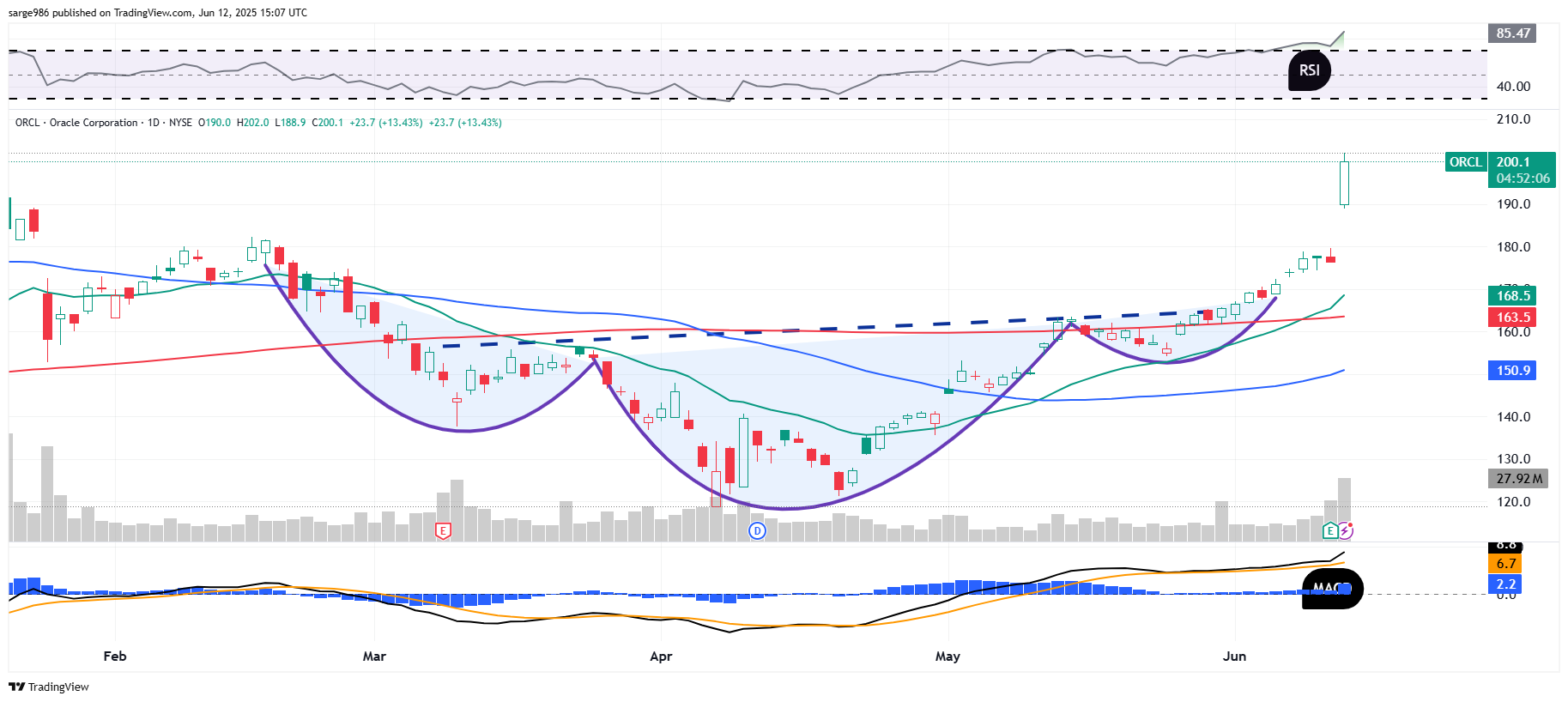
Readers will see that ORCL was just starting to break out of an inverse head-and-shoulders pattern that stretched from late February into the present as earnings approached. The pivot at the time of the breakout was the neckline, or $163. Relative strength has gone from strong to significantly overbought on Thursday morning. The daily MACD has gone nearly parabolic and overtly bullish as well.
Based on that pattern and where the pivot was at breakout, I would put the target price for this stock at a rough $204. At a last sale that I see of $200 and change and a high of the day of just less than $202, I would not consider this stock for a purchase of equity at this time, and at these levels.
It is my opinion that ORCL, at lease levels, is a candidate for a risk-averse bearish options play. Shorting the stock would be too dangerous. A long $200/$190 bear put spread expiring on July 18 would, at this time, run the trader a net debit of roughly $4. In other words, the trader would be risking $4 to try to win back $10.
At the time of publication, Guilfoyle had no positions in any securities mentioned.