New Price Projection for Target After Foolish Leadership Move
Is it time to buy the dip in the beleaguered retailer after an announced C-suite shakeup?
You've reached your free article limit
You've read 0 of 1 free Pro articles.
I saw that Target TGT reported sloppy second quarter earnings. That became standard operating procedure during Chairman and CEO Brian Cornell's reign. I have often written over the past few quarters that I could not believe that the board hung onto this guy, even as the brand took a regular beating despite the fact that Amazon AMZN, Costco COST and Walmart WMT all found ways to evolve and even thrive in a tough retail environment.
I saw that Cornell was stepping down as chair and CEO.
"Oh, the shares are going to soar," was my first thought. Wait, TGT was down 10%-ish in early trade. Why? Oh... Cornell, whose tenure has been catastrophic for Target, is not exactly leaving. He is hanging around as CEO through the holiday season (are you kidding me?) to be replaced on February 1 by current COO and former CFO Michael Fiddelke.
No wonder the stock is down. Not only is the firm promoting from within this beleaguered C-suite when outside leadership was so desperately needed, but Cornell will stick around as executive chair. Fortunately, I was smart enough not to have owned any TGT for years ever since realizing that Cornell was in way, way beyond his depth, but if I had been sucked in by the recent August rally, I would be selling these shares on Wednesday morning along with the rest of Wall Street. Well, sometimes you just can't protect a firm from itself. Let's take a look at the quarter.
The Quarter
For the three-month period ended August 2, Target posted a GAAP EPS of $2.05 on revenue of $25.211 billion. Both the top- and bottom-line results beat Wall Street's expectations by just a smidgen, while that sales print was "good enough" for a year-over-year contraction of 0.9%.
The problem, outside of management, is comparable sales that printed at -1.9% from the year-ago period, suppressed by a 3.2% drop in same-store sales, but partially offset by 4.3% growth in digital sales. Given the poor year-over-year performance, the focus of the press release was on sequential improvement.
Operations
As sales contracted 0.9% to $25.211 billion, the cost of those sales increased 0.4% to $17.903 billion. Selling and administrative expenses decreased 0.1% as depreciation and amortization costs (ex-cost of sales) increased 0.9%. This left a GAAP operating income of $1.317 billion (-19.4%) as operating margin dropped all the way from 6.4% to 5.2%. That's ugly.
After accounting for interest, other income and expenses and taxes, GAAP net income landed at $935 million (-21.5%). That's even uglier. This works out to $2.05 per fully diluted share, down from the year-ago comp of $2.57.
Guidance
For the full fiscal year, Target is stocking to its expectations for a low-single-digit decline in sales. The firm is also projecting a full year GAAP EPS of $8.00 to $10.00 or adjusted EPS of $7.00 to $9.00 after gains from expected litigation settlements are factored in. Wall Street had been looking for a full year adjusted EPS of $7.30 to $7.40 on revenue "growth" of -1.8%, so this is being seen as in-line to slightly positive guidance.
Fundamentals
For the first six months of the fiscal year, Target has generated operating cash flow of $2.358 billion (-29.4%) Yikes. Out of that number, the firm's capex spending came to $1.864 billion (+42%). This left a free cash flow of $494 million, down from $2.026 billion for the first six months one year ago. "Out of that" free cash flow number, the firm repurchased $258 million worth of common stock and paid out $1.019 billion in cash dividends to shareholders. With an imbalanced flow of free cash like that, the balance sheet had better kick some tail. I wouldn't hold my breath.
Turning to the balance sheet, the firm ended the period with a cash balance of $4.341 billion and inventories of $12.881 billion. That put current assets at $19.034 billion. Current liabilities add up to $19.223 billion including shorter-term debt of $1.136 billion.
This leaves the firm's current ratio at 0.99. While we never like to see current ratios below 1.0, this is an improvement for Target. A year ago, the firm's current ratio stood at a paltry 0.89. Of course, the firm's quick ratio would appear to be awful, but in all honesty, due to the inventory-focused nature of the retail business, we cut retailers some slack on publishing quick ratios that would unfairly and negatively impact the appearance of their balance sheets. A sub 1.0 current ratio, even if an improvement, is sloppy enough to get the point across.
Total assets amount to $57.851 billion. The firm included nothing intangible on the asset side of the balance sheet which is quite honorable in my opinion. Total liabilities less equity comes to $42.431 billion. This does include $15.32 billion in long-term debt. I would like to see that number move lower from here as it is up 7.1% over six months and up 12.2% over one year.
My Thoughts
What can you say? I have told readers in the past that I would not buy shares of Target with their money even if I hated their guts. Under Cornell's leadership, at the last sale I saw as I worked on this piece, TGT is down 35% from its 2025 high with the S&P 500 up 9% year to date. The stock is also down 65% since its late 2021 high. The S&P 500 is up quite a bit since then. I think. Right?
Margins are under pressure. Cash flows are under pressure. The firm has been returning more capital to shareholders than it has been creating in free cash. The balance sheet is below average. The firm has been significantly outperformed and, in my humble opinion, out-finessed by its nearest competitors.
The much-needed change in the C-suite has been announced. To keep the underperforming chief executive around in an executive capacity is foolish. To promote someone from his C-suite who certainly had an influence in how poorly this firm has traversed the past few years is just confounding. He may turn out to be great. After working for Cornell, he'll have to pretend he is from Missouri and show us.
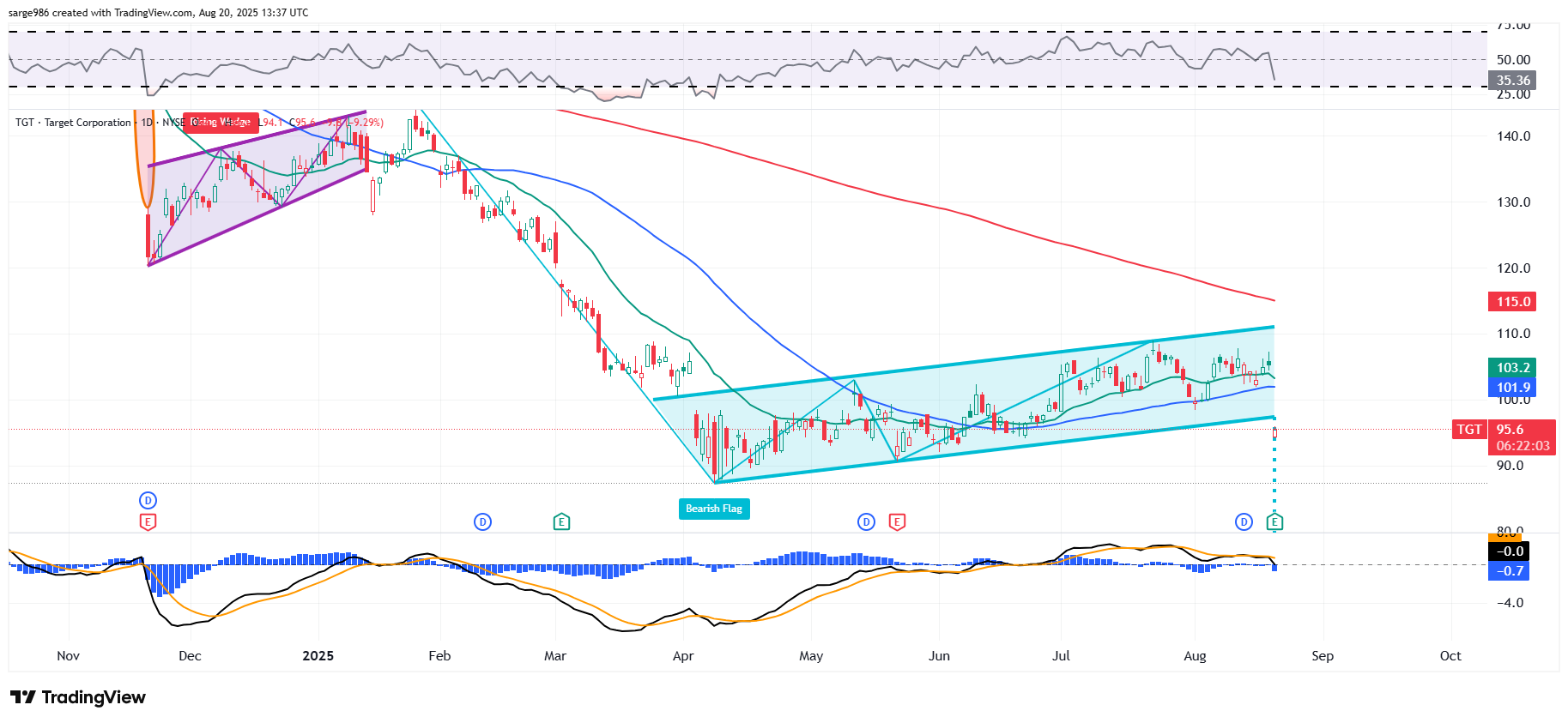
Readers will see a bearish reaction to a rising-wedge pattern of bearish reversal in late January. I think though it is a lengthy flag, we now have to see the April into August rally as a large bearish flag pattern of directional continuance. The stock is most likely, from a technical perspective, in my opinion, still going lower.
The downside pivot was the 50-day SMA that broke on Wednesday morning. If I were short the shares, which I am not, my target price would be in the $85/$86 area. This, for me, is not a "buy the dip" opportunity. The firm is still headed into the holidays with the same batch of misfits running the show.
At the time of publication, Guilfoyle had no positions in any securities mentioned.