New Opendoor CEO Strikes Key to Success Amid AI Refounding
Here's a trade idea for the residential real estate e-commerce platform as a new chief looks to revamp the business.
You've reached your free article limit
You've read 0 of 1 free Pro articles.
On Thursday evening, residential real estate e-commerce platform provider Opendoor Technologies (OPEN) released the firm's third quarter financial results.
For the period ended September 30, the firm posted a GAAP EPS of -$0.12 on revenue of $915 million. That top-line number did beat expectations despite reflecting a year-over-year contraction of 33.7%. The bottom-line print badly missed what had been the consensus view.
The shares are trading lower on Friday morning. I am not so sure whether the tough quarter that the firm had just reported or the firm's new transformation plan is more to blame for the sell off. Let's dig in.
The firm has a new CEO, Kaz Nejatian, who just took over as chief executive in September. It appears that Opendoor is going to focus on scaling acquisitions to boost revenue and improve unit economics or corporate execution as well as accelerate resale velocity in order to increase profitability.
In the press release, the CEO wrote, “We are refounding Opendoor as a software and AI company. In my first month as CEO, we've made a decisive break from the past — returning to the office, eliminating reliance on consultants, and launching over a dozen AI-powered products and features that demonstrate our renewed velocity. Our business will succeed by building technology that makes selling, buying, and owning a home easier and more joyful — not from charging high spreads and hoping the macro saves us.”
On The Plan
Nejatian went on:
“Our path to profitability is clear: transact with more sellers, strengthen our unit economics through better pricing and resale speed, and drive operational efficiency by being ruthless on expenses. By the end of next year, we will drive Opendoor to breakeven Adjusted Net Income on a 12-month go-forward basis. We have three management objectives we believe are critical to reaching this goal. These measures are the same that we monitor internally and to which we hold ourselves accountable. If we can consistently execute and improve each of them, which you will be able to track, we expect to achieve our profitability target.”
Management Objectives
- Scale Acquisitions
- Improve Unit Economics and Resale Velocity
- Build Operating Leverage
Operations
As mentioned above, revenue dropped 33.7% to $915 million. Gross profit dropped 37.1% to $66 million. Gross margin dropped from 7.6% to 7.2%. Ugly.
Homes sold dropped 29% to 2,568. Homes purchased dropped 67% to 1,169. Homes in inventory dropped 50% to 3,139. Net loss dropped from -$78 million to -$90 million. Adjusted net loss actually improved from -$70 million to -$61 million. I know that this is a tough environment for real estate markets, but these numbers are incredible.
Guidance
For the current quarter, the firm expects to increase acquisitions by at least 35% sequentially from the third quarter. Revenue is expected to increase from where it was six months ago but decrease 35% sequentially due to low inventory levels. Adjusted EBITDA loss for the quarter is seen in the high-$40 millions to mid-$50 millions.
Fundamentals
Here, it appears, we see something positive. For the first nine months of the year, Opendoor generated operating cash flow of $979 million, up from the year-ago comp of -$515 million. The firm has spent a whopping $9 million on capital expenditures over nine months, leaving free cash flow of $970 million. The firm is quite obviously in no position to return capital to shareholders.
Turning to the balance sheet, the firm ended the period with a cash position of $962 million with an additional $490 million labeled as "restricted." Inventories stand at $1.053 billion. These are homes, so that value is not static. This puts current assets at $2.587 billion. Current liabilities add up to $914 million including $439 million in convertible senior notes and another $374 million asset-backed short-term debt. That leaves the firm with a current ratio of 2.83, which is strong and a quick ratio of 1.68, which is also strong. The short-term debt load is a concern for me relative to cash.
Total assets amount to $2.7 billion, which is hardly any larger in size than are the firm's current assets. Total liabilities less equity comes to $1.889 billion. That includes another $966 million in asset-backed debt. Yes, the debt load is not necessarily a problem, but definitely something to keep an eye on.
My Thoughts
The firm obviously has its issues. The new CEO is serious about addressing these issues and working towards reversing the firm's fortunes through improved corporate execution. The balance sheet has its issues, but cash flows have gone positive, which would be key to any successful turnaround. The fundamentals don't have me all that interested in getting long this name, but I am willing to take a look at the chart.
We do have a falling wedge pattern and that is a pattern of bullish reversal. Relative strength is weak. The daily MACD is postured bearishly across all three moving averages. That said, the stock did find support where it needed to in order to keep the bullish pattern in play.
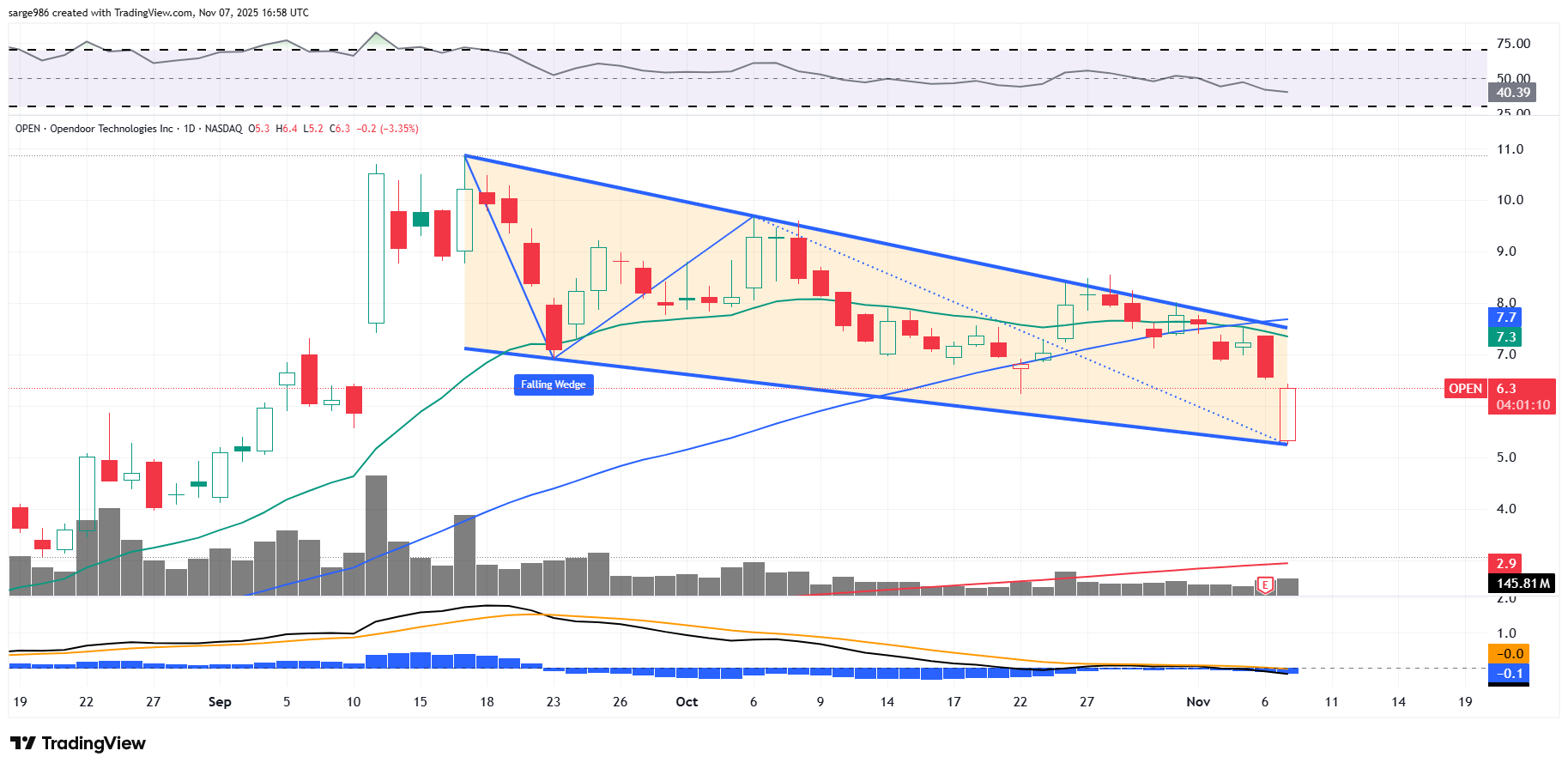
I would not initiate this name now that it has rallied well off of its lows. The shares may be worthy of speculation towards the bottom trend line if they make another approach. Understand though, that should that line fail, there is literally nothing in between that level and the 200-day SMA down at $2.90.
A trader might benefit from selling (writing) December $5 puts for about $0.40. At least that way, the trader either pockets some lunch money or ends up in December, long the stock with a net basis of $4.60 and the shares trading below $5.
At the time of publication, Guilfoyle had no positions in any securities mentioned.