New Nvidia Price Target After Trump Serves $20 Billion Boost
An update for the AI giant provided by the president is expected to provide some major sales growth in China.
You've reached your free article limit
You've read 0 of 1 free Pro articles.
President Donald Trump posted on Monday evening to social media: "I have informed President Xi of China that the United States will allow Nvidia (NVDA) to ship its H200 products to approved Chinese customers in China and other countries under conditions that allow for strong national security."
The U.S. president then added, "President Xi responded positively! $25% will be paid to the United States of America."
Later on in the somewhat lengthy post, the president wrote: "The Department of Commerce is finalizing the details, and the same approach will apply to AMD (Advanced Micro Devices), Intel (INTC) , and other great American Companies."
Nvidia is the dominant player, and Advanced Micro Devices (AMD) a competitor in the AI-capable chip export market. Intel, as far as I am aware, is not. However, the federal government is invested in Intel and Intel is trying to compete with Taiwan Semiconductor (TSM) in the chip foundry business.
Taiwan Semiconductor is the foundry of choice for both Nvidia and AMD and Taiwan Semi is building out massive facilities in Arizona in order to bring that production to the U.S. That said, the high-end chips are made in Taiwan. The White House has confirmed that the 25% fee will be collected as an import tax from Taiwan, as those chips will be imported to the U.S. for a security review prior to being then exported to China.
About These Chips
Nvidia's H200 chips were designed specifically for the Chinese market as were the less advanced H20 chips. H200's are designed on Nvidia's "Hopper" architecture, which is a generation behind the "Blackwell" architecture currently available to U.S. purchasers. Nvidia's next generation "Rubin" architecture is likely to be made available for purchase in early 2026. Blackwell and Rubin are excluded from this approval.
Trouble Again?
Now, to get these chips past the goalie.
The Financial Times has reported on Tuesday morning that Chinese regulators may limit access in China to Nvidia's H200 chips and their AMD counterparts. The FT cited two unnamed sources who feel that authorities in Beijing have been discussing ways to limit purchases of U.S. designed AI-capable chips as China pushes ahead with its plan to become less reliant on non-Chinese produced technologies.
We know that Beijing has stepped up efforts to slow imports of foreign chips at customs and has offered energy subsidies to data centers using only domestic Chinese chips. The two Chinese agencies that would primarily slow things down for Nvidia and AMD are the National Development and Reform Commission and the Ministry of Industry and Information Technology.
That all said, we think these local Chinese designers are at least a generation behind the Nvidia and AMD chips being made available. Chinese tech giants such as Alibaba (BABA) , ByteDance and Tencent are said to be chomping at the bit to gain access to Nvidia products and prefer to use domestic chips only for more basic functions. Nvidia's chips are also said to be easier to maintain than domestic Chinese chips.
Realistic Boost?
Nvidia, in the past, has estimated that China represents a $50 billion total addressable market for GPUs. In 2024, Chinese sales amounted to a rough $13 billion for Nvidia before dropping off sharply in 2025. That was almost 10% of Nvidia's total sales for that year.
Estimates for current full year sales for Nvidia are running at a rough $213 billion with estimates for next year as high as $400 billion, but more realistically around $315 billion. Some analysts see Chinese revenue adding a little as $2 billion or as much as $30 billion in revenue to the firm's sales annually, depending on the level of friction the chips receive at customs. Consensus seems to be for something close to $20 billion.
The Chart
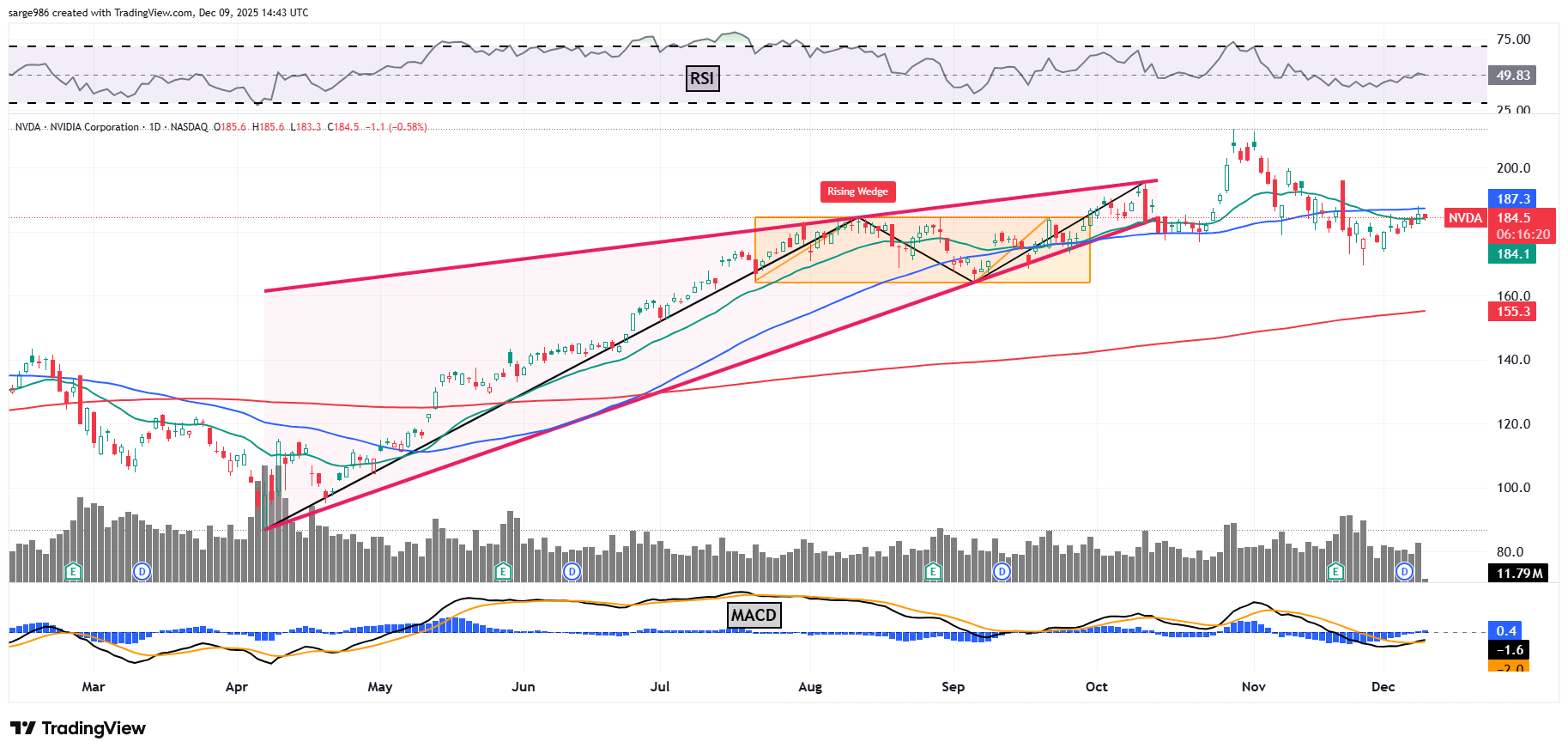
Readers will see that, in this chart, we have two competing technical patterns that have both more or less run their course.
First, we have the April into October rising-wedge pattern of bearish reversal that did ultimately provide a sell-off. However, within that larger pattern, there was a flat basing period of consolidation that produced a short rally.
These patterns are done, and no discernible pattern has developed to take their place in two months. Relative strength tells us almost nothing. The daily MACD is starting to look a little better. The nine-day EMA is positive, and the 12-day EMA has crossed above the 26-day EMA, but both of those lines are still mired below the zero-bound. This places increased importance upon the 21-day EMA and the 50-day SMA.
Readers can see the swing crowd fighting at the 21-day line in real time. The 50-day line, which has been recent resistance, is the pivot. This makes $225 the target. The 200-day SMA, currently at $155, is where I turn tail and run for cover.
At the time of publication, Guilfoyle was long NVDA, AMD and INTC equity.