New Intel Price Target as Surprise Profitability Comes 'Out of Nowhere'
Improved margins from the chip company are like video game stats.
You've reached your free article limit
You've read 0 of 1 free Pro articles.
It didn't take a genius to get long shares of chip designer and chip foundry services provider Intel (INTC) after the company received funding/investment from the likes of the U.S. government, sometimes rival Nvidia (NVDA) and SoftBank.
Intel, which has been under new management since March, released its third-quarter financial results on Thursday evening. For the period ended September 27, it posted adjusted EPS of $0.23 (GAAP EPS: $0.90) on revenue of $13.653 billion.
Wow!
While sales beat Wall Street's expectations by more than half a billion dollars and were good for year-over-year growth of 3.2%, the profitability came out of nowhere. Wall Street was looking for adjusted EPS of just $0.01 and a GAAP loss per share of $0.21. No wonder the stock is trading sharply higher overnight.
The unexpected adjustment primarily came from gains from divestitures that amounted to $1.20 per share. Still, the adjusted beat is legit and comes directly from dramatically improved margins.
Operations
While revenue grew 3.2% to $13.653 billion, GAAP gross margin widened to 38.2% from 15% while adjusted gross margin improved to 40% from 18%. These are like video game stats. GAAP operating margin improved to +5% from -68.2%, while adjusted operating margin improved to +11.2% from -17.8%.
GAAP net income printed at $4.1 billion, up from the year-ago comp of -$16.6 billion. That works out to $0.90 per fully diluted share, up from -$3.88. Adjusted net income landed at $1 billion, up from -$2 billion a year ago. This works out to $0.23 per fully diluted share, up from -$0.46.
The C-Suite
I had almost forgotten how bad things were under former CEO Pat Gelsinger.
Current CEO Lip-Bu Tan commented in the press release: “AI is accelerating demand for compute and creating attractive opportunities across our portfolio, including our core x86 platforms, new efforts in purpose-built ASICs and accelerators, and foundry services. Intel’s industry-leading CPUs and ecosystem, along with our unique U.S.-based leading-edge logic manufacturing and R&D, position us well to capitalize on these trends over time."
CFO David Zinser added: “We took meaningful steps this quarter to strengthen our balance sheet, including accelerated funding from the U.S. Government and investments by NVIDIA and SoftBank Group that increase our operational flexibility and demonstrate the critical role we play in the ecosystem. Our stronger than expected Q3 results mark our fourth consecutive quarter of improved execution and reflect the underlying strength of our core markets. Current demand is outpacing supply, a trend we expect will persist into 2026.”
Segment Performance
-- CCG generated revenue of $8.535 billion (+4.6%), which produced operating income of $2.694 billion (-8.3%).
-- DCAI generated revenue of $4.117 billion (-0.6%), which produced operating income of $964 million (+153%).
-- Foundry generated revenue of $4.235 billion (-2.4%), which produced an operating loss of $2.321 billion, improving from an operating loss $5.799 billion.
Guidance
For the fourth (current) quarter, Intel is projecting revenue of $12.8 billion to $13.8 billion, which largely straddled Wall Street consensus for $13.37 billion.
Gross margin is seen at 34.5% (GAAP) or 36.5% (adjusted) while EPS is seen at $0.08 (adjusted) or -$0.14 (GAAP).
Fundamentals
This is interesting. For the period, Intel generated operating cash flow of $2.546 billion, down 37% from the year-ago comp. However, net capex spending was also down, from $6.756 billion a year ago to $1.556 billion. Hence, free cash flow generation improved to $896 million from the year-ago comparison of -$2.702 billion. The company , understandably, did not return capital to shareholders.
Turning to the balance sheet, Intel ended the period with a cash position of $30.935 billion and inventories of $11.489 billion. That put current assets at $51.731 billion. Current liabilities added up to $32.297 billion, including $2.486 billion in short-term debt. That puts the current and quick ratios at 1.60 and 1.25, respectively. This is up from 1.33 and 0.98 at the year-end 2024. Very nice job by current management in improving this balance sheet.
Total assets amount to $204.514 billion, including $26.789 billion in goodwill and other intangibles. At 13% of total assets, this is no issue whatsoever. Total liabilities less equity comes to $98.138 billion. This does include $44.057 billion in longer-term debt, but this number is down 4.8% since the new kids took over. This balance sheet is already in decent shape and is moving in the right direction.
My Thoughts
This was a very nice quarter. Fiscal discipline is dramatically improved. The balance sheet is improving right before our eyes in a short period of time. The outside investment obviously helps.
A bevy of highly rated analysts reiterated their ratings since Thursday night. Of the 19 analysts rated at five stars by TipRanks that have opined on INTC, we only have one upgrade. The rest have reiterated mostly "hold" and hold-equivalent ratings. There are a few "sells" too.
So, nobody really changed their mind, except for this. Twelve of the 19 analysts increased their price targets, while none reduced their price targets. That's "analyst speak" for "I think I may have gotten this one wrong, but I can't publicly admit it yet for professional reasons."
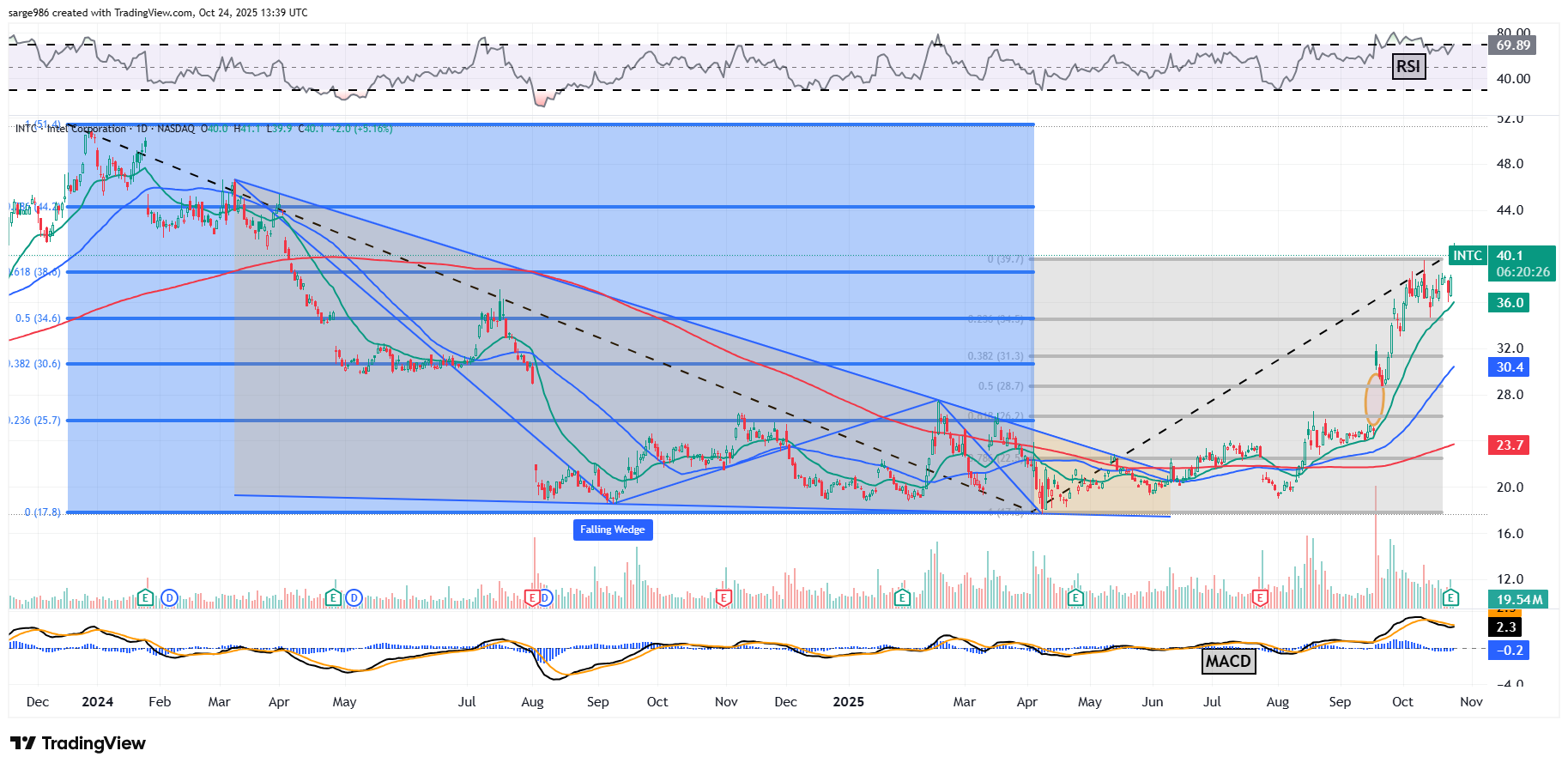
Readers will see that INTC stock appears to trade according to Fibonacci sequence retracement levels. Overlaid on this chart, readers will see the falling wedge pattern of bullish reversal that set up the July into September rally. That rally hit some resistance and consolidated very close to the 61.8% Fibonacci retracement level created by the late December 2023 through early April 2025 selloff.
Coming off of the September 2025 top, the stock then found support at the 23.6% Fibonacci retracement level of that move higher and formed a flat base or trading range close to those recent highs. The recent high, close to $40, is the pivot here.
The indicators are looking positive. Relative strength has remained close to a technically overbought condition.
Below the chart, the daily moving average convergence divergence (MACD) is mixed. The 12-day exponential (EMA) will likely cross above the 26-day EMA, as the histogram of the 9-day EMA moves above the zero-bound. In my experience, few things are more short-term bullish than that.
Intel (INTC)
Price Target: $48
Pivot: $40
Add: Down to $34.50 (Fib level)
Panic: Loss of 50-day simple moving average (currently: $30)
At the time of publication, Guilfoyle was long INTC equity.