New Costco Trade Idea as Balance Sheet 'Crushes' Walmart, Target
There could be a lucrative trading opportunity on Costco stock after earnings.
You've reached your free article limit
You've read 0 of 1 free Pro articles.
On Thursday evening, big-box, membership-driven retailer Costco COST released the firm's fiscal third quarter financial results. For the three-month period ended May 11, Costco posted a GAAP EPS of $4.28 on revenue of $63.205 billion. These top- and bottom-line results both beat Wall Street's expectations, while the print for revenue generation was good for year-over-year growth of 8%, which is in line with the company's recent performance.
Comp sales across the entire company grew 5.7%, which, while being a very good number, fell short of the 6% growth that analysts had projected. Adjusted for fluctuations in currency exchange rates and gasoline prices, this 5.7% becomes an even 8%. Within those comp sales, U.S. comps grew 6.6%, adjustable to 7.9%; Canadian comps grew 2.9%, adjustable to 7.8%; and all other international comps grew 3.2%, adjustable to 8.5%. E-commerce sales grew 14.8%, adjustable to 15.7%.
Operations
Within that revenue print of $63.205 billion, net sales also grew 8% to $61.965 billion. The other $1.24 billion came by way of membership fees. Merchandise costs increased 7.5% to $54.996 billion, which resulted in a gross product margin of $11.25%, slightly beating expectations. Operating expenses increased 10.4% to $5.679 billion, leaving a GAAP operating income of $2.53B billion(+15.2%). This put the firm's operating margin at 4.08%, which beat expectations.
After accounting for interest, other income and expenses and taxes, GAAP net income printed at $1.903 billion, up 13.2% from the year-ago comparison. This works out to $4.28 per fully diluted share, up nicely from $3.78 a year ago.
Fundamentals
For the period reported, Costco generated operating cash flow of $9.468 billion. Out of that number came capex spending of $3.532 billion, leaving free cash flow of $5.936 billion (+13.1%). Out of that free cash, the firm repurchased $623 million in common stock, while dishing out $1.03 billion in cash dividends to shareholders.
Turning to the balance sheet, Costco ended the quarter with a cash position of $14.85 billion and inventories of $18.606 billion. That left the firm with current assets of $38.151 billion. Current liabilities add up to $37.579 billion, which includes no short-term debt. That places Costco's current ratio at 1.02. While this is not some awesome figure, it does pass muster, and it simply crushes what we have seen on the balance sheets of key competitors Walmart WMT and Target TGT.
Total assets amount to $75.482 billion. Total liabilities less equity comes to $48.357 billion. This includes long-term debt of $5.717 million, which is something that the firm could pay off more than 2.5 times over out of pocket if need be. This balance sheet is stronger than the current ratio lets on. Walmart and Target can't touch this.
Need to Know
Costco is mitigating the impacts of President Trump's tariffs by sourcing products for in-house brand Kirkland Signature from nations where the products will be sold. Kirkland-branded products tend to sell with a better profit margin for Costco than name brands and Costco members seem to trust the brand.
The Chart
While the firm is clearly still executing at a high level, the technicals are not, at the moment, singing the same song. Take a look:
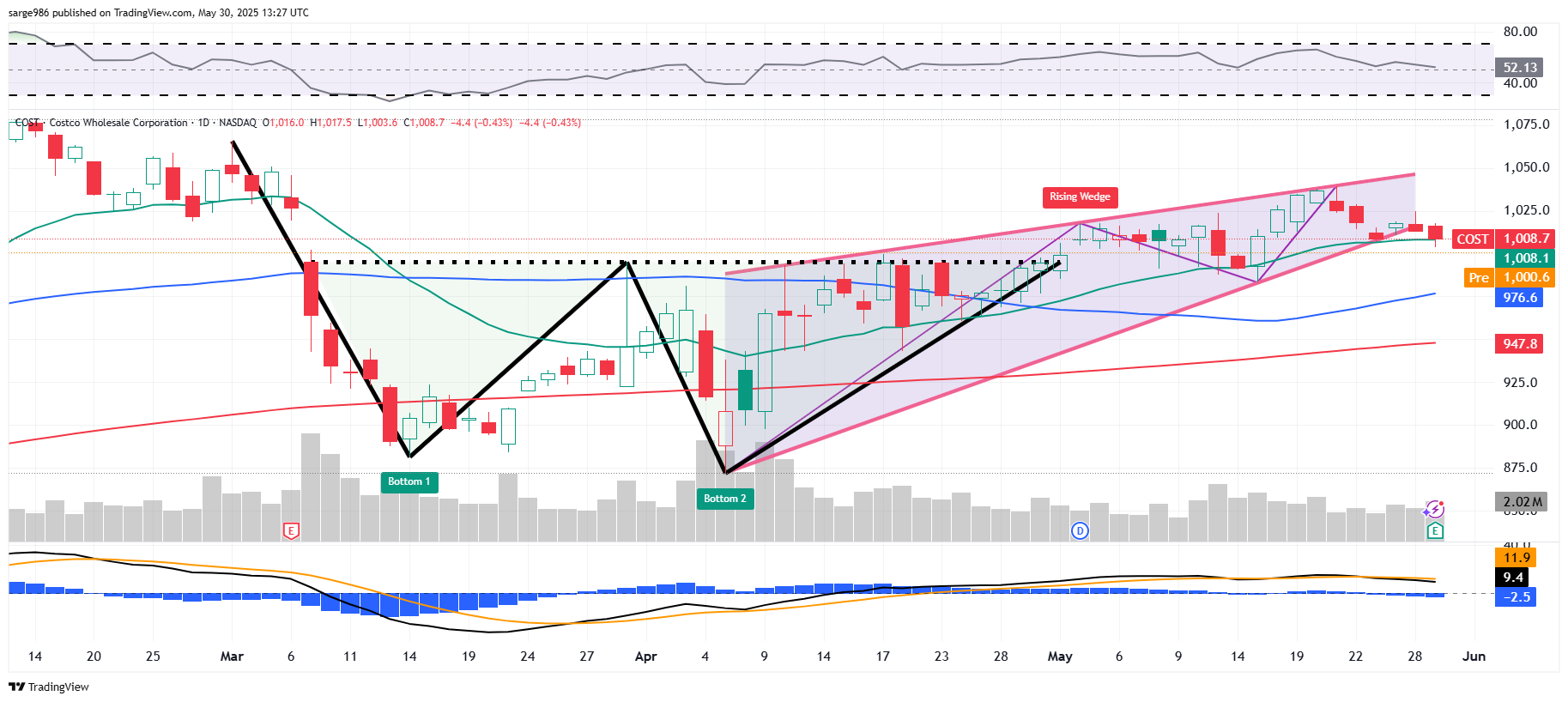
Readers will see the double-bottom pattern of bullish reversal that worked like a charm, stretching from late February into late April. That set up a nice breakout that ultimately took the shares as high as $1,039 by mid-May. It is sometime in April that the final lift visible in the double bottom started to morph into a rising wedge, which is a pattern of bearish reversal.
Relative strength is now neutral after having been more robust. The daily MACD is now postured quite bearishly with the histogram of the nine-day EMA in negative territory and with the 12-day EMA (black line) having crossed below the 26-day EMA (gold line). Now that the shares have broken below the lower trendline of the wedge, I think it very possible that the stock will test either the 50-day SMA, currently at $978 or even the 200-day SMA, now at $948. Let's see what the swing traders do here at the 21-day EMA.
Idea? I would be willing to initiate COST on the long side, but only with the appropriate discount applied. On that note, traders OK with some short-term risk can still get paid about $4 for June 6 $980 puts and/or about $1.20 for June 6 $950 puts. Just an idea. June 6 is just a week away. June 6 will also be the 81st anniversary of D-Day.
At the time of publication, Guilfoyle had no positions in any securities mentioned.