New Boeing Price Target as Ortberg Moves Firm to Brighter Future
Yes, I'm buying the stock.
You've reached your free article limit
You've read 0 of 1 free Pro articles.
Aerospace giant Boeing (BA) went to the tape on Wednesday morning with the firm's third quarter financial results. Holy moly, I haven't seen anything that ugly since I used to sleep exposed to the elements in swamps and rainforests as a young go-getter. My loyal readers already know that as someone who had long (for decades) stayed away from investing in Boeing that I had recently relented and initiated this name. This is a different company than the one that I beat on ever since landing on that tarmac in Panama back in the glory days and this company is under new management.
CEO Kelly Ortberg, who took over the top job in August 2024, is not a Boeing lifer, which is why I think he can be the one to fix this broken firm. Ortberg had been at Rockwell Collins for 17 years and CEO for five when that firm was swallowed up by United Technologies in 2018. He remained on as CEO of the Collins Aerospace segment of that firm until UTX merged into Raytheon Technologies, now RTX (RTX) , in 2020, retiring from RTX in 2021.
Ortberg accepted a seat on Boeing's board of directors after accepting to take on the roles of president and chief executive, succeeding Dave Calhoun who succeeded Dennis Muilenburg in 2024. Coming in after two consecutive CEOs that really could not be looked at as anything close to successful whose terms dated back to 2015 was a huge undertaking. Boeing still has not posted a profitable (adjusted) quarter since Q2 2021 and that was a one-off. The quarter reported on Wednesday morning was as ugly as any of them, but there are signs of the turnaround that I have been talking about.
The Quarter
For the period ended September 30, Boeing posted an adjusted EPS of -$7.47 (GAAP EPS: -$7.14) on revenue of $23.27 billion. While that top-line result beat Wall Street by more than $1 billion and was good enough for year-over-year growth of 30.4%, the bottom-line numbers fell a country mile, no make that five country miles, short of the mark. The deal is this: Wall Street was looking for an adjusted EPS of -$2.38 but had to take a $4.9 billion charge related to the extended 777X certification schedule. This pushed deliveries out to 2027 that had been scheduled for 2026. That jet, by the way, had originally been planned to enter service in 2020. Incredibly, despite the more than $5 miss on adjusted EPS, the number still compares well to the year-ago print of -$10.44.
Operations
With revenues up 30%, Boeing was able to cut its GAAP operating income/loss to -$4.781 billion from the year-ago print of -$5.761 billion. This took the firm's GAAP operating margin up to -20.5% from -32.3%. With that, net income/loss improved to -$5.339 billion from -$6.174 billion. This works out to an EPS of -$7.14, up from -$9.97.
On an adjusted basis, Boeing was able to cut its core operating income/loss to -$5.049 billion from the year-ago result of -$5.9.89 billion. This took the firm's core operating margin up to -21.7% from -33.6%. With that, core adjusted EPS worked out to -$7.47, up from -$10.44. Ugly stick meet Boeing; Boeing meet ugly stick... Oh, I see you two are well acquainted.
The CEO
Ortberg commented in the press release:
"With a sustained focus on safety and quality, we achieved important milestones in our recovery as we generated positive free cash flow (more on that below) in the quarter and jointly agreed with the FAA in October to increase 737 production to 42 per month."
Ortberg then added:
"While we are disappointed in the 777X schedule delay, the airplane continues to perform well in flight testing, and we remain focused on the work ahead to complete our development programs and stabilize our operations in order to fully recover our company's performance and restore trust with all of our stakeholders."
Well, he is saying the right things.
Segment Performance
- Commercial Airplanes: Deliveries were up to 160 from 116, as revenue increased 49% to $11.409 billion. The firm posted a segment operating income/loss of -$5.353 billion, down from -$4.021 billion, as segment operating margin improved from -54% to -48.3%.
- Defense, Space and Security: Revenue increased 25% to $6.902 billion. The firm posted a segment operating income/loss of $114 million, up from -$2.384 billion, as segment operating margin improved from -43.1% to 1.7%.
- Global Services: Revenue increased 10% to $5.37 billion. The firm posted a segment operating income of $938 million (+12%) as segment operating margin improved from 17% to 17.5%.
Fundamentals
For the third quarter, Boeing generated operating cash flow of $1.123 billion, up from -$1.345 billion. Out of that number came capex spending of $885 million, up from $611 million. That left free cash flow of $238 million, up from -$1.956 billion. Obviously outside of mandatory dividend payments to holders of preferred stock, Bowing is in no position to return capital to shareholders.
Moving on to the balance sheet, Boeing ended the period with a cash position of $22.984 billion and inventories of $82.425 billion. That puts current assets at $122.132 billion. Current liabilities add up to $103.324 billion. That includes $8.742 billion in debt that will come due within 12 months. This also includes $57.962 billion in advances and progress billings which is basically industry lingo for deferred revenues. At the headline, the firm's current and quick ratios stand at 1.18 and 0.38.
However, once adjusted for those deferred revenues, these ratios rise to 2.69, which is actually very good, and 0.88, which is not bad at all for an inventories-intense industrial firm. Total assets amount to $150.023 billion, of which just 5.9% would be considered to be intangible in nature. Total liabilities less equity comes to $158.276 billion. This includes long-term debt of $44.611 billion. No, this is not an excellent balance sheet, but the current situation is more than adequate and surprisingly strong for a firm that has been consistently mismanaged and had been hemorrhaging cash for years and years.
My Thoughts
Long way to go? Definitely. Positive free cash flow? Impressive. Bright future? Well, at least a brighter future. I like the "better than tragic" balance sheet. A lot of folks might not have expected that. I may be early, but I see this name as a name to accumulate over time.
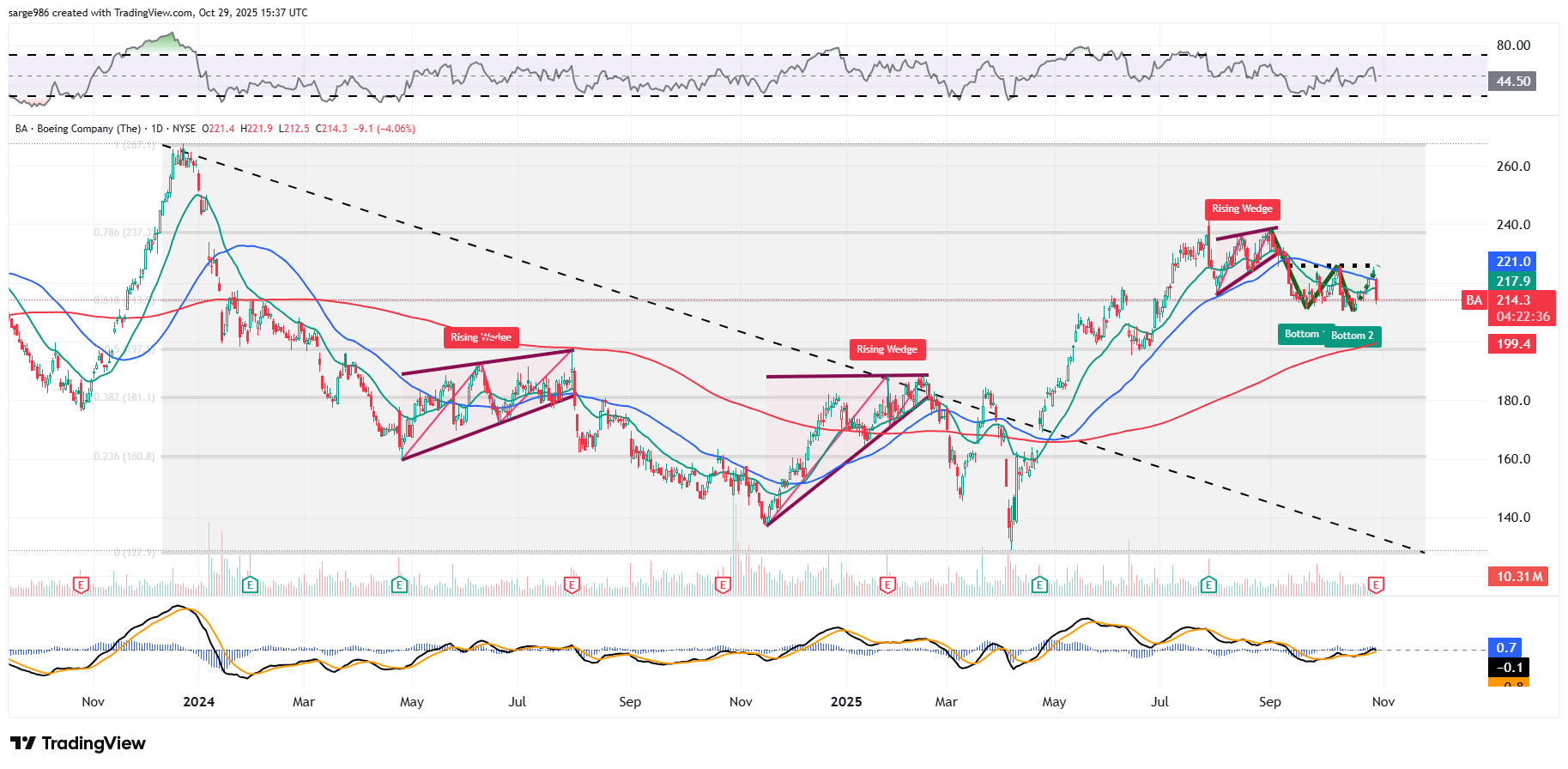
Readers will see that BA has developed three rising wedge patterns of bearish reversal over the past almost two years. In all three instances, the stock sold off as it should have, then based and at least in the first two cases, rallied. This summer, the stock hit resistance at the 78.6% Fibonacci retracement level of the late 2023 through April 2025 sell-off.
BA then caught itself close to the 61.8% Fib. level and developed a smallish double-bottom pattern of bullish reversal. That double bottom may become a triple bottom, but that does not change the signal. The upside pivot created by this pattern is $226. That would, for me, conservatively put the target price at $271. The 200-day SMA is my panic point. I will be adding to my long position on weakness after this article is public information.
At the time of publication, Guilfoyle was long BA equity.