New Bitcoin Trade Idea as Mining Chart Hits 'Interesting' New Spot
This small-cap crypto firm caught my attention after the shares made an interesting move.
You've reached your free article limit
You've read 0 of 1 free Pro articles.
Ever use the butt end of a rifle to keep a pack of ticked off wolves at bay? I have.
There were four of us, so I wasn't alone, but we were tactical, meaning that we couldn't use fire or the business end of our weapons. That said, the wolves raised so much of a ruckus, we had indeed been robbed of our stealth. Now that I have your attention, this is not that story. The corporate name of the stock we are about to discuss did, however, remind me of that long ago and moderately scary night.
A stock that might be perfect for a "Stocks Under $10" or "Small Caps" portfolio caught my eye as I did my homework over the weekend. I am not going to lie to you and tell you that I have been tracking this name or that it was even on my radar. What I am telling you is that I literally just noticed this one and now it is on my radar. So, let's explore.
TeraWulf!
Who the heck is TeraWulf WULF? TeraWulf is an Easton, Maryland based operation that develops and operates environmentally sustainable data center infrastructure in the U.S., with a focus on bitcoin mining and hosting high-performance computing (HPC) workloads. The firm owns and operates the Lake Mariner facility at an obsolete cola plant in western New York State. The facility has room and is scalable for growth to 500 megawatts in the short-term future and 750 megawatts longer term with upgrades.
TeraWulf provides hash compute services to mining pool operator(s), facilitating transaction validation across the global bitcoin network making use of application-specific integrated circuit miners. The firm's infrastructure provides hosting and colocation services for GPU-based workloads, AI, machine learning and cloud computing. The firm also specializes in the development of power generation assets and related electrical generation infrastructure.
Earnings
No, Terawulf does not yet make money. For the first quarter, reported in early May, the firm posted a GAAP EPS of -$0.16 on revenue of $34.41 million. These results were not what Wall Street expected. Not even close. That top-line print fell significantly short of expectations while also sporting a year-over-year revenue contraction of almost 19%. The bottom-line number missed by nine cents.
However, for the second quarter, which will be reported on August 8 ahead of the opening bell, consensus is for a GAAP EPS of -$0.06 on revenue of $49.2 billion. Results like that won't measure up well against the year-ago comp of -$0.03, but would sport year-over-year sales growth of 38.3%. In fact, Wall Street is projecting more than 100% sales growth for the September quarter and 81% sales growth for next year over this year. There is hope.
Fundamentals
This segment will not impress. For the trailing 12 months, as of the March quarter, the firm had generated $9.2 million (yes, that's with an "M") in operating cash flow, while spending $314.6 million in capital expenditures. Over the past 12 months, the firm issued $500.2 million in total debt, but also repaid $109.2 million in debt, so this is not a reckless crew.
Much of that dough was still in cash form as the March quarter ended. The firm had a cash position of $218.2 million at quarter's end and current assets of $230 million. Current liabilities added up to $120.9 million which included no short-er-term debt. Therefore, the firm's current situation is far more than merely "healthy."
Total assets amount to $841.2 million, of which all is tangible. Total liabilities less equity came to $670.8 million. That includes $488.1 million in long-term debt, which could eventually become an issue if the firm cannot start generating positive free cash flow. That said, this is not this year's problem.
The Chart
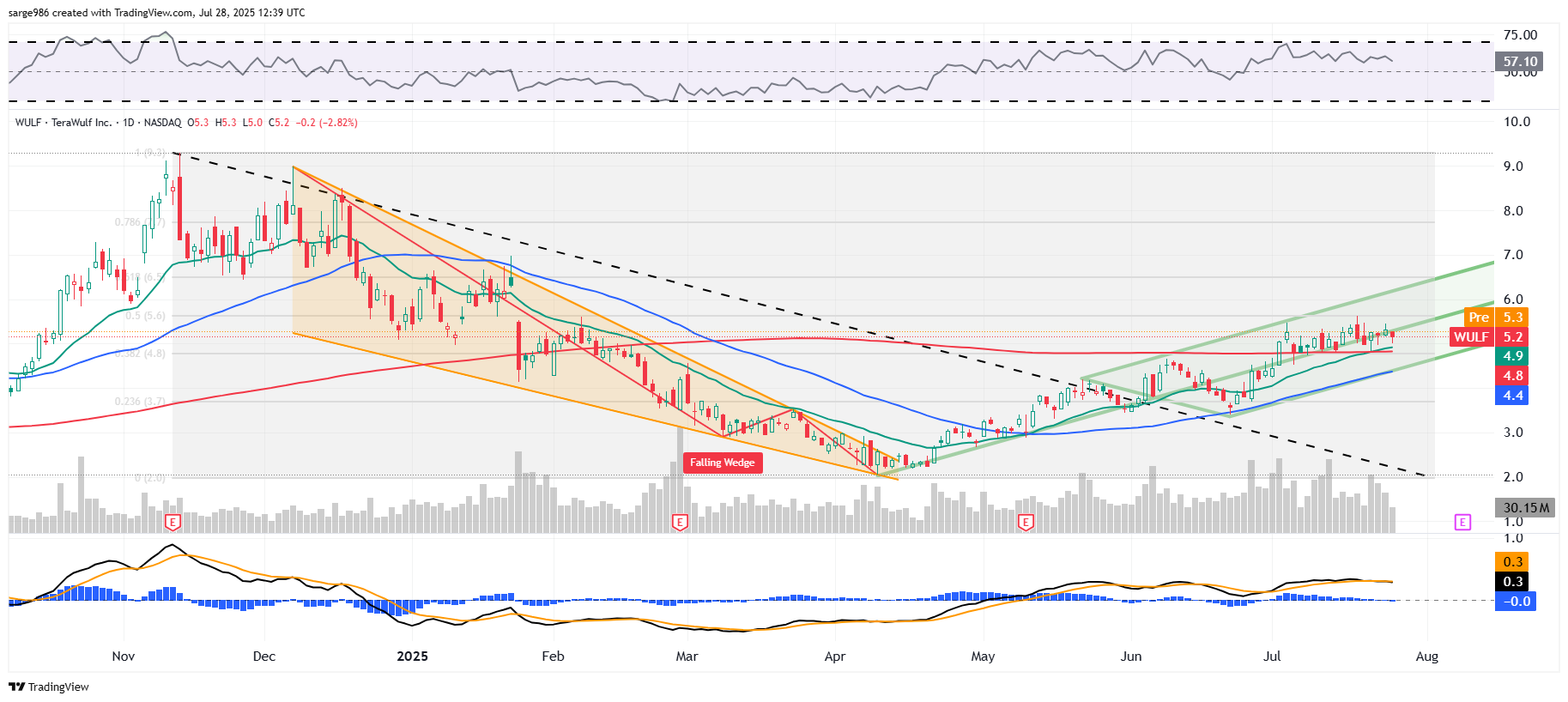
This chart is what caught my attention over the weekend. If you're a chart-monkey like me, this is interesting. Readers will see that the stock rallied out of a falling wedge pattern in April. The rally since then fits neatly inside of an Andrews' pitchfork model, as the stock has retaken its 50-day SMA in early May, its 21-day EMA in late June and its 200-day SMA in early July.
What's interesting is that the shares have hit resistance twice at the "halfway back" or 50% retracement level of the November into April sell-off. We're now in a trading range. Support at the 200-day line, resistance at the half-way back point. What now?
Relative strength is strong, but not very strong. The daily MACD does not tell us much. The histogram of the nine-day EMA is slightly negative while the 12-day and 26-day EMAs are literally running on top of one another. There is no signal here. It's all up to that range bound trade.
The idea? In minimal lots, maybe buy 100 shares close to the pre-opening last sale of $5.27 and write one September 19 $5.50 call against the equity position for about $0.70. That would take the trader's net basis down about $4.57. Should the shares end up being called away at $5.50 in September, the trade would net a cool 20% profit.
To drive the net basis lower, though it would increase the equity risk over the next month and a half, this trader could also write September 19 $4.50 puts for about $0.45. Interesting. To say the least.
At the time of publication, Guilfoyle had no positions in any securities mentioned.