Netflix Should Be Hoping to Lose Warner Bros. Bid After Brutal Stock Reaction
The streaming giant saw an investor exodus continue after reporting its latest financial results.
You've reached your free article limit
You've read 0 of 1 free Pro articles.
Streaming entertainment giant Netflix (NFLX) reported the firm's fourth quarter financial results on Tuesday evening. The stock had closed on Tuesday afternoon down 34.9% since its late June high. Despite narrow beats on both the top and bottom lines, after the release, investors continued on with their now more than half-year long exodus out of that stock.
For the period ended December 31, 2025, Netflix posted a GAAP EPS of $0.56 on revenue of $12.051 billion. The earnings beat Wall Street by one penny per share, while those sales were good for year-over-year growth of 17.6%. That said, those sales also only beat Wall Street by a rough $80 million.
The growth in revenue generation was largely driven by membership growth, higher pricing and ad sales. The issue, though, was twofold:
Q4 is typically a very strong quarter for Netflix. Whisper numbers in some circles were higher. Additionally, guidance is disappointing, which is always a tough obstacle for any stock to overcome.
Then there was the firm's updated bid for most of Warner Bros Discovery (WBD) . Netflix amended its bid to an all-cash offer of $27.75 per share, by securing even more debt from the firm's creditors to fund the deal. Netflix is trying to fend off a $30 all-cash bid by Paramount Skydance (PSKY) for the whole of WBD. It is increasingly starting to look to this spectator that perhaps winning this competition for WBD might just be a colossal mistake for whoever does actually take home that prize.
Operations
As mentioned above, revenues grew 17.6% to $12.051 billion. After accounting for slower growth in cost of those revenues as well as total operating expenses, operating income increased 30.1% to $2.956 billion from the year-ago comp.
As impressive as that is, operating income did contract 9% on a sequential basis. Factoring in for interest, other income and expenses and taxes, GAAP net income improved to $2.419 billion (+29.4% year over year). Again, though, this was 5.1% sequential contraction from Q3 2025. Those results work out to $0.56 per fully diluted share, up from $0.43 a year ago, but down from $0.59 a quarter ago.
Guidance
For the current quarter, Netflix is projecting revenue of roughly $12.16 billion and a GAAP EPS of $0.76. Wall Street had been looking for $0.81 on $12.18 billion, making this a guidance miss at both the top and bottom lines. Wall Street took its pound of flesh out of the stock overnight in response.
For the full year of 2026, Netflix sees revenue of $50.7 billion to $51.7 billion, which does bring the midpoint of the range above the $51 billion that Wall Street was looking for. Netflix also sees an operating margin of 31.5%.
Fundamentals
For the period reported, Netflix generated operating cash flow of $2.112 billion. Out of that number came capex spending of $239.3 million, leaving free cash flow of $1.872 billion. "Out of that free cash flow," Netflix repurchased $2.08 billion worth of common stock.
Turning to the balance sheet, Netflix ended the quarter with a cash position of $9.062 billion and current assets of $13.02 billion. Current liabilities add up to $10.98 billion. This includes both $998.9 million in short-term debt and deferred revenue of $1.776 billion. Remember that deferred revenue is not a true financial obligation. That leaves the firm's current ratio at 1.19, which passes muster. However, adjusted for deferred revenues, that ratio rises to 1.41.
Total assets amount to $55.597 billion. Total liabilities less equity comes to $28.982 billion including long-term debt of $13.464 billion. That's before any potential cash (debt fueled) acquisition of most of the assets of WBD.
My Thoughts
There were not a lot of downgrades of Netflix overnight. That said, I have found 15 sell-side analysts rated at four stars or more out of five by TipRanks that have reduced their target prices. In fact, on Wednesday morning, two of these analysts have reduced their targets to less than $100. Missing on guidance and potentially fueling a very questionable deal through a sharp increase in debt load are not share price friendly realities.
Then, throw in less than stellar sales growth for a firm that even with its H2 2025 sell-off was still trading at 27-times forward-looking earnings and I do not see a recipe for a rebound. Unless, somehow, they lose the bidding war for WBD.
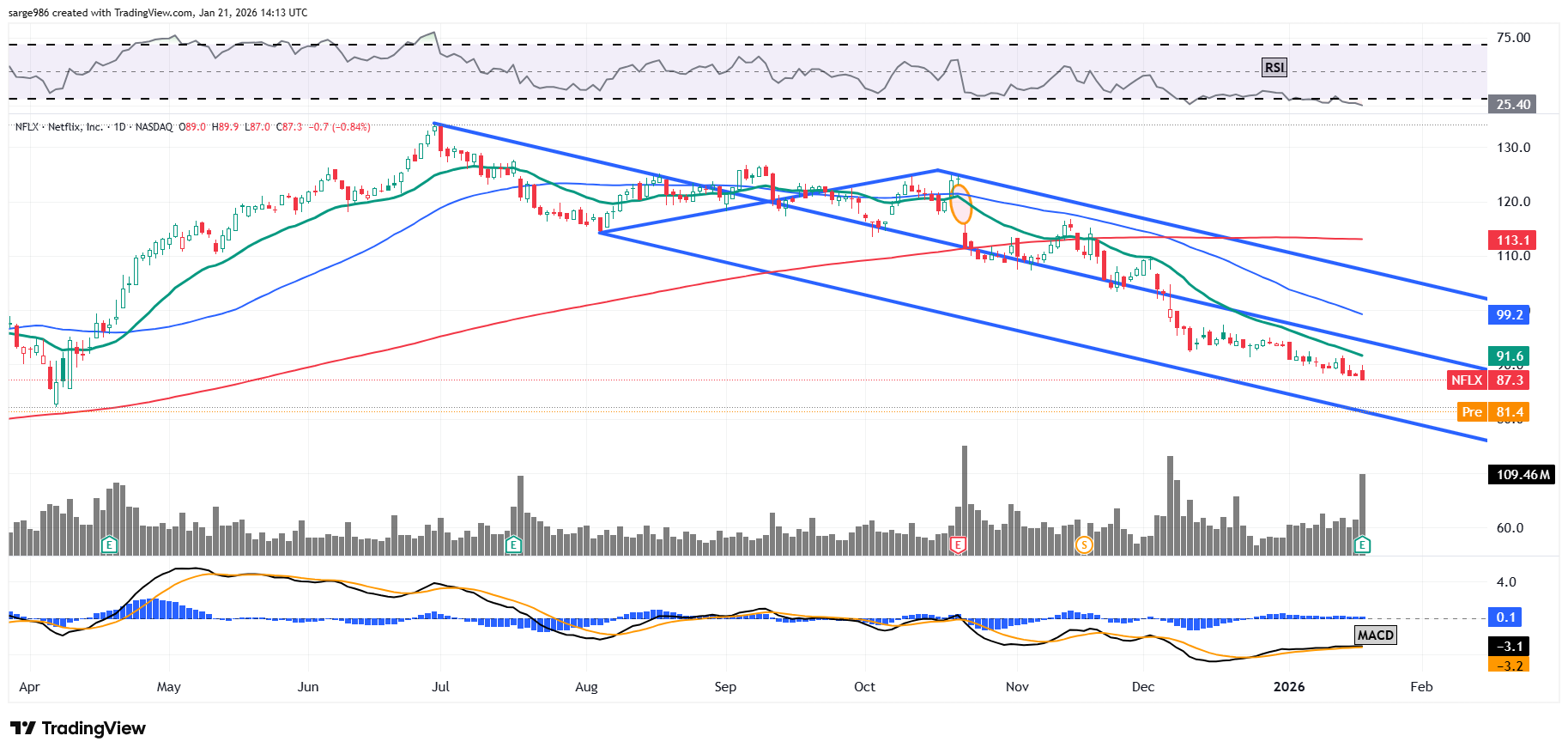
Readers will see a very tough looking chart on this page that's about to get tougher. The stock has surrendered all three of what I see as its key moving averages since October. The stock now has to look up a long way to see its 21-day EMA, 50-day SMA and 200-day SMA. The stock did leave behind both an unfilled gap in October that would require a tick at $124.86 or higher to fill and a death cross in early December.
I have applied one of my Andrews' pitchfork models to this long downtrend, and we can see that the stock has lost the central trendline and has existed within the confines of the lower chamber for about a month and a half now. The lower trendline of this model might be the last line of potential support before analysts start looking at historical charts to find trading levels.
Looking at the indicators, relative strength is now in technically oversold territory. Below the chart, the daily MACD is not in very good shape. The histogram of the nine-day EMA is in positive territory but won't be after the opening bell. Readers will see that the 12-day EMA will cross below the 26-day EMA this morning as well. No, I am not considering this dip in NFLX as an opportunity. If the deal goes through, maybe I'd think about it in the $60s. If not, I'll play catch up. Not my concern.
At the time of publication, Guilfoyle had no positions in any securities mentioned.