My Semiconductor Strategy, Bracing for the Revised Jobs Numbers, the $39B Auction
Here's why we can't forget about 'memory' in the AI and chip horse race; also, let's sort through the employment possibilities and that big auction on new Ten-Year paper.
You've reached your free article limit
You've read 0 of 1 free Pro articles.
Paint it, Black
I wanna see it painted
Painted black
Black as night
Black as coal
I wanna see the sun
Blotted out from the sky
I wanna see it painted, painted, painted
Painted black, yeah
- Jagger, Richards (The Rolling Stones), 1965
Are You Ready?
Remember all of those semi-strong to strong monthly job reports that ran through 2024 into 2025? Yeah. Well, Tuesday is the day that the Bureau of Labor Statistics is forced to come clean on just how inaccurate those reports were. This is not something special. Every autumn the BLS releases a preliminary benchmark revision to monthly payroll estimates that had been collected up to the previous March. That revision will then be finalized in January.
Readers with good memories will recall that last year the BLS revised non-farm payroll job creation down by 589,000 positions. That downward revision of 589,000 fewer jobs was the January number, revised itself down (or is it up?) from an estimate of 818,000 fewer jobs last September. So, even today, we won't know for sure. These numbers will still change.
How is that possible without getting political? We're already fairly sure that the BLS models for seasonal adjustments and especially its birth / death adjustments have been wildly incorrect for a few years now. There are good reasons besides simply not correcting outdated modeling for the inaccuracy as well. The monthly data, known as the CES, or Current Employment Statistics, survey only covers about a third of non-farm employers across the U.S. Those skewed models then are used to extrapolate a ballpark estimate for headline job creation on a monthly basis.
What's known as the QCEW, or Quarterly Census of Employment and Wages, includes data that employers are required to file at the state level and covers about 95% of all U.S. non-farm employers. The annual benchmark revision using the QCEW data is considered to be the most accurate measure for job creation available to U.S. economists.
This Year's Revision?
Estimates made up and down Wall Street show that private sector economists are expecting another huge downward revision this year, for the period covering April 2024 through March 2025. Many economists on the street are expecting the summer and fall data from 2024 to be revised sharply lower later today.
I have seen some estimates for a downward revision of more than a million jobs for the year ended March 2025. I have also seen one estimate for an upward revision. The consensus seems to be for a downward revision of roughly 900,000 jobs, though. If indeed that is the number, it would take the average monthly NFP print for the April 2024 through March 2025 period down from 149,000 to just 74,000 and would take several months during that period into negative growth territory just, as we just saw with the large short-term downward revision to this past June.
Does it matter? Greatly. If the lack of job creation is a more recent development just discovered through those massive short-term revisions made last month, then inaction on rates by the Federal Open Market Committee while inflation was still under control would be a matter of timing. But if this revision shows that labor markets had been much weaker than thought for much of 2024, then it could not only confirm that the economy is much closer to recession than many thought but had been for quite some time.
It also means that, with close to correct labor market data, Fed Chair Jerome Powell probably would have reacted in 2024. I will say this, our children in their 20s and 30s have been telling us anecdotally for more than a year that there were no jobs. There's a very good chance that these kids knew something well before anyone in D.C. Maybe this is why the slope of the Treasury yield curve has all but collapsed since last week. Have you seen the Ten-Year?
Will Massive Downward Jobs Revisions Shift the Market Mood?
About That Ten-Year Note
Tomorrow afternoon, the U.S. Treasury Department will go to auction with $39 billion worth of new Ten-Year paper. By day's end on Monday, the U.S. Ten-Year Note paid just 4.05%, down another three basis points on the session, down from more than 4.3% a week earlier and down from the cycle high of roughly 4.8% in early January. Less than a week ago, we were worried about a 5% yield for the Thirty-Year long bond. Last night, that product paid just 4.69%.
No doubt about it. The yield curve has flattened quickly over just a few days and is clearly pricing something in. Fed rate cuts? That's likely part of the equation, but the long end of the curve is not as influenced by interference at the central bank as is the short end. The long end still enjoys free market price discovery. Yields at the long end would be moving higher if bond traders were pricing in run-away inflation and / or explosive economic growth.
So, no run-away inflation, Sarge? Um, no. Don't get crazy with your bad self. I think we see a 3 handle for headline consumer price index, before this current surge in consumer prices peters out. Maybe not in the August data, which will be released on Thursday morning, but almost definitely in the September numbers. Know what though? That may be the peak. Then inflation cools. Why? Because demand cools. The economy cools. Less regulation will help. So will taxes that are kept in check.
That may keep the nation out of a declared recession, but the nation does not need a declaration of two consecutive quarters of contracting economic activity to feel like it's in recession. The Great Recession ran from December 2007 through June 2009. If you had friends who did not work in the markets or work in economics, then you know that they all thought the economy was still in recession right through 2016. The incremental increases in economic activity through that period, despite near-zero interest rate policy, benefited those of us who know how to invest and trade for a living, but never made it to the folks on Main Street.
Marketplace
Not only were Treasury debt securities hot on Monday, but to a degree, so was the AI trade. The Nasdaq Composite gained 0.45% for the day, closing at an all-time high, as the S&P 500 gained 0.21%. Small to mid-cap stocks were quiet on the whole as were both the Dow Transports and the KBW Banks.
Six of the 11 S&P sector SPDR ETFs closed out the day in the green, led by Technology XLK. Within that group, the Dow Jones U.S. Software Index gained 1.2%, led by AppLovin APP and CoreWeave CRWV. The Philly Semiconductors tacked on 0.84% led by Marvell Technology MRVL and Broadcom AVGO.
In a sign that everything I just told you about collapsing yield curves might be incorrect, growth and cyclical sectors took seven of the top eight slots on the daily performance tables while defensives took the bottom three. In fact, Utilities XLU, a group whose dividend yields often find favor as bond yields collapse, finished in last place.
Breadth was nothing to write home about. Winners beat losers by a rough 5-to-4 margin at the NYSE and by about 4 to 3 at the Nasdaq. However, advancing volume took just a 49.2% share across NYSE-listed trade, while taking a 60.2% share of all Nasdaq-listed activity. Aggregate trading volume was slightly higher across all markets.
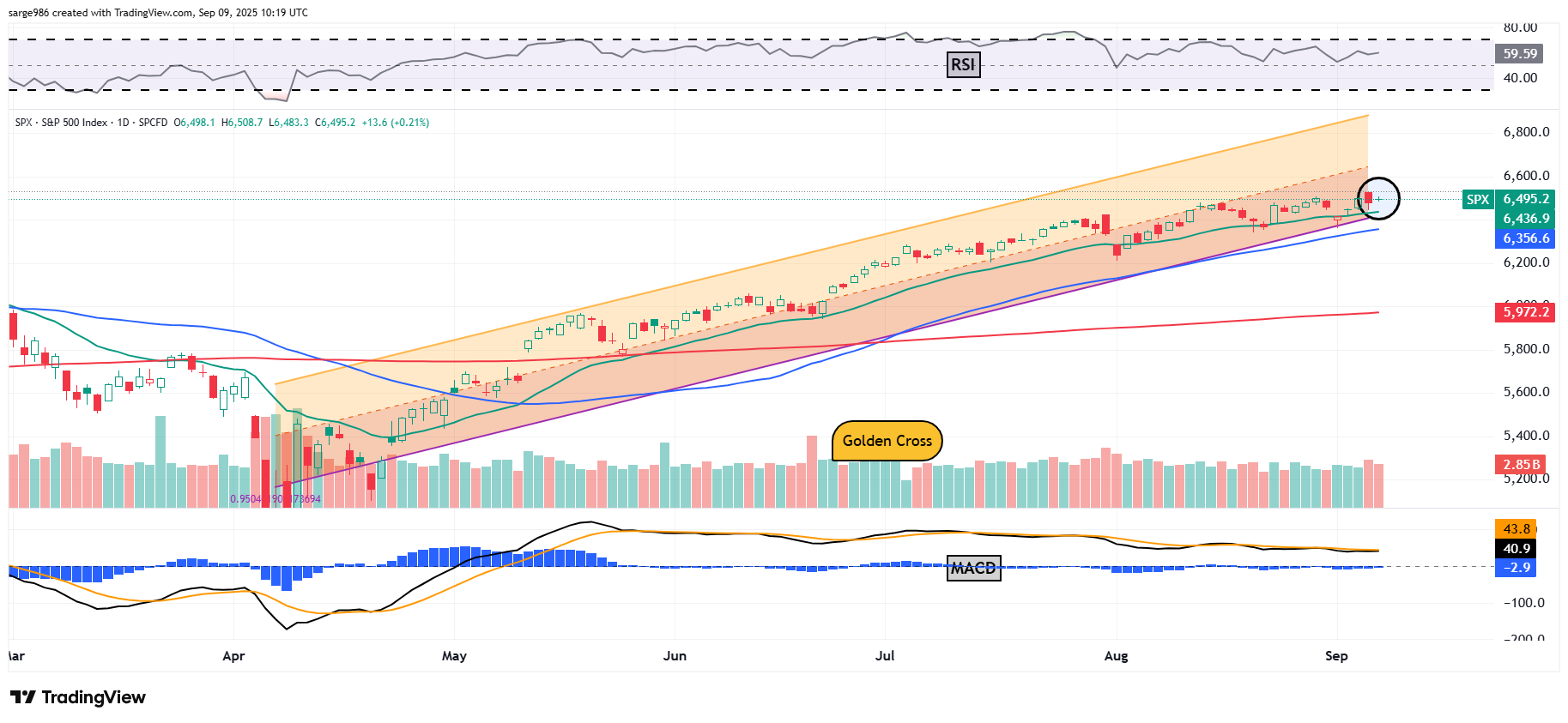
Notice that little green candlestick inside the black circle? That's called an "Inside day." The entire trading range of the Monday session fit neatly inside of the entire trading range of the Friday session while the open and close of the Monday session also fit neatly inside of the open and close of the Friday session. This is seen by traders as a signal of a short period of reduced volatility.
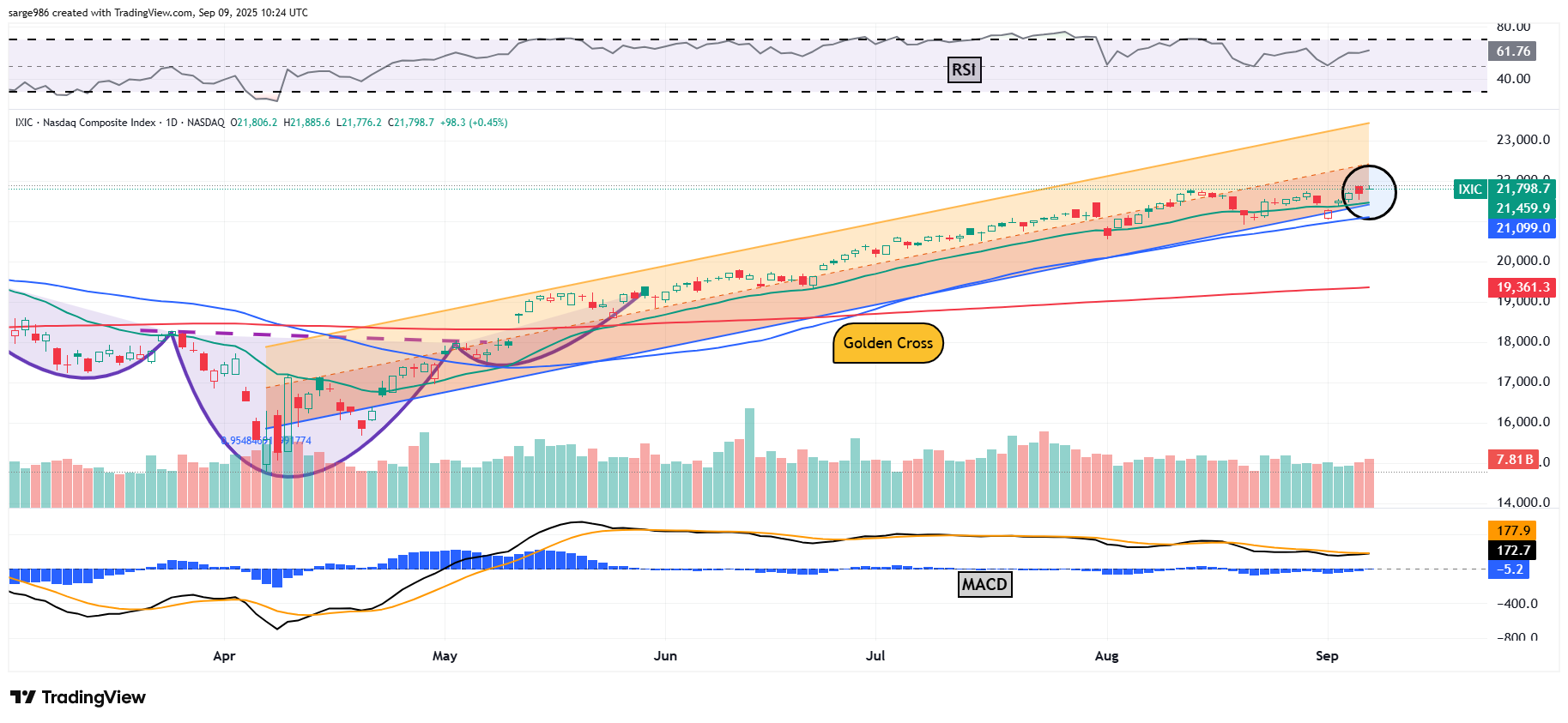
Same chart? No. This is the Nasdaq Composite. Look closely at the black circle. The upper end of the wick on Monday escapes the entire candlestick's range on Friday. This is not an "Inside Day." This is a signal that in an era of lower interest rates, which may or may not be happening. Today's BLS revision will matter here, that growth stocks such as those considered to be part of the AI trade make gains in market assigned levels in valuation.
Trading and Investing
Broadcom AVGO tacked on an additional 3.5% on Monday after gaining 9.4% post-earnings on Friday. The market is pricing in a "fourth big customer" that CEO Hock Tan told us about during the call and pricing in the fact that Tan confirmed that he intends to stick around into the 2030s. Though I readily admit that AVGO is now an AI infrastructure player alongside Nvidia NVDA and maybe even ahead of Advanced Micro Devices AMD, they all don't do exactly the same thing.
Broadcom is more of a custom chip designer, where Nvidia and AMD are in more direct competition. This is now a three-horse race and you know what? If Marvell Technology MRVL, which had a rough quarter, can get its tail in gear, this will be a more than three-horse race. I am currently short some AVGO, and you'll see that in the disclaimer. That was because the stock looked ripe near Monday's highs and has nothing to do with my investment thesis for the group.
I would not stay short any of these stocks, and there is a long case in my opinion for all four of them. Oh, and everything they do, also requires memory. Throw Micron MU in the mix as if they were the oxygen that AI breathes.
Economics
(All Times Eastern)
07:00 - NFIB Small Biz Optimism Index (Aug): Expecting 100.7, Last 100.3.
08:55 - Redbook (Weekly): Last 6.5% y/y.
4:30 p.m. - API Oil Inventories (Weekly): Last +622K.
The Fed
(All Times Eastern)
Fed Blackout Period.
Today's Earnings Highlights
(Consensus EPS Expectations)
Before the Open: CNM (2.07), SAIL (.04)
After the Close: AVAV (.34), GME (.16), ORCL (1.48), SNPS (3.75)
At the time of publication, Guilfoyle was long NVDA, AMD equity. Short AVGO equity.