My New Quantum Computing Price Target Takes a Leap
What's a Qubit? I'll give you the short answer — and my long answer on why I'm big on QUBT.
You've reached your free article limit
You've read 0 of 1 free Pro articles.
"Q-bits." I hear the term all the time. My oldest, in his early 30s, trades these stocks often. When he discusses stocks with me, he does not talk about the semis or generative AI all that much. He's always been in Tesla TSLA and GameStop GME but rarely discusses those stocks anymore. He does talk about quantum computing stocks. Currently he is long both Quantum Computing Inc. QUBT and D-Wave Quantum Inc QBTS, which happen to be the two names that I am long. That said, he has traded these stocks more aggressively than I, as I have largely just purchased shares on weakness.
We also discuss and sometimes he trades, IonQ Inc. IONQ and Rigetti Computing Inc. RGTI. Often, we pick each other's brains concerning IBM's IBM place in this industry and whether IBM or some other legacy tech company will find it more cost effective to acquire one or more of these smaller quantum computing companies than it would to develop and grow that business organically.
So, What is a 'Qubit?'
By definition, a qubit, or quantum bit, is a basic unit of information or the quantum computing equivalent of the "binary" bits used in conventional computing. A binary bit must be either a 0 or a 1. Qubits can be both a 0 and a 1 simultaneously. Don't ask me how to make that make sense. If I ever have to figure that out to make a living, I will. Otherwise, I'll file that under "too much information," but it's not too much information for those developing a quantum computing future, which in my opinion is inevitably where we are going.
Just think of binary bits as factors in traditional mathematics that must exist in a single dimension. Qubits exist in more than one state at any given time, which creates two-dimensional vector space, ultimately creating an entirely new math capable of driving more far complex solutions to far more complex equations. What's that? Good question. While the possibilities are mind-blowingly infinite, with increased complexity in equational development comes increased opportunity for error.
That's just a fact of life as simple as growing pains. That said, is there any more exciting futuristic scientific or mathematical "technology" undergoing its infancy in our world at present? I don't think so. We've come a long way from Sister Marianne making me take 11th grade trigonometry tests in the hallway because she didn't believe that I could do trig in my head. She did not appreciate seeing my answers on the test paper with no work shown.
Math was always a valuable skill that I used in real life. From calling in mortar fire to airstrikes and doing simple land navigation, being able to do math in one's head was an asset. On Wall Street, being able to reverse engineer algorithmic behavior was an asset for a while, until the algorithms became too complex. This quantum stuff though? This can not be done in anyone's head.
Today's News
These stocks have all been red hot. They are set to suffer little profit taking this morning after a week that saw huge upward moves for these names. What drove the move? More capital flowing into growth and tech on prospects for lower short-term interest rates would be the easy answer. That fact that these stocks are all more volatile than anything else in the tech space would be the slightly more complex answer.
There was also the collaboration earlier in the week between IonQ, Honeywell HON, the Electric Power Board of Chattanooga and the Department of Energy to boost the energy needed to work on the relationship between quantum computing and space. Not space as in dimensional metrics, but space as in outer.
Very early this morning, Quantum Computing Inc QUBT announced it had entered into a securities purchase agreement with institutional investors for the acquisition of 26.9 million shares of common stock in an oversubscribed private placement. That's a lot when the entire float is just 135 million shares. QUBT was up 26.8% on Friday and up 36.8% for the week. At last glance more than 26 million of those shares were held in short positions. How much of Friday's action was a squeeze? The stock was down nearly 17% about 45 minutes after the open.
The Chart
The trend is clear. Upward and onward. That said, we see a Double Bottom bullish reversal that worked like a charm, followed by a Double Top bearish reversal that also worked, which was ten followed by another Double Bottom bullish reversal that worked. The algorithms that control price discovery have been tipping their pitches. They double tap the ball before they let it fly.
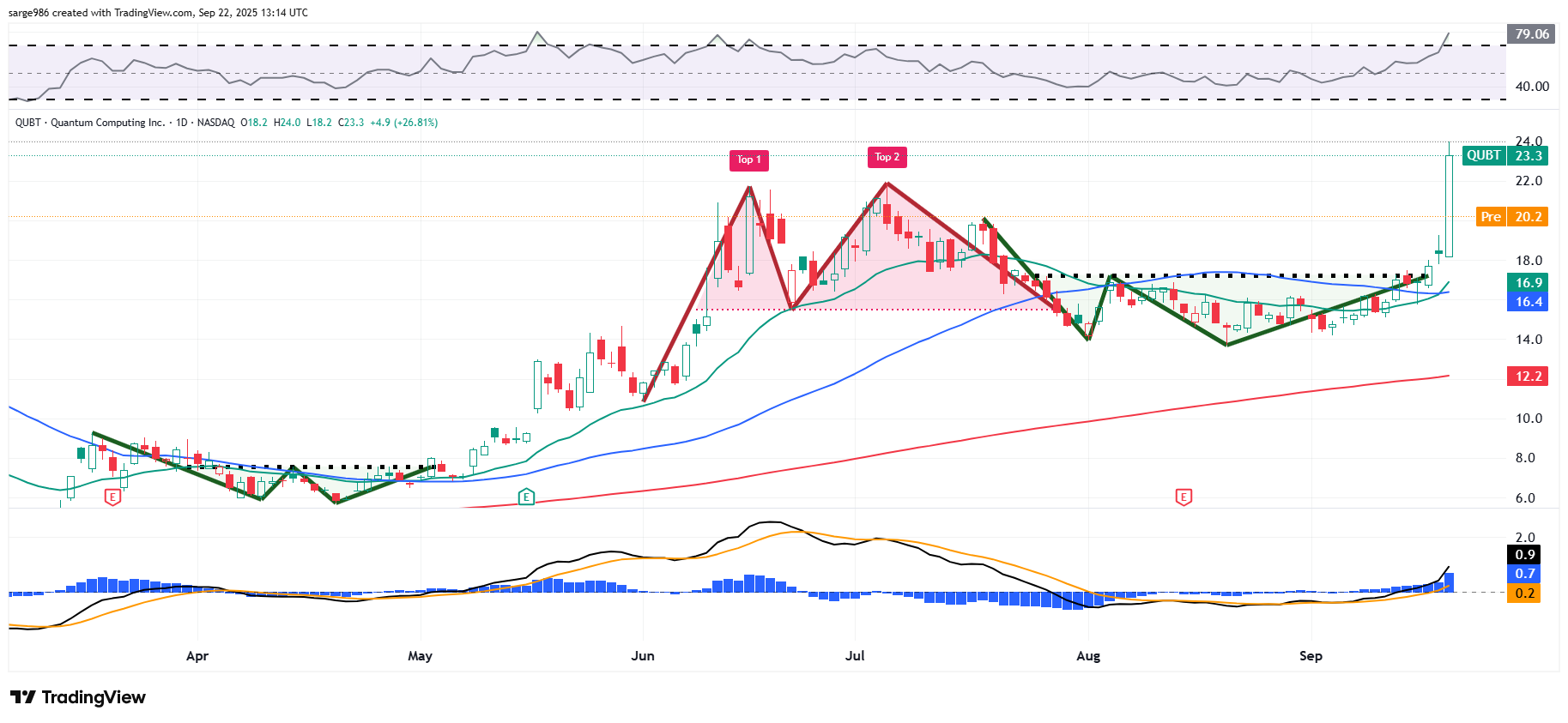
Relative Strength comes in technically overbought and in need of this morning's selloff. The daily Moving Average Convergence Divergence is also red hot and while that's bullish, it also looks a little extended. Is this morning's weakness an opportunity to add?
I think so, from the top of the June / July Double Top down to the pivot created by the recent Double bottom. Could I be wrong? Sure. Am I up in the name? Yes, but only like 65%. This is not a Palantir Technologies PLTR. Yet. The company has a great balance sheet with a current ratio of 87.5 (1.0 is considered okay, 2.0 is considered really good) and the business has no debt on the books whatsoever.
Quantum Computing Strategy, Tarket
Target Price: $30 (up from $22)
Pivot: $24 (Friday's high)
Add: From $22 down to $17 (old pivot).
Panic: Loss of 200-day SMA (currently $12)
At the time of publication, Guilfoyle was long QUBT, QBTS, PLTR equity.