Maybe I'm in the Wrong Bank
Here's what has me contemplating a new position in JPMorgan Chase, including the price when every portfolio manager will be buying the shares.
You've reached your free article limit
You've read 0 of 1 free Pro articles.
Regular readers on TheStreet Pro well know that I have been long Wells Fargo WFC for some time on the expectation that sooner or later (perhaps this year), the Fed would decide CEO Charlie Scharf and his team had done enough to make amends for the bank's scandal-ridden, semi-recent past and lift its asset cap.
I have sold some on the way down, and this has not been a poor investment. Even down 22.6% from its February high, I am still up 20% on WFC.
As a consumer and as a business, I conduct business with both Wells Fargo and JPMorgan Chase JPM. They both do a nice job as far as I'm concerned. However, as an investor, I think we have to acknowledge that JP Morgan is probably still "best in class."
Perhaps I should have been in JPM over WFC, or maybe a little diversified in my exposure to the financials.
Let's dig in.
JPM Reports
On Friday morning several large banks essentially kicked off the first-quarter 2025 earnings season by releasing their financial results for the period. First and foremost, among them was JPMorgan.
The bank posted GAAP EPS of $5.07 that the firm adjusted down to $4.91 due to a $588 million gain related to the First Republic acquisition. That easily beat Wall Street's expectations for something in the mid-$4.60s. The firm generated "adjusted" revenue of $46.014 billion, which crushed expectations, while sporting year-over-year growth of 8.1%.
Net income grew 9.1% to $14.643 billion, as return on common equity improved from 17% to 18%, beating expectations for little more than 16%. Return on tangible common equity was flat from the year-ago period at 21%.
JPM's CET1 capital ratio printed at 15.4%, which is strong, but was slightly below the 15.7% expected by the Street. For the sake of perspective, the regulatory minimum is just 4.5%. Net interest income printed at $23.4 billion (+1%), while non-interest revenue grew 17% to $22.6 billion.
Provision for credit losses was $3.305 billion, up from $1.884 billion for the year-ago period. Net charge-offs were $2.3 billion, up $376 million, predominantly driven by Card Services. The net reserve build of $973 million included $549 million in Wholesale and $41 million in Consumer. This was largely driven by changes in the weighted-average macroeconomic outlook.
CEO Jamie Dimon
The Chairman and CEO commented in the press release.
On the Business: “In the CIB, Investment Banking fees rose 12% in the first quarter, although clients have become more cautious amid an increase in market volatility driven by geopolitical and trade-related tensions. Meanwhile, we saw increased activity in the Markets business. Markets revenue rose to $9.7 billion, an exceptionally strong quarter with record revenue in Equities. In CCB, the franchise continued to acquire new customers at a robust pace, opening 500,000 net new checking accounts and adding record first-time investors in wealth management. Finally, AWM had healthy AUM net inflows of $90 billion, and investment performance remained strong.”
On the Economy:. “The economy is facing considerable turbulence (including geopolitics), with the potential positives of tax reform and deregulation and the potential negatives of tariffs and “trade wars,” ongoing sticky inflation, high fiscal deficits and still rather high asset prices and volatility. As always, we hope for the best but prepare the Firm for a wide range of scenarios.”
Sector Performance
Consumer & Community Banking generated net revenue of $18.313 billion (+4%), supported by 12% growth in Card Services & Auto and offset by a 1% contraction in Banking & Wealth Management. The provision for credit losses was up 37% to $2.629 billion, as net income contracted 8% to $4.425 billion.
Commercial & Investment Banking generated net revenue of $19.666 billion (+12%), supported by 19% growth in Markets & Securities Services and slowed by 4% growth in banking & Payments. Markets revenue was $9.7 billion, up 21%. Fixed Income Markets revenue was $5.8 billion, up 8%, predominantly driven by higher revenue in Rates and Commodities. Equity Markets revenue was $3.8 billion, up 48%, driven by higher revenue across products, with particularly strong performance in Derivatives amid elevated levels of volatility. The provision for credit losses was up very small to $705 million, as net income expanded 5% to $6.942 billion.
Asset & Wealth Management generated net revenue of $5.731 billion (+12%), supported by growth in management fees. Assets under management and client assets were each up 15% to $4.1 trillion and $6 trillion, respectively. Provisions for credit losses were not a factor here.
Corporate generated net revenue of $2.304 billion (+5%). Net interest income was $1.7 billion, down $826 million, driven by the impact of lower rates and changes in funds transfer pricing for consumer deposits. Non-interest revenue was $653 million, compared with a net loss of $275 million in the prior year, driven by the $588 million First Republic-related gains as well as lower net investment securities losses. Provisions for credit losses were not a factor here.
Guidance
Not in the press release, but in the slides for the post-earnings presentation, JPM guided investors towards full-year net interest income of roughly $94.5 billion, up from prior guidance for $94 billion. Excluding markets, the expectation is for about $90 billion. The full-year card services NCO (net charge off) rate is seen at an approximate 3.6%.
The Chart
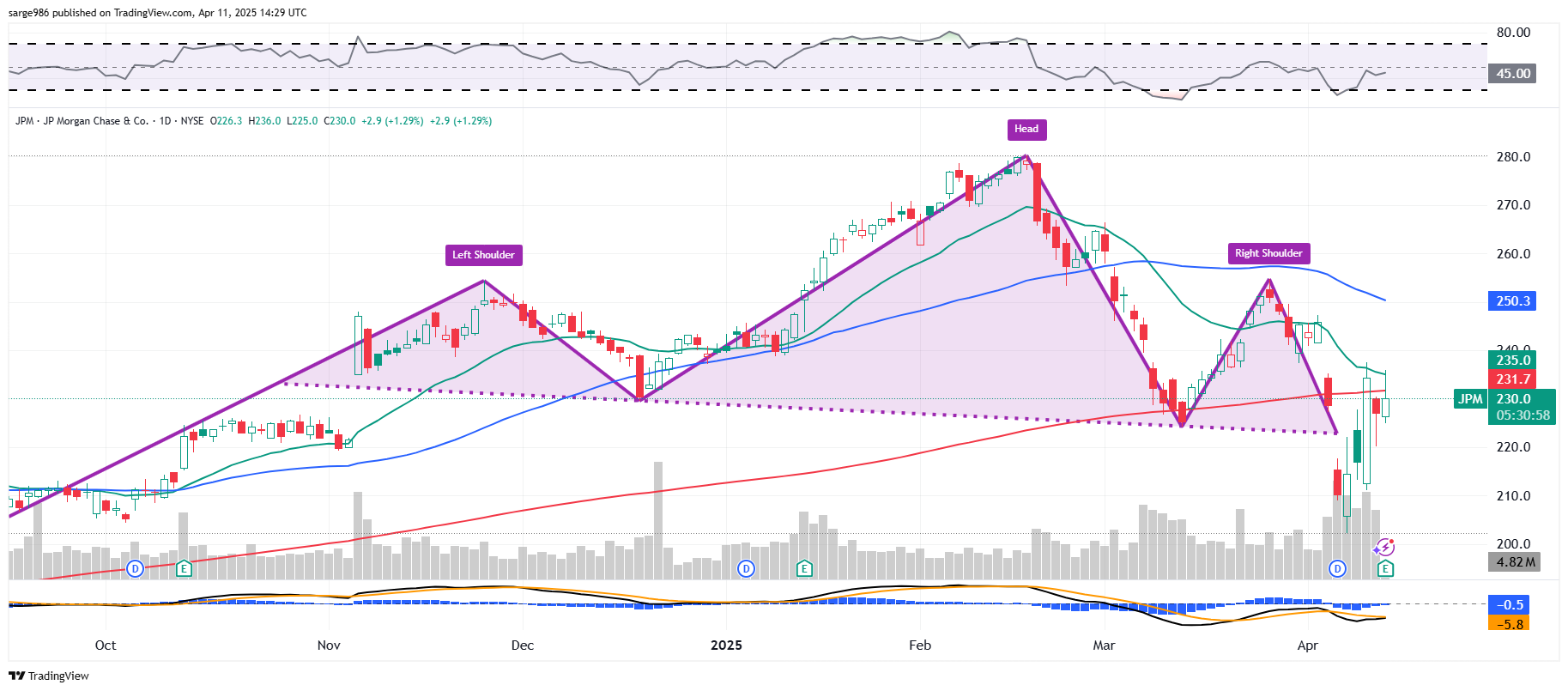
What we have here is a large (and sloppy) head-and-shoulders bearish pattern going back to last autumn with a $223 pivot that had been triggered. The stock did get down to about $202 before finding support.
Relative strength has improved, but the daily MACD (moving average convergence divergence) is still postured quite bearishly. That said, within that indicator, the 12-day EMA (exponential moving average) appears to be ready to overtake the 26-day EMA. That would be a positive development.
This is the deal. The stock has hit resistance for consecutive days at its 200-day SMA (simple moving average). Should JPM take and hold that level, not just me, but every portfolio manager with an interest in the name will be trying to increase long-side exposure. That's it. That's the pivot. Take the 200-day line and shoot for the 50-day SMA up around $250.
If this stock can do that, I'll sell some WFC and put that cash into JPM. Fail at this level? Hey, it's Friday, I'm not looking to do anything too risky going into the weekend in this market environment. As for WFC, I'm a little disappointed, but that's a story for a different piece.
At the time of publication, Guilfoyle was long WFC equity.