I'm Looking at Macy's Dividend After Strong Earnings
The retailer's earnings report has some wonky guidance but positive cash flow and here's where I'd get in on the dividend.
You've reached your free article limit
You've read 0 of 1 free Pro articles.
The shares of iconic New York City retailer Macy's M do not trade under $10 but traded on Thursday morning with a $12 handle and are closer than they have been since 2023.
Macy's is not really a small-cap stock, but with a market capitalization value of little more than $3.5 billion, the firm is a smaller mid-cap. All that said, I think the shares, after Wednesday night's earnings release, are at least worthy of some analysis for our "stocks under $10/small cap" crowd.
Let's take a look, shall we?
Macy's Operations
For the firm's fiscal fourth quarter, which ended February 1, Macy's posted an adjusted EPS of $1.80 (GAAP EPS: $1.21) on revenue of $8.007 billion. This top line and adjusted bottom line numbers both beat Wall Street, though that revenue print was reflective of a 4.5% year-over-year contraction.
The firm reported comp sales of -1.1% on an owned basis. The firm's highly focused upon "Fist 50" locations delivered comparable sales growth of 0.8%, which was a fourth consecutive positive quarter for that metric. Additionally, Bloomingdales reported comparable sales growth of 4.8%, while Bluemercury reported comp sales growth of 6.5%. That was the sixteenth-consecutive quarter of positive comp sales growth for Bluemercury.
Cost of sales decreased 3.1% to $4.991 billion as gross margin dropped from 36.5% to 35.7%. After factoring in operating expenses and impairments, GAAP operating income/loss came to $500 million, up from -$149 million for the year-ago period.
Accounting for interest, other income and expenses and taxes, GAAP net income/loss improved to $342 million from -$128 million. That worked out to a GAAP EPS of $1.21, up from the year-ago comparison of -$0.47 per fully-diluted share. Adjustments were made for restructuring costs and settlement charges, partially offset by tax impacts of certain identified items that bring the adjusted EPS up to $1.80.
Macy's Stock Fundamentals
For the full year, Macy's was able to generate operating cash flow of $1.278 billion. Out of that number came capex spending of $518 million and spending of $364 million on capitalized software. Then added to that number was $283 million as net proceeds from the disposition of various assets. This placed the firm's free cash flow at $679 million. Out of this figure, Macy's paid $192 million in cash dividends to shareholders and paid off some debt.
Turning to the balance sheet, Macy's ended the period with a cash position of $1.306 billion and inventories of $4.468 billion. That put current assets at $6.479 billion. Current liabilities add up to $4.524 billion, which includes very close to nothing in short-term debt. The firm's current ratio stands at 1.43, which is pretty darned decent for a large retailer. We don't harp on quick ratios for retailers given the nature of the business.
Total assets amount to $16.402 billion, which includes just $1.253 billion in goodwill and other intangibles. That's not really very significant. Total liabilities less equity comes to $11.85 billion, which does include long-term debt of $2.773 billion. This is down 7.5% over 12 months. Macy's balance sheet is in much better shape than many investors probably think it is and in better shape than many high-profile retailers.
Macy's Stock Guidance
For the current quarter, Macy's sees net sales of $4.4 billion to $4.5 billion, which is just a hair better at the midpoint than Wall Street expected. However, the firm is projecting an adjusted EPS of $0.12 to $0.15. Wall Street was looking for something like $0.29. That's one reason why the stock was hit hard on Thursday morning.
For the full year, Macy's sees net sales of $21 billion to $21.4 billion, which at the midpoint is below the consensus view of $21.34 billion. The firm also sees an adjusted EPS of $2.05 to $2.25. That's well below the $2.32 that Wall Street had in mind.
My Thoughts on Macy's Stock
These earnings aren't bad at all. The guidance is a little wonky, but the cash flows are positive, and the balance sheet is in above decent shape. Additionally, the stock pays a nice, and probably sustainable, dividend yielding almost 5.5%.
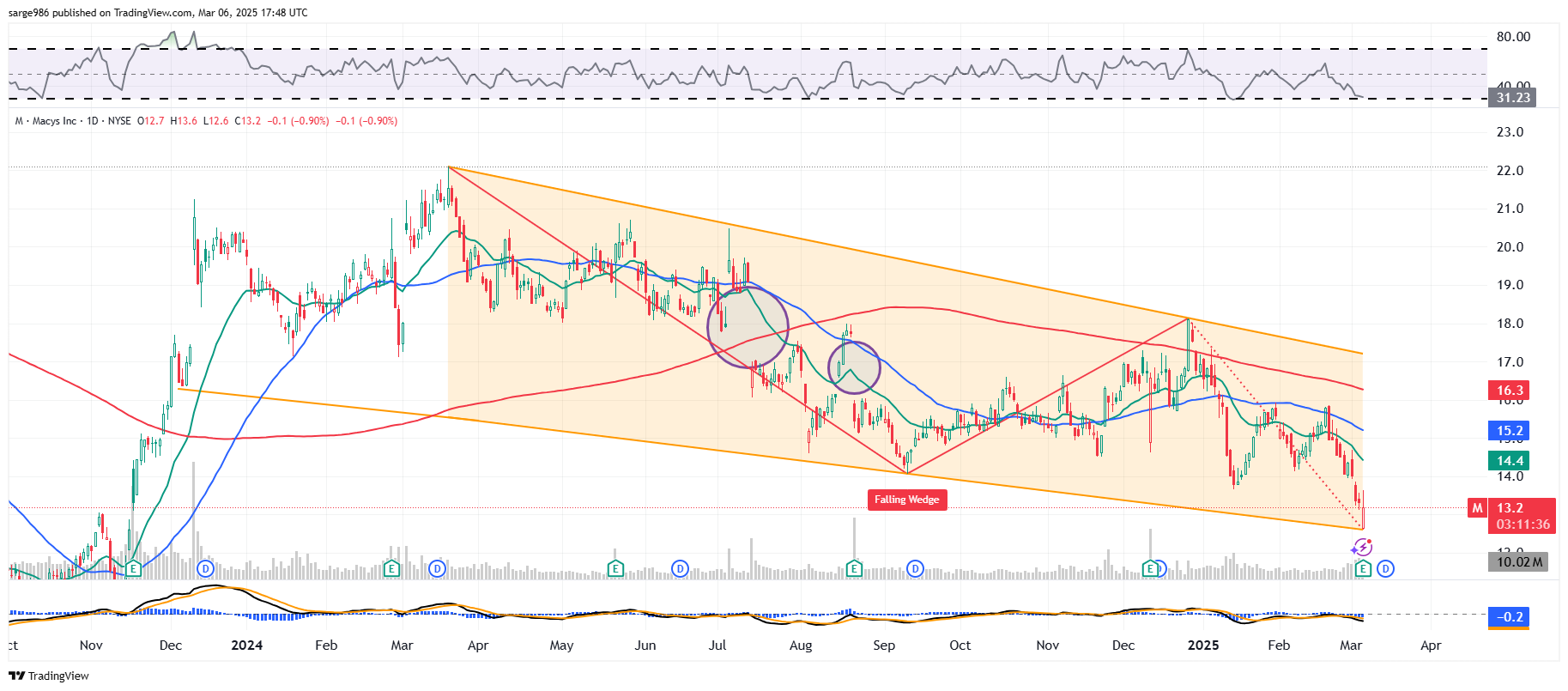
Readers will see what looks like a falling-wedge pattern of bullish reversal in progress on this chart of Macy's stock. The lower bound of the wedge is being tested on Thursday. If it holds, I think Macy's may have a ballgame. If it fails, we could be talking prices between $10 and $11.
The upside pivot for now is the 50-day SMA. The area of interest would be the unfilled gap from last July that would require a tick at $19.10 or above to fill. If this stock sneaks back below $13 on Thursday afternoon's broad market weakness, I may take on a starter position. I really, really like that dividend.
At the time of publication, Guilfoyle had no positions in any securities mentioned.